

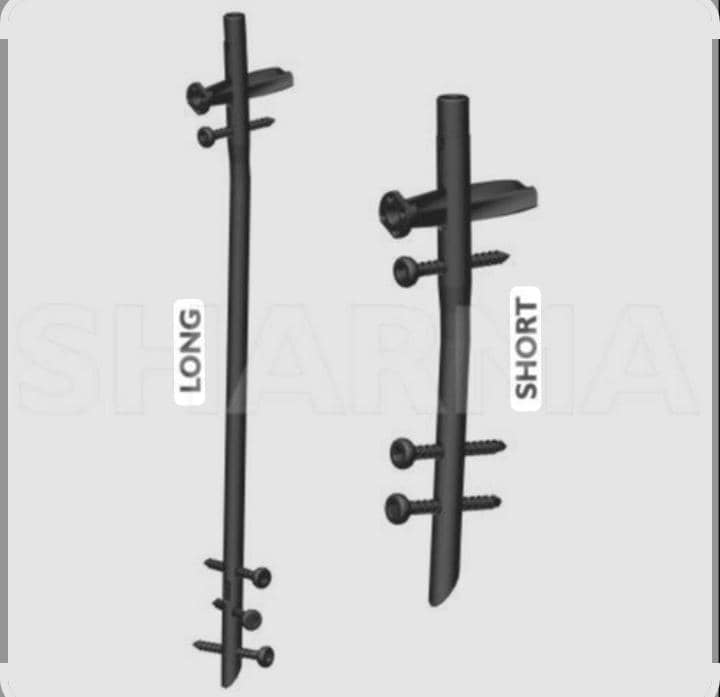


The intramedullary nails shown, whether long or short, are orthopedic implants used to stabilize long bone fractures. Their main characteristics are:
Materials: They are generally made of titanium alloy or surgical stainless steel, biocompatible materials resistant to corrosion and mechanical stress.
Design:
Long nails: Designed for diaphyseal (central portion) fractures of long bones, such as the femur or tibia.
Short nails: Used for proximal fractures, such as those of the proximal humerus or proximal femur (subtrochanteric or intertrochanteric fractures).
Locking: They are equipped with locking screws (e.g., 4.5 mm) that pass through the bone and the nail to ensure stable fixation of the fracture and prevent rotation or shortening.
Functionality:
Cannulated: Many nails are cannulated, allowing for the insertion of a guide wire during surgery for precise positioning.
Indications: Their use varies depending on the patient’s age, the site, and the type of fracture, including diaphyseal and metaphyseal fractures, and nonunions.



Reviews
There are no reviews yet.