

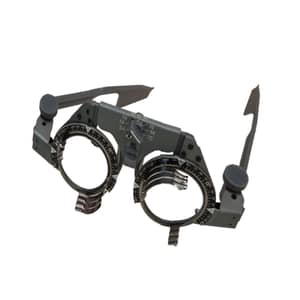
The characteristics of an ophthalmic trial frame like the one shown generally include the following:
Material and Design:
Often made of titanium alloy and plastic for lightweight performance.
Simple design for easy fitting.
Lens Capacity:
Holds up to 4 pairs of trial lenses (3 front and 1 back).
Adjustments for a Precise and Comfortable Fit:
Pupillary Distance (PD): Adjust the PD (e.g., 54-70mm) with a single knob.
Lens Axis: Adjust the astigmatic axis by turning a dedicated knob after inserting the lenses.
Temple Angle: Temple angle adjustment knob for optimal positioning (e.g., a tilt angle of approximately 15°).
Temple Length: Adjustable by gently pulling the adjustment part.
Nose Pads: Adjustable in length and angle to fit the patient’s nasal bridge.
Ear Pads: Often equipped with soft ear pads for patient comfort.
Scales and Graduations:
Axis Scale: The axial scale increases counterclockwise along the frame axis, with a marking interval of 5°.
Lenses rotate 360° around the optical axis within the lens frame.
Use:
Suitable for eye examinations in optical stores, hospital ophthalmology departments, schools, and businesses.





Reviews
There are no reviews yet.