


Graduated Cylinder 100ML
A graduated cylinder is a laboratory instrument used to accurately measure liquid volumes. Its main characteristics are as follows:
Materials:
This is a graduated cylinder made of borosilicate glass, known for its resistance to chemicals and thermal shock.
Shape and Structure:
It has an elongated cylindrical shape and is equipped with a stable base (here, a round base, although hexagonal bases also exist) and a pouring spout to facilitate the transfer of liquids.
Graduations:
The cylinder is clearly graduated, allowing the volume of liquid contained to be read. In the image, the graduations are visible from 10 ml to 100 ml.
Accuracy:
Graduated cylinders are designed for precise volume measurement, often calibrated “to contain” (TC or In) and classified according to accuracy standards (such as Class ).

Graduated Cylinder 250ML
A graduated cylinder is a laboratory instrument used to accurately measure liquid volumes. Its main characteristics are as follows:
Materials:
This is a graduated cylinder made of borosilicate glass, known for its resistance to chemicals and thermal shock.
Shape and Structure:
It has an elongated cylindrical shape and is equipped with a stable base (here, a round base, although hexagonal bases also exist) and a pouring spout to facilitate the transfer of liquids.
Graduations:
The cylinder is clearly graduated, allowing the volume of liquid contained to be read. In the image, the graduations are visible from 20 ml to 250 ml.
Accuracy:
Graduated cylinders are designed for precise volume measurement, often calibrated “to contain” (TC or In) and classified according to accuracy standards (such as Class ).
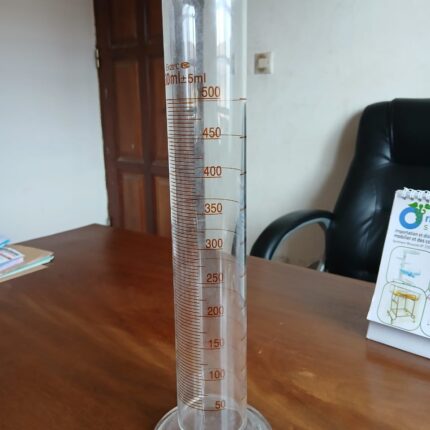
Graduated Cylinder 500ML
A graduated cylinder is a laboratory instrument used to accurately measure liquid volumes. Its main characteristics are as follows:
Materials:
This is a graduated cylinder made of borosilicate glass, known for its resistance to chemicals and thermal shock.
Shape and Structure:
It has an elongated cylindrical shape and is equipped with a stable base (here, a round base, although hexagonal bases also exist) and a pouring spout to facilitate the transfer of liquids.
Graduations:
The cylinder is clearly graduated, allowing the volume of liquid contained to be read. In the image, the graduations are visible from 100 ml to 500 ml, indicating a maximum capacity.
Accuracy:
Graduated cylinders are designed for precise volume measurement, often calibrated “to contain” (TC or In) and classified according to accuracy standards (such as Class ).
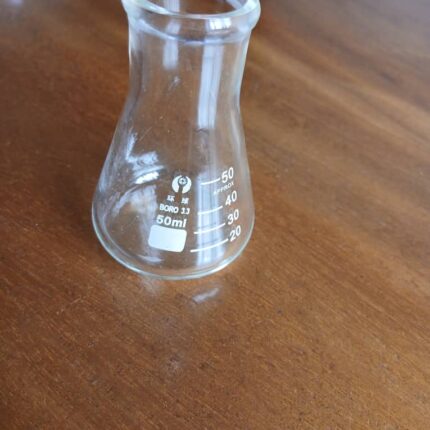
Erlenmeyer Flask 50ML
A borosilicate glass Erlenmeyer flask has several key characteristics:
Materials:
It is made of borosilicate 3.3 glass (such as Pyrex™ or Duran®), known for its high resistance to thermal shock and chemical corrosion.
Capacity:
The flask pictured has a capacity of 50 ml, with graduations indicating volumes (20,30,40,50ml).
Shape:
Its conical shape ensures good stability and facilitates mixing and heating liquids. The neck can be narrow or wide.
Graduations:
It has graduations (often white enamel) for approximate volume measurements.
Resistance:
Borosilicate glass provides excellent heat resistance, allowing direct heating and autoclaving for sterilization.
Use:
It is commonly used in laboratories for mixing, heating, cooling, and storing liquids, as well as for titrations and cell cultures.
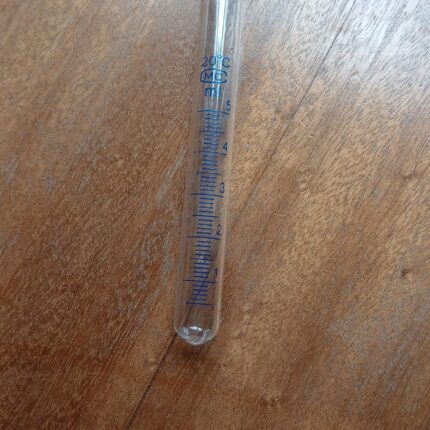
Test Tubes 5ml
The characteristics of a test tube like the one pictured include the following:
Materials:
Clear glass (such as soda-lime glass or borosilicate).
Shape:
A narrow cylindrical body with a base that can be round (U-shaped), conical (V-shaped), or flat, and a top opening. The image shows a flat bottom.
Dimensions and Capacity:
Test tubes come in various sizes and volumes. The one pictured is graduated up to 5ml, with an accuracy indication of “±0.2”. The visible graduations are 1, 2, 3, 4, and 5ml.
Use:
Used in laboratories to hold, mix, and heat chemicals, or for specific analyses such as food quality control or blood tests. The object in the image, being graduated, is more specifically a flask, used to precisely measure liquid volumes.
Resistance:
Resistance to temperature changes and chemicals varies depending on the type of glass.
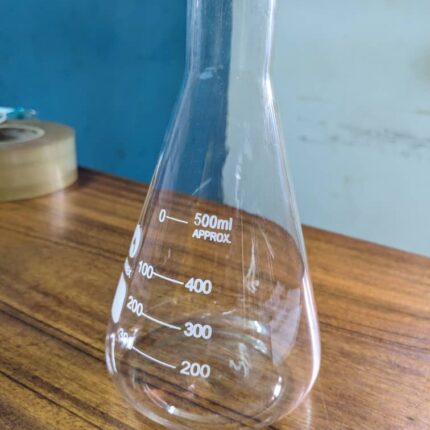
Erlenmeyer flask 500 ml
A borosilicate glass Erlenmeyer flask has several key characteristics:
Materials:
It is made of borosilicate 3.3 glass (such as Pyrex™ or Duran®), known for its high resistance to thermal shock and chemical corrosion.
Capacity:
The flask pictured has a capacity of 500 ml, with graduations indicating volumes (e.g., 400 ml, 300 ml, 200 ml).
Shape:
Its conical shape ensures good stability and facilitates mixing and heating liquids. The neck can be narrow or wide.
Graduations:
It has graduations (often white enamel) for approximate volume measurements.
Resistance:
Borosilicate glass provides excellent heat resistance, allowing direct heating and autoclaving for sterilization.
Use:
It is commonly used in laboratories for mixing, heating, cooling, and storing liquids, as well as for titrations and cell cultures.
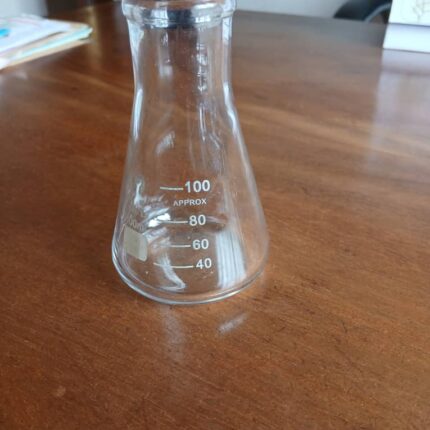
Erlenmeyer flask 100ML
A borosilicate glass Erlenmeyer flask has several key characteristics:
Materials:
It is made of borosilicate 3.3 glass (such as Pyrex™ or Duran®), known for its high resistance to thermal shock and chemical corrosion.
Capacity:
The flask pictured has a capacity of 100 ml, with graduations indicating volumes (40,60, 80, 100ml).
Shape:
Its conical shape ensures good stability and facilitates mixing and heating liquids. The neck can be narrow or wide.
Graduations:
It has graduations (often white enamel) for approximate volume measurements.
Resistance:
Borosilicate glass provides excellent heat resistance, allowing direct heating and autoclaving for sterilization.
Use:
It is commonly used in laboratories for mixing, heating, cooling, and storing liquids, as well as for titrations and cell cultures.
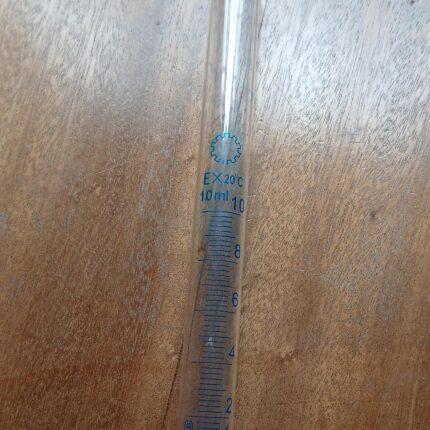
Test Tubes 10ml
The characteristics of a test tube like the one pictured include the following:
Materials:
Clear glass (such as soda-lime glass or borosilicate).
Shape:
A narrow cylindrical body with a base that can be round (U-shaped), conical (V-shaped), or flat, and a top opening. The image shows a flat bottom.
Dimensions and Capacity:
Test tubes come in various sizes and volumes. The one pictured is graduated up to 10 ml, with an accuracy indication of “±0.2”. The visible graduations are 1, 2, 4, 6, 8and 10ml.
Use:
Used in laboratories to hold, mix, and heat chemicals, or for specific analyses such as food quality control or blood tests. The object in the image, being graduated, is more specifically a flask, used to precisely measure liquid volumes.
Resistance:
Resistance to temperature changes and chemicals varies depending on the type of glass
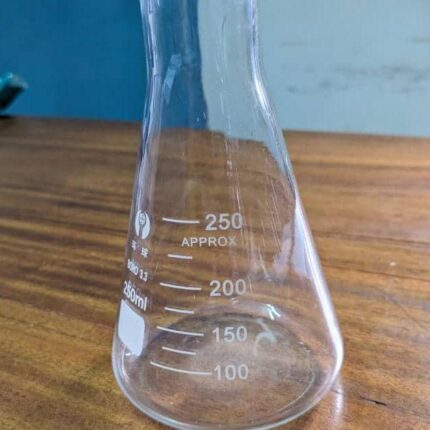
Erlenmeyer flask 250 ml
A borosilicate glass Erlenmeyer flask has several key characteristics:
Materials:
It is made of borosilicate 3.3 glass (such as Pyrex™ or Duran®), known for its high resistance to thermal shock and chemical corrosion.
Capacity:
The flask pictured has a capacity of 250 ml, with graduations indicating volumes (100,150, 200, 250ml).
Shape:
Its conical shape ensures good stability and facilitates mixing and heating liquids. The neck can be narrow or wide.
Graduations:
It has graduations (often white enamel) for approximate volume measurements.
Resistance:
Borosilicate glass provides excellent heat resistance, allowing direct heating and autoclaving for sterilization.
Use:
It is commonly used in laboratories for mixing, heating, cooling, and storing liquids, as well as for titrations and cell cultures.

Burette Stand
The burette stand features the following:
Materials:
Made of high-quality aluminum alloy or plastic for the clamp, and metal (such as iron or aluminum) for the stem and base, providing durability and corrosion resistance.
Functionality:
Designed to securely hold burettes during laboratory titration experiments, particularly on a titration table.
Clamp Design:
The clamp is often a “butterfly” or “double” type, allowing two burettes to be held simultaneously. Its jaws have sufficient elasticity to hold the burettes securely without obscuring the graduations.
Stability:
The heavy base and sturdy stem ensure stability during laboratory manipulations.
Use:
Easy to use for securing and adjusting the position of burettes, making it an essential accessory for science laboratories, schools, and factories.
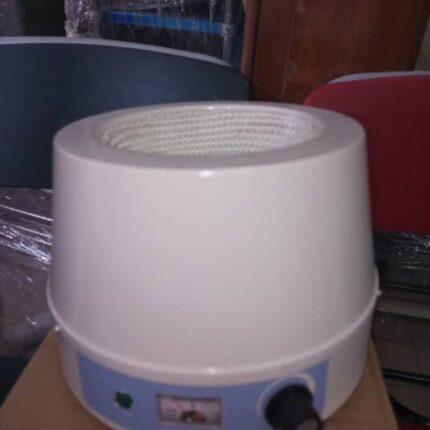
Heating Mantle
The 250 ml laboratory heating mantle.
Key Features:
Capacity: Designed to heat round-bottomed flasks with a capacity of 250 ml.
Temperature Control: It is equipped with electronic temperature control, allowing precise heating control.
Maximum Temperature: Can reach a maximum temperature of 370°C, or even 450°C for some models.
Power: Typically 150 W.
Construction: Chemical-resistant steel or polypropylene outer shell, with thermal insulation made of mineral fiber wool or molded silica.
Safety: Some models include protective fuses and a “cool-touch” outer casing to minimize the risk of burns.
Additional Features: Some heating mantles of this capacity can also incorporate magnetic stirring, allowing the contents of the flask to be heated and stirred simultaneously.
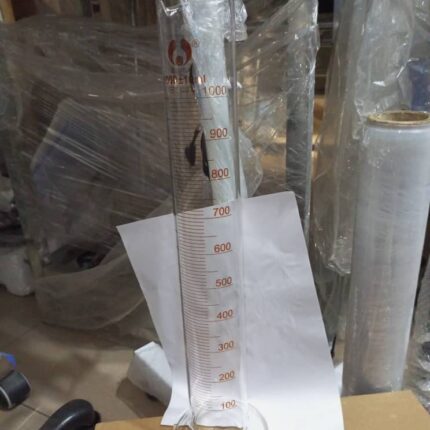
Graduated Cylinder 1000 ml
A graduated cylinder is a laboratory instrument used to accurately measure liquid volumes. Its main characteristics are as follows:
Materials:
This is a graduated cylinder made of borosilicate glass, known for its resistance to chemicals and thermal shock.
Shape and Structure:
It has an elongated cylindrical shape and is equipped with a stable base (here, a round base, although hexagonal bases also exist) and a pouring spout to facilitate the transfer of liquids.
Graduations:
The cylinder is clearly graduated, allowing the volume of liquid contained to be read. In the image, the graduations are visible from 100 ml to 1000 ml, indicating a maximum capacity of 1 liter.
Accuracy:
Graduated cylinders are designed for precise volume measurement, often calibrated “to contain” (TC or In) and classified according to accuracy standards (such as Class ).