


Flat-bottomed flask 250ML
The flat-bottomed flash, 250 ml laboratory flask has the following features:
Flask Type:
This is a flat-bottomed flask, which provides optimal stability and allows it to stand unsupported on a flat surface, such as a hot plate or laboratory stand.
Materials:
It is made of borosilicate glass, known for its high temperature resistance and good transparency.
Capacity:
The flask has a capacity of 250 ml, as indicated by the 250 ml” marking on the glass.
Use:
Flat-bottomed flasks are commonly used in laboratories for processes requiring uniform heating or as reaction vessels.
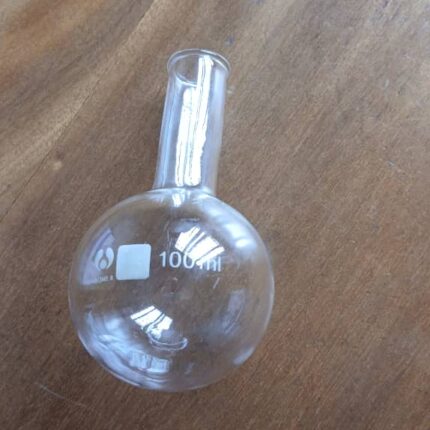
Flat-bottomed flask 100ML
The flat-bottomed flash, 100 ml laboratory flask has the following features:
Flask Type:
This is a flat-bottomed flask, which provides optimal stability and allows it to stand unsupported on a flat surface, such as a hot plate or laboratory stand.
Materials:
It is made of borosilicate glass, known for its high temperature resistance and good transparency.
Capacity:
The flask has a capacity of 100 ml, as indicated by the 100 ml” marking on the glass.
Use:
Flat-bottomed flasks are commonly used in laboratories for processes requiring uniform heating or as reaction vessels.

Volumetric Flask
Volumetric Flasks – Technical Specifications
(Precision Liquid Measurement Vessels)
1. Material & Construction
-
Primary Material: Borosilicate glass 3.3 (e.g., Pyrex®)
-
Thermal shock resistant (ΔT ≤ 200°C)
-
Chemical resistance to acids/bases (except HF)
-
-
Stopper: Ground glass joint (NS 29/32 standard)
-
Markings: Permanent enamel graduation
2. Accuracy & Compliance
| Parameter | Class A Specification |
|---|---|
| Tolerance | ±0.08 mL (100 mL flask) |
| Calibration Temp | 20°C ± 0.5°C |
| Standards | DIN EN ISO 1042, ASTM E288 |
| Marking | Engraved “IN” (TC) & “A” grade |
3. Standard Capacities
| Volume | Neck Diameter | Uses |
|---|---|---|
| 50 mL | 14 mm | HPLC standards |
| 100 mL | 16 mm | Titrant prep |
| 250 mL | 22 mm | Molar solutions |
| 500 mL | 28 mm | Bulk reagents |
4. Key Features
✔ Single graduation mark for precise filling
✔ Hexagonal base for stability
✔ Traceable certification (NIST/DKD)
5. Usage Protocol
-
Cleaning: Chromic acid rinse → triple DI water wash
-
Filling: Meniscus tangent to mark (eye-level)
-
Mixing: 10× inversions (no shaking)
Do NOT heat when sealed – thermal expansion risks rupture
6. Quality Verification
-
Weight Test: Verify volume using distilled water (d=0.9982 g/mL at 20°C)
-
Documentation: Class A requires individual calibration certificate