


Human Skull Anatomical Model
Human Skull Model Features
This human skull model features several notable features, ideal for anatomical study:
Life-Size: The model is a faithful reproduction of the life-size human skull, allowing for realistic visualization of proportions.
Disassemblable Structure: It is designed to be disassembled into several parts, such as the cranial vault, skull base, and lower jaw, facilitating the study of internal structures and bone relationships.
Anatomical Details: The model reproduces important anatomical details, including the cranial sutures and the dentition, which is similar to real teeth in terms of positioning.
Materials and Finish: Made of PVC plastic, it represents a natural bone color for a realistic appearance.
Articulated Jaw: The lower jaw is articulated and removable, allowing for the simulation of chewing movements.

Human Hand Model
Characteristics of the Human Hand Model:
The human hand model has several distinctive features.
Material: It is generally made of PVC plastic, making it odorless, durable, environmentally friendly, and portable.
Anatomical Details: The model faithfully reproduces the bony structure of the hand, including the eight carpal bones, five metacarpal bones, and fourteen phalanges.
Flexible Joints: Each joint is fixed with high-quality stainless steel wire, providing limited flexibility to simulate the natural movement of the hand.
Scientific Accuracy: This is a life-size, scientifically accurate hand skeleton, making it an excellent teaching tool for studying anatomy.
Standing Base: The model is mounted on a lightweight white base, making it easy to display and transport for teaching or demonstration.
Application: Designed for educational and demonstration purposes, it is useful for medical students, practitioners, and for display in classrooms or medical environments.

Anatomical model of the human heart
- Ideal for studying and teaching cardiac anatomy.
- These models are made of high-quality PVC for safe use.
- They accurately reproduce the morphological structures of the heart, including veins and valve details.
- Some models are multi-part, often held together by magnets, allowing for the study of internal structures such as chambers and valves.
- These models are mounted on a stable base and can be removed for closer examination.
- They are available in various sizes, including life-size and enlarged models.

Anatomical model of the human liver
This type of model is commonly used for educational purposes, particularly in medical schools or for patient education
Features of this model:
- It represents the basic anatomical structure of the liver, including the four lobes (right, left, quadrate and caudate).
- It highlights the complex vascular network of the liver, with the portal vessels, hepatic arteries and hepatic veins, often shown in different colours for easy identification.The gallbladder and the intrahepatic and extrahepatic bile ducts are also visible.
- The model is usually mounted on a stand for greater stability during demonstrations.

Pregnant Female Anatomy
An anatomical model or medical simulator, likely used for teaching or training in obstetrics or gynecology.
Its main features are as follows:
Anatomical Representation:
This is a detailed model of the pregnant uterus, showing the position of the fetus inside.
Materials:
Made from soft, realistic materials to simulate human tissue.
Functionality:
Designed to simulate obstetric procedures or gynecological examinations, allowing students to practice palpation, simulated deliveries, or other procedures.
Visible Details:
The model allows for observation of the relationship between the fetus and the uterus, as well as the structure of the pelvis.
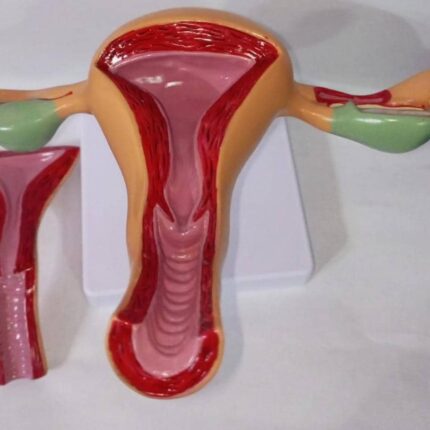
Healthy Uterus
Features of a healthy uterus model, such as this one, include the following:
Detailed Anatomical Representation: The model shows the three-layered structure of the uterus (endometrium, myometrium), the uterine cavity, the cervix, and the vagina, often with the fornix visible.
Associated Female Reproductive Organs:
It includes the ovaries and fallopian tubes (oviducts), illustrating their relationship to the uterus. Sections may show follicles and the egg in various stages of maturity.
Open Vagina and Cervix:
The vagina and cervix are cut longitudinally to allow internal visualization of the uterine lining and uterine muscles.
Life-Size and Realistic:
The model is generally life-size for better anatomical understanding, with hand-painted structures for increased realism.
Educational Use:
Designed as an educational tool for teaching female anatomy, it is useful for medical students and healthcare professionals.

Birthing Pelvis with 2 Babies (Male and Female)
The Birthing Pelvis: Structure and Function in Childbirth
The female birthing pelvis serves as the crucial bony framework that enables successful vaginal delivery. This specialized structure combines anatomical precision with dynamic adaptability to facilitate the birth process.
Bony Architecture:
-
Composed of four interconnected bones:
-
Paired ilium bones (forming the sides)
-
Sacrum (posterior wall)
-
Coccyx (tailbone)
-
-
Forms a complete pelvic ring connecting the spine to the femurs
-
Provides structural support while allowing necessary movement
Morphological Features:
-
Distinctive hourglass configuration with:
-
Expanded false pelvis (greater pelvis) superiorly
-
Constricted true pelvis (lesser pelvis) inferiorly
-
Demarcated by the pelvic brim (superior strait)
-
-
Exhibits characteristic female adaptations:
-
Wider subpubic angle (>90°)
-
Broader, more circular inlet
-
Shorter sacral curvature
-
Obstetric Dimensions:
Three critical planes determine fetal passage:
-
Pelvic Inlet (Superior Strait):
-
Key diameter: Promontoretropubic (11.5-13 cm)
-
-
Midpelvis:
-
Crucial measurement: Median transverse (10.5 cm)
-
-
Pelvic Outlet:
-
Important span: Interspinous (10-11 cm)
-
Dynamic Adaptations:
-
Hormonally-mediated changes (relaxin, progesterone):
-
Increased sacroiliac joint mobility
-
Pubic symphysis widening (2-3 mm)
-
Ligamentous relaxation
-
-
Permits up to 10-15% expansion of birth canal dimensions
Parturition Mechanics:
-
Fetal Engagement: Head enters pelvic inlet
-
Descent: Progressive movement through planes
-
Rotation: Internal adjustment to navigate contours
-
Expulsion: Final passage through outlet
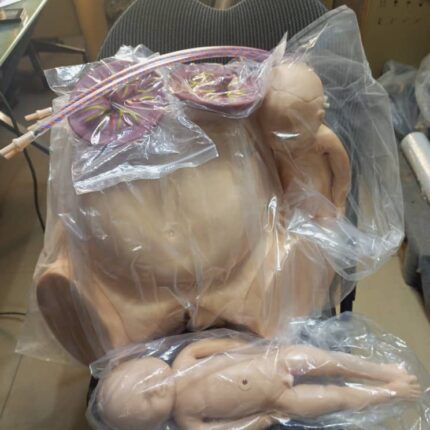
Birthing Pelvis with 2 Babies (Male and Female)
The birthing pelvis is the female bony structure essential for childbirth, providing both structural support and a dynamic passageway for fetal delivery.
Anatomical Composition
-
Comprises four fused bones:
-
Paired iliac bones (forming the pelvic girdle)
-
Sacrum (posterior base of the spine)
-
Coccyx (tailbone)
-
-
Connects the spine to the lower limbs, ensuring stability and weight distribution.
Shape & Structural Divisions
-
Funnel/hourglass shape with distinct regions:
-
Upper flare (false pelvis): Wider, supports abdominal organs.
-
Lower flare (true pelvis): Narrower, forms the birth canal.
-
-
Superior strait: The narrowing between these regions, a critical landmark for obstetric assessment.
Obstetric Straits & Key Measurements
The pelvis features three key straits, each with critical diameters for fetal passage:
-
Upper strait:
-
Promontoretropubic diameter (anteroposterior measurement).
-
-
Middle strait:
-
Median transverse diameter (widest point between ischial spines).
-
-
Lower strait:
-
Interspinous diameter (between ischial tuberosities).
-
-
These measurements determine cephalopelvic disproportion (CPD) and delivery feasibility.
Dynamic Adaptability
-
Not rigid: Hormonal changes (relaxin, progesterone) increase ligament laxity late in pregnancy.
-
Pubis symphysis and sacroiliac joints slightly widen, expanding the birth canal by up to 10–15%.
Role in Childbirth
-
Guides fetal descent: The baby navigates through the pelvic inlet, mid-cavity, and outlet.
-
Facilitates rotation: Bone contours help the fetus rotate into optimal positioning (e.g., occiput anterior).
-
Enables vaginal delivery: Optimal pelvic dimensions and adaptability prevent obstructed labor.

Anatomical Model of the Human Pelvis Skeleton
Anatomical Model of the Female Pelvis – Key Features
This detailed anatomical model accurately represents the structure and function of the female human pelvis, designed for both educational and clinical applications.
Bone Composition:
-
Includes paired iliac (coxal) bones, sacrum, and coccyx
-
Features L1 and L2 lumbar vertebrae to demonstrate spinal articulation
-
Provides complete representation of pelvic skeletal anatomy
Structural Characteristics:
-
Distinctive funnel-shaped architecture divided into:
-
Greater pelvis (false pelvis): Upper, flared portion
-
Lesser pelvis (true pelvis): Lower, narrower cavity
-
-
Anatomically accurate female morphology:
-
Wider, more circular pelvic inlet
-
Broader subpubic angle
-
Shorter, more everted sacrum
-
-
Designed to reflect obstetric adaptations for childbirth
Functional Attributes:
-
Supports weight transfer between trunk and lower limbs
-
Provides attachment points for major muscle groups
-
Protects reproductive organs and lower abdominal viscera
-
Facilitates bipedal locomotion and spinal stability
Educational & Clinical Applications:
-
Essential teaching tool for:
-
Medical and nursing education
-
Physical therapy programs
-
Midwifery training
-
-
Valuable clinical reference for:
-
Obstetric and gynecological practice
-
Orthopedic assessments
-
Surgical planning
-
-
Enables detailed study of:
-
Pelvic dimensions and variations
-
Biomechanical relationships
-
Pathological conditions
-

Anatomy of the Human Urinary System
### **Human Urinary System – Key Features**
The urinary system consists of specialized organs that work together to filter blood, remove waste, and maintain fluid and electrolyte balance.
**Kidneys**
– Paired, bean-shaped organs that filter blood to eliminate waste (e.g., urea, excess salts).
– Regulate blood pressure, electrolyte levels, and red blood cell production.
**Ureters**
– Two narrow tubes that transport urine from the kidneys to the bladder.
**Bladder**
– A muscular, expandable sac that stores urine (capacity: ~600 mL).
– Contracts during urination to expel urine.
**Arteries & Veins**
– Represented in red (arteries) and blue (veins) on models.
– Supply blood to the kidneys for filtration and oxygenate urinary tissues.
**Urethra**
– The final passageway for urine excretion from the bladder to the exterior.

CPR Manikin
**Cardiopulmonary Resuscitation (CPR) Manikins**
CPR manikins are lifelike training tools designed to replicate human anatomy, enabling users to practice life-saving first aid techniques.
**Key Features:**
✔ **Realistic Anatomical Landmarks** – Includes clearly defined sternum and ribs for accurate hand placement during chest compressions.
✔ **Thoracic Simulation** – The rib cage offers human-like resistance to mimic real cardiac massage conditions.
✔ **Multiple Size Options** – Available in adult, child, and infant models to train for various emergency scenarios.
✔ **Quick Response (QCPR) Technology** – Advanced feedback system to monitor and improve CPR performance in real time.

Dental Anatomy Model
Features of the Dental Demonstration Model:
Materials:
Constructed from non-toxic, eco-friendly polyvinyl chloride (PVC) plastic.
Structure:
Features a full set of 32 fixed teeth, soft gums, and an included tongue for realistic representation.
Function:
Designed to demonstrate proper dental hygiene, especially correct toothbrushing techniques.
Use:
Serves as an effective educational tool for dental students, dentists (for patient instruction), and teachers (to promote good oral habits in school and kindergarten settings).
Simulation:
Boasts naturally colored gums and highly durable teeth with accurate anatomical shaping.
Durability & Maintenance:
Resistant to corrosion and easy to clean and disinfect for long-term use.