

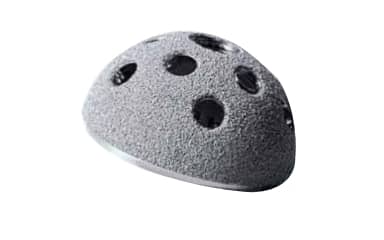


The cementless acetabular prosthesis has several main characteristics:
Shape and Material: It is generally hemispherical in shape, with an outer shell (metal-back) often made of titanium alloy or high-nitrogen stainless steel, such as M30NW (ISO5832-9).
Bone fixation: The outer surface is designed to promote osseointegration, often with a porous coating (e.g., titanium plasma or HA/TPS) or specific texturing, ensuring long-term fixation.
Anchorage holes: It can have cluster holes or a specific number of holes (e.g., 1/3 holes) for the insertion of acetabular screws, improving initial stability.
Inner surface: The inner surface is polished to minimize wear of the joint between the insert and the cup.
Compatibility: It is designed to be combined with different types of inserts (e.g., polyethylene or ceramic) and femoral heads, allowing for great surgical flexibility.
Rotation and Positioning: Some models allow the component to rotate, facilitating optimal positioning in the recipient bone.



Reviews
There are no reviews yet.