

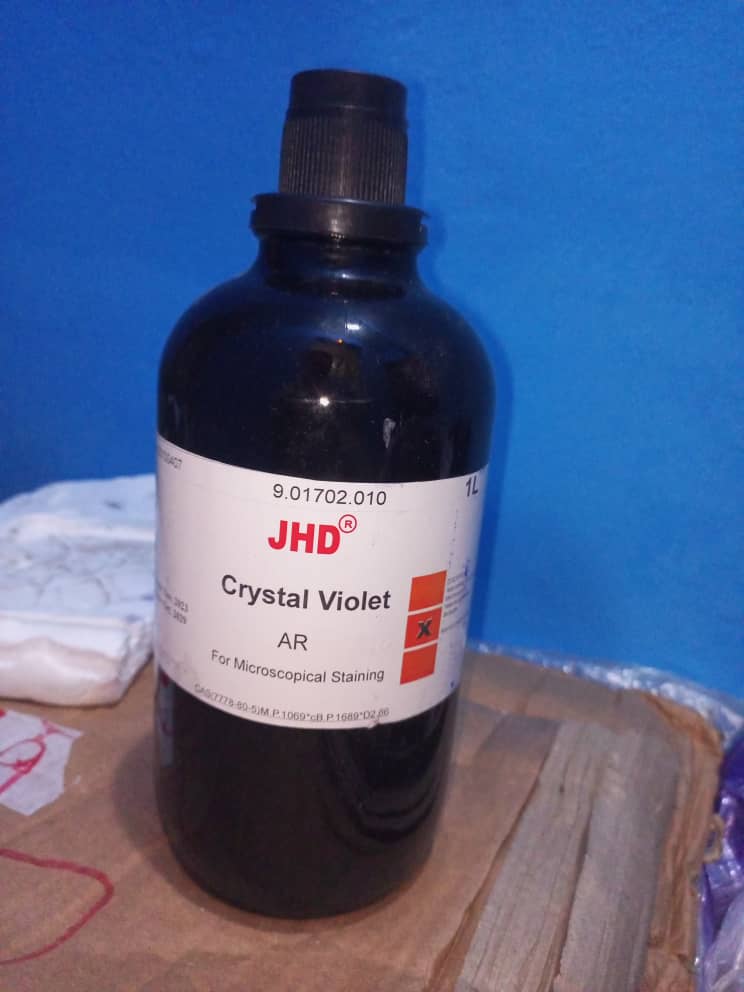

Crystal Violet (Gentian Violet): Key Characteristics
Crystal Violet, also known as Gentian Violet, is a triarylmethane dye with significant applications in microbiology and medicine. Its key properties are outlined below.
-
Primary Application: Its principal use is in microscopic staining, most notably in the Gram stain procedure. It differentiates bacteria by causing Gram-positive organisms to retain the dye and appear purple, while Gram-negative bacteria do not retain it and can be counterstained a different color.
-
Mode of Action: As a cationic (positively charged) dye, it readily binds to negatively charged cellular components, such as proteins and nucleic acids (DNA/RNA).
-
Antimicrobial Properties: It exhibits potent antibacterial and antifungal activity, which has led to its historical use as a topical antiseptic for treating minor skin infections and wounds.
-
Chemical Composition: It is an organic chemical compound classified as an aminotriarylmethane, also known under the broader name of methyl violet.
-
Physical Properties:
-
Appearance: In its pure form, it is a dark green, crystalline or powdery solid that dissolves in water to form an intense purple solution.
-
Solubility: It is highly soluble in water and chloroform, and partially soluble in alcohol and glycerol.
-
-
Safety Profile: Crystal violet requires careful handling. It is very toxic to aquatic life and is classified as a potential carcinogen (cancer-causing agent) in humans.




Reviews
There are no reviews yet.