

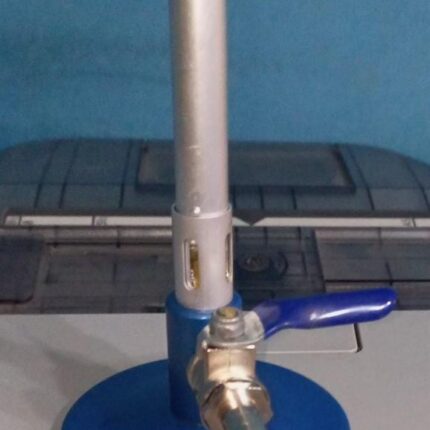
Bunsen Burner
The Bunsen burner is a laboratory burner commonly used for heating, sterilizing, or burning substances.
Its main characteristics are as follows:
Components: It consists of a stable base, a gas inlet (with a control valve), a vertical tube (chimney), and a movable ferrule at the base of the tube that controls the air supply.
How it works: It mixes combustible gas (town gas, butane, propane) with air to produce an open flame. The ferrule regulates the air supply, thus influencing the intensity and temperature of the flame.
Types of Flames: By adjusting the air supply, different flames can be obtained, ranging from a cool, yellow flame (incomplete combustion) to a hot, blue, and almost invisible flame (complete combustion).
Temperature: The flame temperature can vary considerably depending on the air setting, reaching high temperatures (e.g., 750 to 1600°C).
Use: It is essential in chemistry and biology laboratories for various applications, including heating reagents, sterilizing instruments, and creating a sterile area for delicate manipulations such as mushroom cultivation.

Burette 10ml
Laboratory burettes are glassware instruments used for the precise measurement of liquid volumes.
Here is some information for purchasing burettes:
- Burettes are graduated glass tubes made of borosilicate glass such as Pyrex, known for their resistance to thermal shock.
- They are used to deliver a precise volume of liquid, particularly during chemical titrations.
- Capacity: 10 ml, with glass or PTFE stopcocks.

Burette 25ml
Laboratory burettes are glassware instruments used for the precise measurement of liquid volumes.
Here is some information for purchasing burettes:
- Burettes are graduated glass tubes made of borosilicate glass such as Pyrex, known for their resistance to thermal shock.
- They are used to deliver a precise volume of liquid, particularly during chemical titrations.
- Capacity: 25 ml, with glass or PTFE stopcocks.

Burette Stand
The burette stand features the following:
Materials:
Made of high-quality aluminum alloy or plastic for the clamp, and metal (such as iron or aluminum) for the stem and base, providing durability and corrosion resistance.
Functionality:
Designed to securely hold burettes during laboratory titration experiments, particularly on a titration table.
Clamp Design:
The clamp is often a “butterfly” or “double” type, allowing two burettes to be held simultaneously. Its jaws have sufficient elasticity to hold the burettes securely without obscuring the graduations.
Stability:
The heavy base and sturdy stem ensure stability during laboratory manipulations.
Use:
Easy to use for securing and adjusting the position of burettes, making it an essential accessory for science laboratories, schools, and factories.

Burettes
Burettes – Precision Liquid Dispensing Instruments
(For Titrations & Volumetric Analysis)
1. Key Components
| Part | Description |
|---|---|
| Graduated Tube | Long cylindrical glass with precision markings (Class A/B tolerance) |
| Stopcock | PTFE or glass valve for flow control |
| Tip | Tapered delivery end for drop-wise dispensing |
| Mounting Clamp | For secure positioning on stands |
2. Technical Specifications
| Parameter | Details |
|---|---|
| Standard Volumes | 10 mL, 25 mL, 50 mL (Also available: 5 mL, 100 mL) |
| Graduation | 0.1 mL increments (50 mL) |
| Accuracy | ±0.05 mL (Class A) |
| Meniscus Reading | Bottom (clear liquids) / Top (dark solutions) |
| Material | Borosilicate glass (3.3) |
3. Types & Selection Guide
-
Digital Burettes: Motorized, programmable dispensing
-
Microburettes: For <1 mL volumes (0.01 mL gradations)
-
Automatic Zeroing: Self-refilling designs
4. Proper Usage Protocol
-
Rinsing: Pre-wet with titrant solution
-
Filling: Avoid air bubbles (use funnel)
-
Reading: Eye level at meniscus
-
Delivery: Slow, drop-wise near endpoint
5. Calibration & Maintenance
-
Verification: Annual calibration with distilled water
-
Cleaning: Chromic acid for stubborn residues
-
Storage: Vertical position, stopcock grease applied

Butyrometer
A Babcock butyrometer, a laboratory instrument used to determine the fat content of milk and dairy products. Its main features are:
Material: Made of high-quality borosilicate glass, conforming to USP Type I and ASTM E438, Type I, Class A requirements.
Graduation: Features a graduated neck with permanent brown markings for direct measurement of fat percentage, e.g., up to 50% for cream or 0.5% in 0.01% increments for skim milk.
Design: Includes a reaction vessel body.
Use: Designed for use in Babcock testing procedures for determining fat content, with a sample size of 18g.
Compliance: Meets specific standards such as ASTM E1043, Type II A, USP Type I, and ASTM E438, Type I, Class A.

C-section box
The AROMA C-section box (branded as “Aroma for Quality C-section Box”) is a stainless steel surgical box designed to contain the instruments needed for a C-section procedure.
Here are the main features of this type of box:
Material: It is made of high-quality stainless steel, making it robust, durable, and resistant to corrosion, sterilization chemicals, and autoclave processes.
Contents: A complete C-section box, such as the AROMA one, contains a set of specific surgical instruments needed to perform a C-section, such as forceps, scissors, retractors, a scalpel handle, and a needle holder, among others. The AROMA box shown in the image indicates that it contains “28 items.”
Dimensions: Dimensions may vary.
Functionality: It is designed for the storage, sterilization, and secure transport of surgical instruments in the operating room, particularly for obstetric procedures such as cesarean sections.

Cannulated compression headless screw
A portfolio of cannulated screws available in Titanium alloy and offered in 9 diameters

Cannulated Humeral Nail
The cannulated humeral nail shown has several essential features for the treatment of humeral fractures:
Material: Typically made of titanium alloy (Ti6Al4V) or implant steel (ISO 58321E).
Design: It is cannulated, allowing for the insertion of a guide wire to facilitate placement. It can be slightly curved to accommodate humeral anatomy.
Locking Options: It offers multiple proximal and distal locking options for stable fixation of even short or complex fracture fragments. These options can include cancellous and cortical locking screws.
Dimensions: Available in several diameters (e.g., 7, 8, 9 mm) and lengths (e.g., 190 to 310 mm, varying by diameter) to accommodate different anatomies and fracture types.
Insertion: Can be introduced antegrade or retrograde, depending on the location and type of fracture.
Stability: The design and locking options are designed to provide robust fixation and axial stability, promoting bone healing.

Capillary Viscometer
A Cannon-Fenske Opaque Capillary Viscometer.
Its main features are:
Measurement Type: It is designed to measure the kinematic viscosity of transparent and opaque Newtonian liquids.
Conformity to Standards: It is manufactured and used in accordance with international standards such as ASTM D445, ISO 3104, and ASTM D2170.
Design: It is a reverse-flow type U-tube viscometer, allowing the measurement of liquids whose meniscus cannot be easily observed with other types of viscometers.
Sample Volume and Bath Depth: The minimum sample volume required is 12 mL, and the minimum bath depth is 230 mm (9 in).
Calibration: It is supplied with a calibration certificate and an instruction sheet, and both calibrated and uncalibrated versions are available.
Material: It is made of high-quality glass.
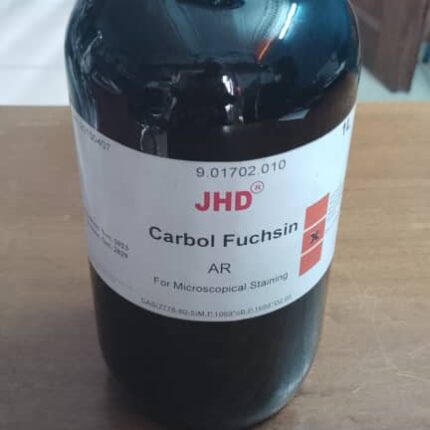
Carbol Fuchsin
Carbol Fuchsin is a staining solution used primarily in microbiology, with specific characteristics and uses.
Key Features:
Composition: It is a mixture of phenol and basic fuchsin.
Use in staining: It is essential for staining mycobacteria, particularly in the Ziehl-Neelsen method, due to its affinity for the mycolic acids present in their waxy cell walls.
Resistance to decolorization: Mycobacteria stained with carbol fuchsin are resistant to decolorization by acidic alcohol, allowing them to be distinguished from other bacteria.
Microscopic Appearance: Acid-fast bacteria appear red or magenta-red under the microscope after staining with carbol fuchsin. Stability: The solution should be stored in an airtight, light-resistant container at a temperature below 40°C, preferably between 15 and 30°C, avoiding freezing.
Main Applications:
Disease Diagnosis: Crucial in the diagnosis of diseases such as tuberculosis and leprosy, as it helps identify the responsible acid-fast bacteria.
Microbiology Research: Used for the microscopic study of acid-fast bacteria and the staining of bacterial spores.
Topical Medical Use: Can be used as a first aid antiseptic for certain skin conditions where there is excess moisture.

Cardiotocograph
NAME: Cardiotocograph
BRAND: Contec
MODEL: CMS800G
The Contec CMS800G fetal monitor is a compact device designed to monitor fetal heart rate (FHR), uterine contractions (TOCO), and fetal movements (FMOV).
Key Features:
Design and Display:
Compact design, can be placed horizontally or hung on a wall.
8.0-inch color LCD screen, 60° rotatable.
Clear display of monitoring waveforms and data.
Monitoring Features:
Real-time acquisition of FHR, TOCO, and FMOV.
Marking of the normal FHR zone (120 BPM~160 BPM).
Manual recording of fetal movements.
Audible and visual alarm for abnormal fetal heart rates (high or low).
Continuous 24-hour real-time monitoring.
Storage and Printing:
Storage, playback, and printing of monitoring curves and data for 12 continuous hours.
Built-in long-life, high-resolution thermal printer.
Freeze frame function.
Connectivity and Options:
Can be used standalone or connected to a central monitoring system via a built-in RJ45 port.
Optional English interface.
Twin monitoring option.
9-crystal broadband pulsed-wave transducer (or 12 crystals depending on the source).
Supports external USB flash drive and SD card functions for data storage.
Built-in rechargeable batteries ensure more than three hours of operation after a power outage.
Use:
Suitable for use in hospitals, clinics, doctor’s offices, and at home by professional medical personnel.