

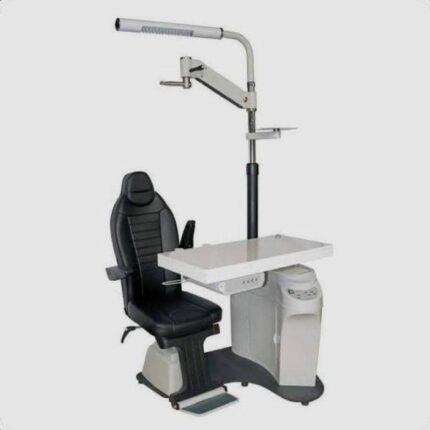
Complete Workstation Designed For Eye Examinations
The ophthalmic unit illustrated is a complete workstation designed for eye examinations, incorporating several key components:
Examination chair: A height-adjustable, often electrically powered, swiveling seat, providing comfort for the patient and flexibility for the ophthalmologist.
Instrument table: A lifting, sometimes sliding, table designed to accommodate various ophthalmic instruments such as a refraction head, an autorefractor, or a slit lamp.
Lighted column and supports: A vertical column incorporating an examination light (often halogen with adjustable lighting) and supports for other equipment, such as a chart projector or a motorized phoropter arm.
Control panel: Integrated controls on the table or a footswitch for adjusting the chair height and other unit functions.
Built-in storage: The unit often includes a cabinet or drawers for storing trial lenses and other small accessories.
Power supply: Built-in power transformers to power the instruments, as well as outlets for additional devices.
Ergonomic and compact design: Many units are designed to optimize space and facilitate intensive use in medical settings, with particular attention to stability and robustness.

Compression Screw
The characteristics of a compression screw, such as the DHS/DCS lag screw, are as follows:
Material: Generally made of surgical-grade stainless steel.
Design: Consists of a thread and a head, with a specific design to allow dynamic compression.
Function: Used to stabilize fractures, particularly proximal femoral fractures (dynamic hip screw or DHS) or distal femoral fractures (dynamic condylar screw or DCS), by allowing controlled sliding of the screw within a plate to promote compression at the fracture site.
Use: Designed to be inserted into bone, such as the femoral neck, and combined with a plate (e.g., DHS or DCS plate) that is secured along the bone.
Sterility: Screws intended for surgical use are sterile.
Dimensions: Available in various lengths and thread diameters to accommodate anatomical needs and fracture types.
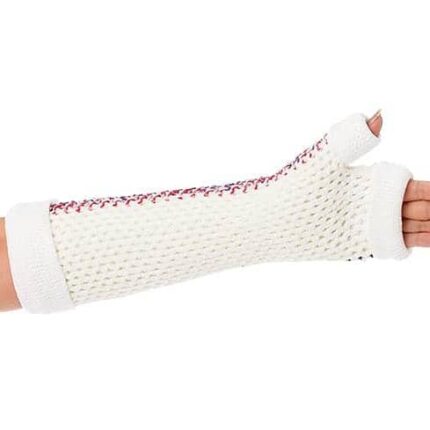
Compression Sleeve
Compression Sleeve Characteristics
A compression sleeve, like the one shown, has several important characteristics, including:
Material and Texture: Usually made from elastic and breathable textile materials (such as polyamide and elastane), it offers a comfortable texture and allows the skin to breathe.
Graduated Compression: Designed to apply graduated pressure, often greatest at the wrist and decreasing toward the upper arm, to promote venous and lymphatic return and reduce edema.
Integrated or Separate Design: May include a built-in gauntlet to cover the hand and wrist, or be a simple sleeve without a mitten, with options for open or closed fingers.
Ease of Use: Often stretchy and equipped with fastening systems (non-slip strip, hook-and-loop fasteners) for easy donning and adjustment, and to prevent slippage.
Comfort and Discretion: Seams are often placed on the outside to prevent chafing, and the design can be streamlined for discretion under clothing.
Care: Generally hand washable to maintain hygiene and durability.
Adaptability: Available in various sizes and lengths, and sometimes customizable, to accommodate various body shapes and clinical needs.

Conical washers couple
Axial Force: The conical shape allows the washer to act as a spring, providing a constant axial force that maintains tension in a bolted joint, even under vibration or thermal expansion.
Vibration Damping: The spring action absorbs and dissipates vibrations, which reduces mechanical noise, prevents loosening, and minimizes wear on components.
Load-Bearing Ability: Conical washers are designed to provide a high level of load-bearing ability in a small area, making them suitable for various industrial and automotive applications.
Enhanced Locking Properties: The surfaces of these washers can be serrated or toothed, which enhances their locking properties, offering an increased grip and preventing screws from loosening.
Dental Application (Conical Connection)
Bio-mechanical Interface: The conical connection between the dental implant and the abutment (the part that supports the crown) is designed to create a stable and secure junction.

Connection plates with threated ends.
The defining feature is an internally or externally threaded opening, which accepts screws or other components with corresponding threads.
Hexagonal Head: The threaded component typically has a hexagonal head, requiring a 2.5mm hex screwdriver for tightening.
K-Wire Holes: Pre-drilled holes are included for inserting k-wires, allowing for preliminary fixation to the bone and preliminary realignment of fractured femurs.
Compression Slots: Some plates incorporate compression slots, which allow for a controlled amount of compression to achieve a stable fixation.
Material: These plates are made from materials like titanium and its alloys, known for their biocompatibility, high corrosion resistance, and mechanical properties similar to bone.

Coverslips
Coverslips have the following characteristics:
Material: They are made of D 263 M borosilicate glass, of the first hydrolytic class, known for its chemical resistance.
Quantity: The package contains 100 coverslips.
Dimensions: The coverslips measure 22x22mm.
Optical quality: They are colorless, perfectly clear, and suitable for fluorescence microscopy.
Conformity: They meet all the requirements of DIN ISO 8255.
Thickness: The thickness corresponds to standard No. 1 (0.13-0.16 mm).

CPR Manikin
**Cardiopulmonary Resuscitation (CPR) Manikins**
CPR manikins are lifelike training tools designed to replicate human anatomy, enabling users to practice life-saving first aid techniques.
**Key Features:**
✔ **Realistic Anatomical Landmarks** – Includes clearly defined sternum and ribs for accurate hand placement during chest compressions.
✔ **Thoracic Simulation** – The rib cage offers human-like resistance to mimic real cardiac massage conditions.
✔ **Multiple Size Options** – Available in adult, child, and infant models to train for various emergency scenarios.
✔ **Quick Response (QCPR) Technology** – Advanced feedback system to monitor and improve CPR performance in real time.
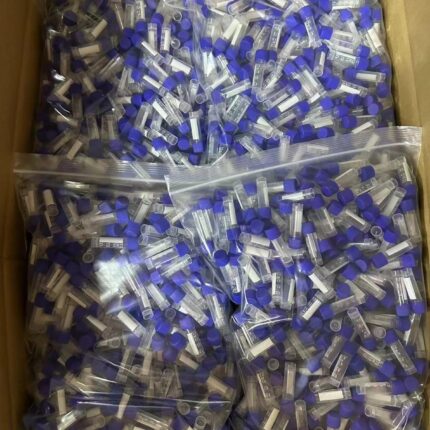
Cryotubes
2 ml cryotubes, such as those shown in the image, have several important characteristics for their use in laboratories:
Materials:
They are generally made of high-quality polypropylene, a material resistant to corrosion, extreme temperatures (low and high), and acids and bases.
Capacity and Dimensions:
The typical capacity is 2 ml, with dimensions of approximately 11 x 50 mm (diameter x length).
Leak-Proof:
They are designed with a screw cap and often equipped with a silicone washer to ensure an excellent seal, preventing leaks and sample volatilization, even at very low temperatures (down to -180°C or -200°C).
Freestanding:
These vials have a round or conical bottom that allows them to stand upright, facilitating handling and storage.
Graduations and Writable Area:
They feature clear graduations to facilitate volume measurement and a writable area on the tube for labeling and sample identification.
Resistance:
They are designed to withstand very low temperatures (down to -180°C or -200°C) and can withstand high temperature and high pressure conditions, such as autoclaving.
Sterility and Non-Toxicity:
Many cryogenic vials are sterile, non-pyrogenic, and non-cytotoxic, ensuring the safety of biological samples.

Crystallizing Dish
The borosilicate glass crystallizing dish has the following characteristics:
Material: Made of borosilicate glass 3.3, it offers high resistance to temperature and thermal shock.
Shape and Design: It is a shallow, flat-bottomed cylindrical container with a pouring spout for easy transfer of liquids.
Use: Ideal for evaporative crystallization in the laboratory.
Resistance: It is resistant to cold alkaline solutions and strong acids (except hydrofluoric acid and concentrated hot phosphoric acid).
Sterilization: It can be sterilized in an autoclave, withstanding high temperatures (up to 500°C).
Stability: Its wide base ensures good stability.
Other Features: It features high purity (SiO2 >99.99%), good light transmission, and excellent thermal shock stability.

Curettage Box
The AROMA brand curettage box is a stainless steel container designed to store and organize the medical instruments needed for curettage procedures.
Its main features are as follows:
Material: It is made of stainless steel (inox), which gives it high corrosion resistance and ease of cleaning, essential for maintaining hygiene standards in a medical environment.
Contents: Although the box itself is an AROMA product, it contains a variety of gynecological and obstetric instruments used during curettage procedures, such as uterine curettes (e.g., Gourdet, Simon, Sims), forceps (e.g., Museux, Pozzi, Foerster), hysterometers (e.g., Valleix), and vaginal specula (e.g., Collin).
Dimensions: 500 x 200 x 120 mm.
Functionality: Its robust design ensures instrument protection and availability for quick and efficient use during curettage procedures.

Cuvette (analysis)
A spectrophotometric cuvette, specifically a quartz cuvette suitable for UV analysis (as indicated by the designation “UV -6030-“).
A cuvette is a small, transparent container, usually square or rectangular, used in laboratories to hold samples (most often liquids) during spectroscopic analyses, such as spectrophotometry, fluorimetry, or colorimetry.
Characteristics and Uses:
Material: Cuvettes are made of glass. Cuvettes are suitable for analyses in the ultraviolet (UV) region, in addition to the visible and infrared, thanks to their wide spectral transmission range.
Function: They measure the absorbance or transmission of light through a sample, providing information about its concentration or composition.
Path Lengths: They are available with different optical path lengths.

D-Mannitol
D-Mannitol Technical Specifications
*(C₆H₁₄O₆ | CAS No.: 69-65-8 | EC No.: 200-711-8)*
1. Fundamental Properties
| Parameter | Specification |
|---|---|
| Molecular Weight | 182.17 g/mol |
| Appearance | White crystalline powder |
| Melting Point | 167-170°C |
| Solubility | 213 g/L in water (20°C) |
| pH (10% sol.) | 5.0-7.0 |
| Sweetness | 70% of sucrose |
2. Key Applications
A. Pharmaceutical
-
Osmotic diuretic: Reduces intracranial/intraocular pressure
-
Excipient: Tablet filler (direct compression), lyophilization stabilizer
-
Diagnostic agent: Renal function tests
B. Food Industry
-
Low-calorie sweetener (E421)
-
Anti-caking agent in chewing gums/sweets
-
Sugar-free product formulations
C. Microbiology
-
Carbon source in culture media (e.g., Mannitol Salt Agar)
-
Fermentation studies
3. Safety & Handling
| Aspect | Detail |
|---|---|
| Glycemic Index | Low (GI=0) |
| Storage | ≤25°C, dry environment |
| Explosion Risk | Dust-air mixtures may be combustible |
| Regulatory Status | GRAS (FDA), EFSA-approved |
4. Quality Standards
-
Purity: ≥98% (HPLC)
-
Residues: Heavy metals ≤10 ppm
-
Microbial Limits: TAMC <100 CFU/g
5. Comparative Advantages
✔ Renal-safe diuretic (minimal tubular reabsorption)
✔ Tooth-friendly sweetener (non-cariogenic)
✔ High chemical stability in formulations