


Dissection Kit
Composition & Materials:
Included Instruments:
Comprehensive set of dissection tools, typically including:
-
Scalpels with interchangeable handles and blades
-
Scissors: straight, iris, and dolphin types
-
Forceps: dissecting, splinter, sharp-tipped, and fine-point
-
Probes: grooved and buttoned
-
Dissecting Needles: lanceolate style, often with a durable handle
Material Quality:
All instruments are crafted from high-grade stainless steel, offering:
-
Exceptional durability and precision
-
Resistance to rust and corrosion
-
Compatibility with various sterilization methods, including autoclaving
Kit Design:
Protective Storage Case:
-
Lightweight, compact case—commonly vinyl with a secure zipper
-
Designed for portability and instrument protection
Internal Organization:
-
Features elastic loops or dedicated compartments to securely hold each tool
-
Enables quick identification and access during use
Applications & Audience:
Versatile Use Cases:
Suitable for a wide range of dissection activities, including:
-
Anatomical and biological studies
-
Veterinary procedures
-
Medical training
-
Educational demonstrations
-
Artistic anatomy studies
Target Users:
Ideal for:
-
Medical and veterinary students
-
Educators and instructors
-
Surgeons, doctors, and nurses
-
Artists and anatomical modelers
-
Laboratory personnel and enthusiasts
Quality & Safety:
High Performance:
-
Designed for repeated use without loss of precision or structural integrity
Sterilization Compatibility:
-
Instruments are fully autoclavable and suitable for standard sterilization techniques
Safe Handling:
-
The protective case minimizes handling risks and prevents accidental injuries

Distal Femoral Nail
The distal femoral nail (DFN) is an orthopedic implant used for the fixation of distal femoral fractures. Its main characteristics are:
Design and Dimensions:
- The DFN is available in various lengths (e.g., 160 to 420 mm) and diameters (e.g., 9.0 to 13.0 mm for the nail, and 13 mm for the proximal portion) to adapt to the patient’s anatomy.
- It can be curved to conform to the anterior femoral arch.
Locking and Stability:
Distal Locking: This allows for multiplanar fixation to increase stability, often with locking screws or spiral blades for a better contact surface.
Proximal Locking: Static and dynamic locking options are available, allowing immediate or secondary dynamization of the fracture.
Materials and Features:
- The DFN is designed to reduce friction and facilitate insertion through grooves, also increasing elasticity to avoid stress concentration.
- Short and long nails are available, with lateral or anteroposterior locking options depending on the length and fracture type.
- Some systems combine a nail and plate for more stable fixation in cases of complex fractures or poor bone quality, offering multiple fixation points.

Distal radius fixator
Adjustability: Components and joints are designed for easy adjustment in multiple planes, allowing for accurate reduction of the fracture.
Lightweight and Radiolucent Materials: Carbon fiber rods are lightweight and transparent to X-rays, improving post-operative monitoring.
Versatility: Modular components and different fixator types enable the system to be adapted for a wide range of distal radius fracture patterns.
Ligamentotaxis: The use of traction can help reduce comminution and maintain the space within the joint, supporting the natural healing process.
Augmentation: K-wires can be added to external fixation to provide increased stability, prevent late collapse of the fracture, and aid in the reduction of impacted fragments.
Application Considerations
Soft Tissue Protection: Incisions are made carefully, and soft tissue protectors are used to prevent damage to nerves, vessels, and tendons.

Dockhorn Retractor
The Dockhorn retractor and its main features are as follows:
Type and Function: This is a manual retractor used in surgery to hold tissue and improve visibility of the surgical field.
Blade Design: The blade is L-shaped and has a concave upper surface, designed to maximize vision of the surgical field.
Handle and Ergonomics: The handle is ergonomic, often with a ring for optimal grip, and is designed to reduce hand fatigue during prolonged procedures.
Material and Durability: Made of surgical-grade stainless steel, it is reusable and guarantees a long service life, even after frequent use.
Available Sizes: It is available in various sizes (40 x 12 mm and 55 x 14 mm) to accommodate various mouth sizes or surgical areas.
Versatility of Use: Particularly chosen for its precision and control during oral surgery, it is also versatile for various dental and oral procedures, including complex extractions.

Draps d’examen
Les draps d’examen, couramment utilisés dans les milieux médicaux ou esthétiques pour recouvrir les tables ou divans d’examen.
Caractéristiques générales des draps d’examen :
Matériaux:
Généralement fabriqués en pure ouate de cellulose, parfois avec plusieurs plis (ex: 2 plis) pour une meilleure absorption et résistance. Certains peuvent être plastifiés pour une imperméabilité accrue.
Dimensions :
Disponibles en différentes laizes (largeurs), couramment 50 cm ou 50 cm, et en rouleaux de diverses longueurs, souvent prédécoupés en formats standards , pour faciliter l’utilisation et l’hygiène.
Type :
Sont lisses pour une meilleure tenue et absorption.
Hygiène :
Conçus pour un usage unique afin de garantir une propreté maximale et prévenir la contamination croisée entre les patients.
Conditionnement :
Souvent vendus en cartons contenant plusieurs rouleaux.
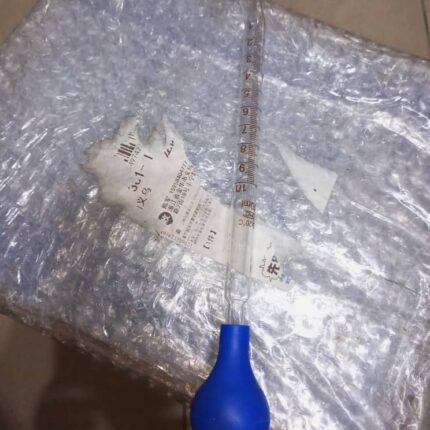
Dropper Pipette
The characteristics of the glass dropper pipette with a rubber bulb are as follows:
Materials: The pipette is made of glass, borosilicate glass for its durability and chemical resistance, while the bulb is made of rubber.
Graduation and Precision: Glass pipettes are often graduated, like the one in the image, which has a graduation up to 10 ml, allowing for precise measurement of liquids.
Reusability: They are reusable after cleaning, making them more environmentally friendly than single-use plastic alternatives.
Use: This instrument is commonly used in laboratories, chemistry, microbiology, or for transferring and measuring liquids such as reagents or oils.
Functionality of the Bulb: The rubber bulb is used to draw and dispense liquid into the pipette by creating pressure or suction.

Dropping Funnel
The dropping funnel, also called an isobaric dropping funnel, is a laboratory instrument made of borosilicate glass (such as LBG 3.3) used for the controlled addition of liquids, usually dropwise.
Its main features are:
Function: It allows the precise and controlled addition of a liquid reactant to a reaction medium, particularly for rapid or exothermic reactions where slow addition is crucial to avoid runaway reactions or explosions.
Isobaric Design: Unlike the separating funnel, the dropping funnel’s stopcock is located higher on the stem, and a thin glass section below the stopcock slows the flow by capillary action, allowing finer flow control.
Material: It is made of borosilicate glass for its resistance to heat and chemicals.
Controlled atmosphere use: It can be used in systems under an inert atmosphere (argon, nitrogen) if the reagent is sensitive to air or moisture.
Variations: It is available in various capacities (50 ml, 250 ml, 500 ml, 1000 ml). It is equipped with a PTFE stopcock for improved sealing and chemical resistance.
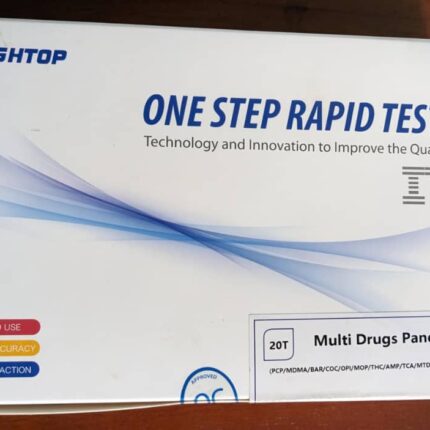
Drug Test
The features of the “Hightop One Step Rapid Test Multi Drugs Panel 12” are as follows:
Test Type: One-step rapid test for the detection of multiple drugs.
Ease of Use: Easy to use.
Accuracy: High accuracy.
Speed: Fast response.
Substances Detected: 12-drug panel, including PCP, MDMA, BAR, COC, OPI, MOP, THC, AMP, TCA, MTD, MET, and KET.
Packaging: Box of 20 tests (“20T”).
Certification: Approved.
Technology: Uses technology and innovation to improve quality of life.
Purpose: Designed for in vitro diagnostic (IVD) use.

Drums
Stainless steel steam sterilization drums are commonly used in medical or laboratory environments for sterilizing instruments and equipment.
Typical Features:
Material:
Stainless steel, offering durability, corrosion resistance, and ease of cleaning and sterilization.
Design:
Cylindrical shape with a tight-fitting lid, featuring latches to ensure a secure closure during sterilization.
Use:
Designed for moist heat (steam) sterilization or sterile storage of instruments and medical supplies.
Stackability:
Their design allows them to be stacked, facilitating storage and optimizing space.

Dry Tube
-
Tube Type: Dry Tube (Plain Tube)
-
Material: PET (Polyethylene Terephthalate)
-
Cap Color: Red – typically signifies no additives or may indicate a clot activator
-
Dimensions: 13 x 75 mm
-
Packaging: 100 tubes per pack
-
Traceability:
-
Lot Number: 20221102
-
Expiry Date: 2027-11-01
-
-
Certification: CE Marked – meets European safety and quality standards
Function and Use:
Designed for vacuum-based blood collection, these tubes ensure precise sample volumes and maintain a sterile, closed system to protect both medical personnel and sample integrity. Commonly used in clinical chemistry where serum is required after clotting and centrifugation.

Dual Threaded Suture Anchor
- The Dual Threaded Suture Anchor is an arthroscopic implant used in shoulder arthroscopy surgeries to enhance fixation strength.
- It features two different thread patterns, allowing easy pull-out and insertion during surgeries.
- The anchor is particularly useful in cases where bone quality is compromised or a higher tensile strength is required.
- With optimal anchor performance, surgeons can achieve better post-operative outcomes in repairing rotator cuff tears and other shoulder injuries.
- It is loaded with Two/Three Pc Refiber (with/without Needle) which saves time and reduces the risk of irritation/contamination during surgical procedures.
- The Suture Anchor is available in 5.0mm and 6.5mm lengths to accommodate individual anatomical variations

Dual-Sensor Pulse Oximeter
MODEL: CMS60D
The Contec CMS60D handheld pulse oximeter.
Its main features are:
Measurements and Display: It measures blood oxygen saturation (SpO2) and pulse rate. It displays these values, along with a pulse bar graph and a plethysmographic curve, on a color OLED display.
Design and Portability: It is small, lightweight, and easy to carry.
Ease of Use and Consumption: It is simple to use and has low power consumption, allowing for long battery life (up to 32 hours).
Advanced Features:
Adjustable display brightness.
Review and clock functions.
Alarms for exceeded measured data limits and low voltage (low battery).
Ability to store data (up to 72 hours and 10 patients) and transfer it to a computer via a USB cable and dedicated software.
Sensors: It comes with an integrated SpO2 probe and can be used with different sensors (adult, pediatric, neonatal) as needed.
Accuracy: It ensures accurate measurement even in low pulse rate conditions (up to 0.4%) and is resistant to ambient light.