


Rollator with Wheels
The rollator with wheels has the following characteristics:
Type:
This rollator has two wheels, making it easier to move around by sliding it instead of lifting it.
Material:
The frame is made of metal, stainless steel, for lightweight and strength.
Adjustable:
The height is adjustable to suit the user’s height, allowing for correct and comfortable posture.
Foldable:
Its design allows it to be folded for easy storage or transport.
Stability:
It provides significant support to improve the user’s stability and confidence when walking.
Handles:
It is equipped with padded or ergonomic handles for a comfortable grip.

Ophthalmoscope
An ophthalmoscope is a medical instrument used for examining the eye. Its general characteristics include:
Type:
This is a direct optical ophthalmoscope, portable and battery-powered (2 AA batteries).
Optics and Illumination:
It features a light source, an LED bulb, offering high and adjustable brightness, with good color rendering.
The optical system is designed to minimize glare and ensure clear visibility of the back of the eye, even with small pupils.
It can include different diaphragms and filters (e.g., a green filter that eliminates red) for various observations.
Optical Correction:
A lens correction range (from -20 D to +20 D) is integrated to compensate for ametropia in the examiner or patient.
Design and Ergonomics:
The handle is designed for a comfortable grip and is compatible with various instrument heads.

Test Tube Rack
The test tube rack features the following:
Material: It is made of polypropylene (PP), providing good visibility and easy cleaning.
Capacity: The model shown is a 40-position rack, designed to hold 40 test tubes simultaneously.
Design: It features a three-layer structure for greater stability. The top two layers have holes of the same diameter, while the bottom layer has openings of different sizes to ensure stable support for the tubes.
Assembly: This type of rack is detachable or easy to assemble and disassemble, making it convenient for storage, transport, or cleaning.
Use: Ideal for organizing and holding test tubes in the laboratory, for school experiments, or for applications requiring upright tubes.

Tip Holder
Tip racks are essential laboratory equipment designed to organize, protect, and facilitate the use of tips. Their key features include:
Material: They are made of polypropylene (PP) plastic, a lightweight, durable, and temperature-resistant material (allowing freezing and autoclaving for sterilization).
Design and Functionality:
Organization and Safety: They feature multiple slots (96 wells) to securely hold tips in place and protect them from contamination when the box is closed.
Refill and Reuse: The case and rack are reusable, and the rack can be refilled with loose tips, saving money and reducing waste.
Ease of Use: The rack design facilitates quick and clean attachment of the tip to the automatic pipette.
Compatibility and Specifications:
They are designed to fit specific pipette tip volumes (e.g., 200 µL, 1000 µL) and are compatible with various pipette brands (DragonLab, etc.).
Sterility and Purity: The racks and tips can be sterilized at high temperatures (autoclavable), and high-purity tips (DNase-free, RNase-free, etc.) are available for sensitive applications.
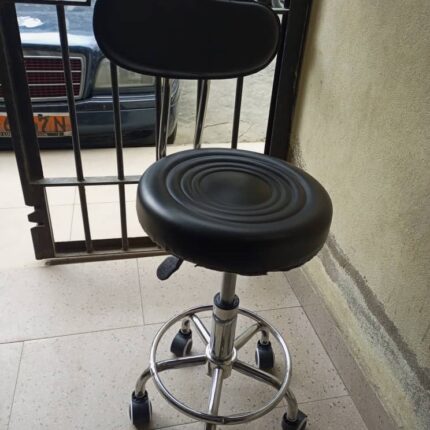
Laboratory Stool with Backrest
The Laboratory Stool
with Backrest features the following features:
Upholstered Seat and Backrest: The seat and backrest are black and upholstered, providing comfort.
Caster Base: The chair is equipped with a chrome-plated base with five casters, allowing for easy mobility.
Height Adjustment: A lever is visible under the seat, suggesting a seat height adjustment function.
Circular Footrest: A circular chrome-plated ring is present on the base, likely serving as a footrest.
Materials: The frame is made of chrome-plated metal, and the seat and backrest are made of synthetic material upholstered in faux leather.
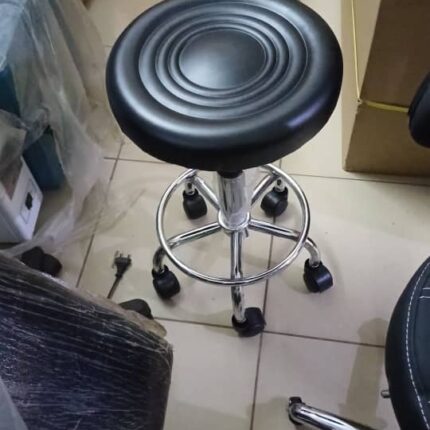
Backless Laboratory Stool
The backless laboratory stool with height-adjustable casters.
Here are its main features:
Height adjustment: It is equipped with a hydraulic lift allowing easy height adjustment to accommodate different uses and ergonomic sitting positions.
Swivel: The seat swivels, offering the user great freedom of movement.
Casters: It has several casters (five) on its base for easy movement and maneuverability.
Design: It features a round, padded seat in black faux leather and a sturdy chrome-plated metal base.
Versatility: This type of stool is functional and can be used in various professional environments such as laboratories, hair salons, beauty or dental offices, bars, studios, or as an office stool.

Drums
Stainless steel steam sterilization drums are commonly used in medical or laboratory environments for sterilizing instruments and equipment.
Typical Features:
Material:
Stainless steel, offering durability, corrosion resistance, and ease of cleaning and sterilization.
Design:
Cylindrical shape with a tight-fitting lid, featuring latches to ensure a secure closure during sterilization.
Use:
Designed for moist heat (steam) sterilization or sterile storage of instruments and medical supplies.
Stackability:
Their design allows them to be stacked, facilitating storage and optimizing space.
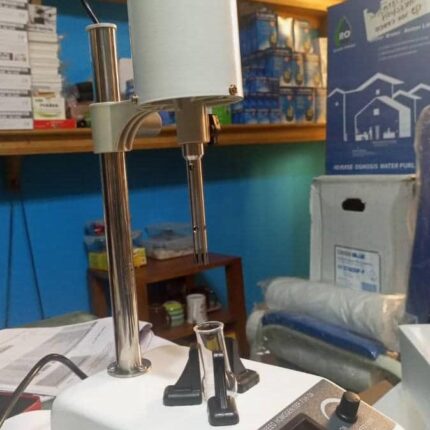
High-Speed Power Homogenizer
MODEL: FSH-2A
The FSH-2A homogenizer is an adjustable high-speed homogenizer commonly used in laboratories for homogenizing various materials, including animal and plant tissues.
Main Features:
Motor Speed:
The motor can reach a speed of 22,000 rpm. The homogenizing knives have specific speed ranges: 8,000 to 18,000 rpm for the large knife and 8,000 to 20,000 rpm for the small knife.
Homogenization Features:
It uses an internal suction homogenization structure (internal cutter).
It can efficiently homogenize and emulsify two or more immiscible liquids.
It is capable of extracting trace organic compounds, fat-soluble substances, and soluble organic solvents.
It allows for the homogenization and mixing of various animal and plant tissues.
It can rupture cell membranes for separation and fragment DNA strands into small molecules at varying speeds.
Additional Features:
It can be used as a low-speed stirrer.
The speed is digitally displayed for intuitive and accurate readings.
It incorporates a high-speed thyristor control system and Hall element speed measurement with advanced electronic circuits.
Technical Specifications:
Power: 185W.
Voltage: Available in 110V or 220V.
Continuous Working Time: 3 minutes.
Capacity: Can handle volumes of 5ml, 10ml, 15ml, and 20ml.

4-Blade Laryngoscope
The laryngoscope set presented, including a handle and four blades, has the following characteristics:
Set Composition:
It generally includes a laryngoscope handle and four blades of different sizes.
Materials:
The blades and handle are often made of stainless steel, ensuring durability and ease of disinfection.
Illumination:
This can be a fiber optic (FO) system, providing powerful and even illumination, or a conventional bulb illumination. FO systems use replaceable optical fibers.
Compatibility and Standards:
The equipment complies with ISO 7376, ensuring interchangeability between handles and blades from different manufacturers.
Sterilization:
The blades are autoclavable, withstanding high temperatures (e.g., up to 134°C) for optimal hygiene.
Handle Power Supply:
The handle is powered by rechargeable batteries.
Packaging:
The set comes in a rigid plastic case for secure transport and storage.

Pressure Regulator
The medical oxygen pressure regulator with flowmeter and humidifier is used to manage the flow of oxygen from cylinders to patients.
Typical features include:
Function:
Reduces the oxygen pressure in the cylinder to a safe level for patient administration and regulates the flow.
Components:
Pressure Gauge: Indicates the remaining pressure in the oxygen cylinder.
Flowmeter: Allows precise adjustment of the oxygen flow, with multiple flow ranges.
Humidifier: Humidifies the oxygen before it reaches the patient to prevent airway dryness.
Materials:
The body is made of brass, while the flowmeter tube cover can be made of polycarbonate.
Safety:
Incorporates safety features such as pressure relief valves to prevent overpressure.
Use:
Primarily used in clinical settings and for home oxygen therapy.

Treatment Tray
The characteristics of a treatment tray are as follows:
Material:
Made of medical-grade stainless steel (such as 18/10 or AISI 304/316) to ensure corrosion resistance and ease of cleaning.
Dimensions:
The tray shown measures 31 x 24 x 3.1 cm, which corresponds to its length, width, and height/depth, respectively. Treatment trays are available in various dimensions to accommodate different uses and instruments.
Design:
It is rectangular with rounded edges for easy cleaning and hygiene.
Use:
Designed to hold instruments and treatment supplies, such as dressings, syringes, or surgical instruments, whether in an operating room, treatment room, or doctor’s office.
Sterilization:
Stainless steel trays are autoclavable (sterilizable at high temperatures, e.g., 134°C for 18 minutes), which is essential for maintaining the sterility of medical instruments.
Maintenance:
Easy to clean and disinfect, either manually or by machine, using products that do not attack the material.

Fridge Thermometer
The features of the probeless refrigerator thermometer are as follows:
Type: Digital refrigerator and freezer thermometer.
Measuring range: -50°C to +70°C (-58°F to +158°F).
Features:
Temperature display in Celsius (°C) or Fahrenheit (°F).
Max/Min temperature recording function.
Reset button (CLR) to clear Max/Min recordings.
Large LCD display for easy reading.
Indication for battery replacement when the LCD display becomes blurred.
Power supply: Requires one CR2032 battery.
Accuracy: ±1°C (±2°F).
Resolution: 0.1°C (0.2°F).
Placement: Can be hung using an integrated hook or placed on a wall.