


Femoral intramedullary nail
The characteristics of this femoral intramedullary nail are as follows:
Use: It is designed for internal fixation and stabilization of fractures of long bones, primarily the femur, tibia, and humerus. In the case of the femur, it is used for shaft fractures, subtrochanteric and intertrochanteric fractures, as well as femoral neck fractures.
Material: These nails are generally made of implant steel (ISO 58321E) or titanium (Ti6Al4V ELI ISO 5832-3).
Design: It is a rod-shaped device inserted longitudinally into the medullary cavity of the fractured bone. Better match the anatomy
Dimensions: Femoral intramedullary nails come in various sizes and diameters, for example, diameters of 10-14 mm and lengths of 320-500 mm. Shorter nails are also available, such as the short femoral reconstruction intramedullary nail (PFN).
Fixation: They allow for static, dynamic, compression, or reconstructive intramedullary osteosynthesis, depending on the fracture type and nail design. They can include proximal and distal locking screws for better stabilization.
Advantages: Femoral intramedullary nailing provides good fracture stabilization without excessive scarring and promotes good restoration of anterior function.
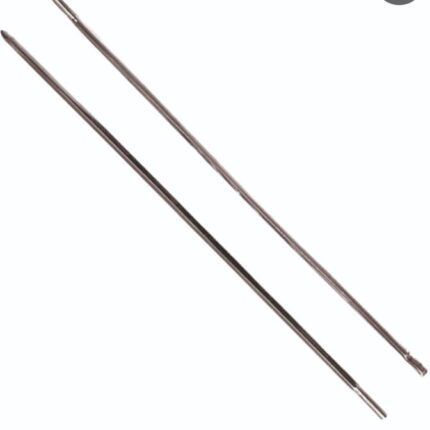
Round Files
Round files, specifically identified as Makita D-67359 4.0 mm round files.
Their main characteristics are:
Type: Round file.
Diameter: 4.0 mm.
Use: Designed for filing saw chains, particularly those with a 3/8″ P or 1/4″ pitch.
Behavior: They exhibit a smooth behavior.
File Angle: Ideal for a 30° file angle.
Compatibility: Suitable for various types of saw chains such as 25AP, 80TXL, 91VXL, 91P, 91PX, 91VX, and 91VG.
Blade Length: The blade length is 256 mm.
Shank Shape: Single-sided.

Distal Femoral Nail
The distal femoral nail (DFN) is an orthopedic implant used for the fixation of distal femoral fractures. Its main characteristics are:
Design and Dimensions:
- The DFN is available in various lengths (e.g., 160 to 420 mm) and diameters (e.g., 9.0 to 13.0 mm for the nail, and 13 mm for the proximal portion) to adapt to the patient’s anatomy.
- It can be curved to conform to the anterior femoral arch.
Locking and Stability:
Distal Locking: This allows for multiplanar fixation to increase stability, often with locking screws or spiral blades for a better contact surface.
Proximal Locking: Static and dynamic locking options are available, allowing immediate or secondary dynamization of the fracture.
Materials and Features:
- The DFN is designed to reduce friction and facilitate insertion through grooves, also increasing elasticity to avoid stress concentration.
- Short and long nails are available, with lateral or anteroposterior locking options depending on the length and fracture type.
- Some systems combine a nail and plate for more stable fixation in cases of complex fractures or poor bone quality, offering multiple fixation points.

Interlocking Tibia Nail
The characteristics of an interlocking tibia nail, such as the one shown, generally include the following:
Material: Made of stainless steel or titanium.
Dimensions:
Diameter: Available in several diameters, such as 8, 9, 10, and 11 mm.
Length: Typically ranges from 260 to 380 mm, with variations of 10 mm.
Type: Typically “Solid” type.
Design:
Each nail has a precisely calibrated diameter, such as 4.5 mm for femoral nails, making them suitable for various patient anatomies and fracture types.

Cannulated Humeral Nail
The cannulated humeral nail shown has several essential features for the treatment of humeral fractures:
Material: Typically made of titanium alloy (Ti6Al4V) or implant steel (ISO 58321E).
Design: It is cannulated, allowing for the insertion of a guide wire to facilitate placement. It can be slightly curved to accommodate humeral anatomy.
Locking Options: It offers multiple proximal and distal locking options for stable fixation of even short or complex fracture fragments. These options can include cancellous and cortical locking screws.
Dimensions: Available in several diameters (e.g., 7, 8, 9 mm) and lengths (e.g., 190 to 310 mm, varying by diameter) to accommodate different anatomies and fracture types.
Insertion: Can be introduced antegrade or retrograde, depending on the location and type of fracture.
Stability: The design and locking options are designed to provide robust fixation and axial stability, promoting bone healing.

Compression Screw
The characteristics of a compression screw, such as the DHS/DCS lag screw, are as follows:
Material: Generally made of surgical-grade stainless steel.
Design: Consists of a thread and a head, with a specific design to allow dynamic compression.
Function: Used to stabilize fractures, particularly proximal femoral fractures (dynamic hip screw or DHS) or distal femoral fractures (dynamic condylar screw or DCS), by allowing controlled sliding of the screw within a plate to promote compression at the fracture site.
Use: Designed to be inserted into bone, such as the femoral neck, and combined with a plate (e.g., DHS or DCS plate) that is secured along the bone.
Sterility: Screws intended for surgical use are sterile.
Dimensions: Available in various lengths and thread diameters to accommodate anatomical needs and fracture types.

Volary Locking Plate for Radius Fractures
The features of the Volary Locking Plate for Distal Radius Fractures include:
Anatomical Design and Low Profile: The plate is designed to conform to the anatomy of the distal radius, with a low profile to minimize soft tissue irritation.
Stable and Multi-Angle Fixation: It provides fixed or variable angle fixation, allowing for the stabilization of bone fragments in various configurations, including complex and osteoporotic fractures.
Material and Strength: These plates are generally made of biocompatible materials such as titanium, providing adequate strength and durability for bone fixation.
Multiple and Specific Holes: The plate features locking holes for angle-stable screws and oval holes for cortical screws, allowing for precise positioning and adjustments.
Surgical Use: Primarily used for the surgical treatment of complex intra-articular and extra-articular fractures of the distal radius, as well as for osteotomies.
Identification Markings: The plate may include markings such as “R” to indicate the side (right) and model/serial numbers, such as “Deffron 3 Hole ST240.003” shown in the image.

Security Locking Plate
Features of proximal radius security locking plates for the radial head rim include:
Material: Typically made of medical-grade stainless steel or titanium, ensuring biocompatibility and strength.
Anatomical Design: Specifically designed to conform to the curvature and anatomy of the proximal radius, providing an optimal fit.
Fixed or Variable Angle Locking: Provides stable fixation and prevents radial head collapse. Screws can be placed at fixed or variable angles for improved stability of the bone fragments.
Multi-Angle Fixation: Provides improved angular fixation of the radial head proximally.
Low Profile: Designed to minimize soft tissue irritation with beveled edges, rounded and polished surfaces, and countersunk screws.
Screw Holes: Often include locking holes for fixed-angle screws and combination holes for compression and locking screws.
Indications: Primarily used for the treatment of proximal radius fractures, including those affecting the radial head.

Reconstruction Plate
The characteristics of a Y-shaped reconstruction plate generally include the following:
Shape and Design: It is designed in a “Y” shape to accommodate specific anatomical configurations, often used for complex fractures or osteotomies requiring fixation in multiple directions, such as the calcaneus or pelvis.
Material: Made of high-quality stainless steel or titanium, providing biocompatibility and corrosion resistance.
Screw Holes: Multiple holes along the plate legs for the insertion of fixation screws, providing angular stability or compression, depending on the type of screw used (locking or non-locking).
Dimensions: Can vary in thickness, width, and hole spacing to accommodate different bone sizes and fracture types. For example, a Y-shaped reconstruction plate might be 2.0 mm thick, 9.6 mm wide, and have a 12.0 mm hole spacing, and be designed for 3.5 mm screws.
Applications: Used for internal fixation of fractures, osteotomies, or arthrodesis in areas such as the calcaneus, pelvis (especially the acetabulum), or distal fibula.

Pelvic Straight Locked Plate
The Pelvic Straight Locked Plate features are as follows:
Material: 316L / 316LVM stainless steel / Titanium.
Dimensions: Available in various sizes, from 2 to 20 holes (with a difference of one hole between each size).
Profile: 10.0 mm x 3.0 mm.
Hole spacing: 13.0 mm.
Screws: Compatible with 4.0 mm screws.
Use: Suitable for the pelvic ring, the medial and lateral aspects of the ilium, and posterior and anterior wall fractures.

Cerclage System
Features of the SuperCable® Iso-Elastic™ multifilament polymer cerclage system, shown in the image, include:
Iso-elasticity: Allows long-term dynamic compressive loading on bone fragments, promoting better healing and greater construct strength.
Superior fatigue resistance: Compared to metal cables and wires, reducing complications related to fracture.
Polymer cable: Eliminates metal contact with metal implants, the risk of sharps injuries, and glove tears.
Unique “no-crimp” locking mechanism: Allows for easy cable tightening, saving time in the operating room and reducing the number of cables required.
Biocompatibility: The cable is composed of UHMWPE strands braided over a nylon core, and the clasp components are made of titanium alloy.
Flexible Design: The polymer cable is flexible and has high fatigue and tensile strength.
Larger Footprint: The double-stranded cable can minimize penetration into soft bone.
Ease of Use: The polymer cable is easy to handle and can be quickly cut with a scalpel for rapid reinsertion in an emergency.

Femoral Intramedullary Nail
A femoral intramedullary nail is an orthopedic implant used for the fixation of femoral fractures, particularly femoral neck fractures.
Here are the main characteristics of this implant:
Implant Type: Femoral intramedullary nail, often referred to as the Femoral Neck Fixation System (FNS).
Targeted Joint/Bone: Femur, specifically the femoral neck for fractures.
Fixation Mechanism: It provides proximal and distal fixation using screws that pass through the nail and anchor into the bone.
Material: Made of titanium, a biocompatible and strong material.
Stability: Designed to provide improved angular and rotational stability, with the goal of reducing reoperations related to fixation complications.