


Femoral Head Prosthesis
The MOBIPOP® femoral head prosthesis has the following features:
Materials and Bearing Options: It is available with a ceramic/polyethylene or stainless steel/polyethylene bearing pair. The heads are made of stainless steel or BIOLOX®delta ceramic.
Sizes and Diameters: The implant range offers 12 different sizes. Femoral heads are available in several diameters, including Ø22.2 mm, Ø28 mm, Ø32 mm, Ø36 mm, and Ø40 mm (for BIOLOX®delta heads).
Taper: All femoral heads are generally compatible with a 12/14 taper, although 10/12 and 14/16 tapers are also available upon request.
Stability and Range of Motion: The double-cone design improves rotational stability, and the reduced neck geometry optimizes range of motion while reducing the risk of femoral fracture.
Use: These prostheses are implantable medical devices indicated for total hip arthroplasty. A wide range of bipolar heads is also available for partial hip replacement.

Femoral intramedullary nail
The characteristics of this femoral intramedullary nail are as follows:
Use: It is designed for internal fixation and stabilization of fractures of long bones, primarily the femur, tibia, and humerus. In the case of the femur, it is used for shaft fractures, subtrochanteric and intertrochanteric fractures, as well as femoral neck fractures.
Material: These nails are generally made of implant steel (ISO 58321E) or titanium (Ti6Al4V ELI ISO 5832-3).
Design: It is a rod-shaped device inserted longitudinally into the medullary cavity of the fractured bone. Better match the anatomy
Dimensions: Femoral intramedullary nails come in various sizes and diameters, for example, diameters of 10-14 mm and lengths of 320-500 mm. Shorter nails are also available, such as the short femoral reconstruction intramedullary nail (PFN).
Fixation: They allow for static, dynamic, compression, or reconstructive intramedullary osteosynthesis, depending on the fracture type and nail design. They can include proximal and distal locking screws for better stabilization.
Advantages: Femoral intramedullary nailing provides good fracture stabilization without excessive scarring and promotes good restoration of anterior function.

Femoral Intramedullary Nail
A femoral intramedullary nail is an orthopedic implant used for the fixation of femoral fractures, particularly femoral neck fractures.
Here are the main characteristics of this implant:
Implant Type: Femoral intramedullary nail, often referred to as the Femoral Neck Fixation System (FNS).
Targeted Joint/Bone: Femur, specifically the femoral neck for fractures.
Fixation Mechanism: It provides proximal and distal fixation using screws that pass through the nail and anchor into the bone.
Material: Made of titanium, a biocompatible and strong material.
Stability: Designed to provide improved angular and rotational stability, with the goal of reducing reoperations related to fixation complications.
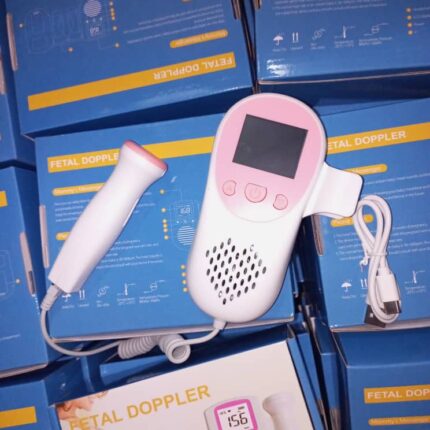
Fetal Doppler
his professional-grade fetal doppler is designed for accurate, safe, and convenient fetal heart monitoring with the following features:
1. High-Performance Probe
-
High sensitivity for early detection (typically from 12 weeks)
-
Precision accuracy (±1 BPM) in heart rate measurement
-
Ergonomic design for comfortable handling
2. Superior Audio Quality
-
Adjustable volume control with high-fidelity sound output
-
Noise reduction technology for clear fetal heartbeat detection
-
Dual audio modes:
-
Built-in speaker for shared listening
-
Earphone jack for private monitoring
-
3. User-Friendly Display
-
Backlit LCD screen for clear visibility in all lighting conditions
-
Real-time fetal heart rate (FHR) display
-
Battery level indicator
4. Safe & Hygienic Design
-
Radiation-free operation (ultrasound power <10mW/cm²)
-
Medical-grade ABS plastic construction:
-
Durable & impact-resistant
-
Easy to clean & disinfect
-
5. Power & Portability
-
Rechargeable lithium battery (4-6 hours continuous use)
-
USB charging for convenience
-
Compact & lightweight for clinic or home use
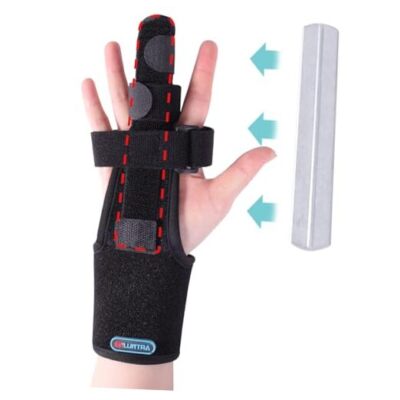
Finger Splint
Features of a finger splint, like the one pictured, typically include the following:
Materials: Made from composite fabrics, neoprene, nylon, foam, and/or aluminum for support and comfort.
Design:
Contoured, streamlined design, often adjustable to fit the user’s body shape.
May include an aluminum splint or splints to stabilize the finger or thumb.
Adjustable straps (often hook-and-loop) at the wrist and/or fingers for a custom fit and secure fixation.
Some models are reversible, suitable for both left and right hands.
Comfort and Breathability:
Soft, lightweight, breathable, and moisture-wicking materials keep the hand cool and dry.
May feature ventilation holes to reduce heat.
Function:
Provides moderate support and immobilization of the injured or painful finger or thumb joint.
Relieves pain associated with arthritis, tendonitis, sprains, strains, carpal tunnel syndrome, trigger thumb, etc.
Generally allows free movement of unaffected fingers.
Easy to apply and adjust, setimes with one hand.
Care: Often hand-washable for hygiene.


Finger Splints
The featured finger splint, commonly used for conditions such as trigger finger or fractures, has several key features:
Built-in support: It often features aluminum foil or a built-in rigid support to immobilize and support the affected finger, preventing flexion and promoting healing.
Breathable and comfortable material: Made from materials such as neoprene, stretch nylon, and cotton, it ensures all-day comfort and wicks away moisture.
Adjustable fit: Velcro straps allow the splint to be adjusted to fit different finger and palm sizes, providing a secure fit and a customized fit.
Pain relief: By limiting finger movement, it helps reduce inflammation and relieve pain associated with various injuries such as sprains, fractures, arthritis, or tendonitis.
Versatile use: It can be worn day or night, while working or sleeping, and is designed for various finger injuries, including broken or sprained fingers.
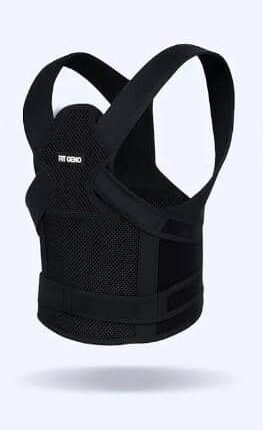
Fit Geno back brace posture corrector
- Fit Geno Back Brace Posture Corrector for Women and Men
- Shoulder Straightener
- Adjustable Full Back Support
- Upper and Lower Back Pain Relief – Scoliosis
- Hunchback, Hump, Thoracic, Spine Corrector

Fixed Ultrasound Machine – Model DW-370 from Dawei Medical.
Advanced Digital Ultrasound System
-
Type: High-definition, cart-based multifunctional diagnostic ultrasound
-
Display: 15″ LED monitor with superior imaging clarity
-
Probe Connectivity: 3-socket configuration for multi-probe versatility
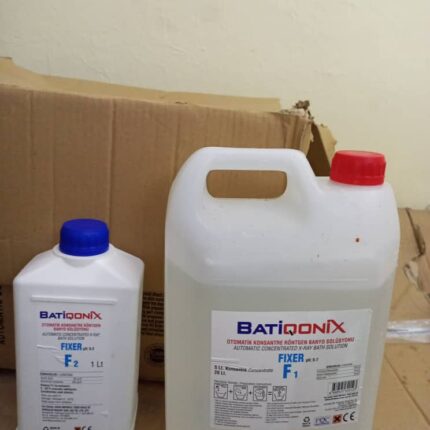
Fixer
Product Type:
Concentrated Fixer Solution for Automatic X-Ray Processing Systems
Intended Use:
Essential for the final stage of X-ray film development, the BATIQONIX Fixer enhances image clarity, contrast, and overall quality by stabilizing and preserving the developed image.
Composition:
Formulated with premium chemical components to deliver consistent and reliable results during sensitive radiographic processing.
Available Volumes:
-
1-Liter Bottle (F2)
-
0.5-Liter Bottle (F1)
(Additional sizes may be available as shown in product visuals)

fixing element 4 mm hole with centrally tapped bore
Mark the center: Use a center punch and hammer to create a small dimple where the hole will be drilled. This prevents the drill bit from wandering.
Chamfer the hole: Create a small chamfer on the edge of the pilot hole. This helps the tap enter the hole more easily and prevents burrs from interfering with the threads.
2. Drilling
Select the correct drill bit: For a 4mm tapped bore (which usually indicates an M4 thread), a pilot hole drill size of 3.3 mm is needed.
Drill the pilot hole: Securely hold the material and the drill at a right angle to the surface. Use a low drill speed to maintain control and prevent the bit from breaking.
3. Tapping
Secure the tap: Attach the tap to a tap handle or a drill press.
Start the tap: Align the tap with the center of the pilot hole and begin turning it by hand or using the drill press.

Flat-Bottom Flask
Flat-Bottom Flask, Borosilicate Glass 3.3
Engineered for stability and resilience, our flat-bottom flasks are essential glassware for a wide range of laboratory procedures. Crafted from high-quality borosilicate glass 3.3, they are built to perform under demanding conditions.
Key Features & Benefits:
-
Superior Stability: The flat base provides a secure, non-tipping foundation on any flat surface. This makes them the ideal choice for heating solutions on a hotplate, long-term storage, and general mixing tasks where safety is paramount.
-
Exceptional Durability: Manufactured from borosilicate glass 3.3, these flasks offer high resistance to chemical corrosion, thermal shock, and mechanical stress. They can withstand high temperatures, ensuring reliability for even the most rigorous applications.
-
Unmatched Versatility: A workhorse in any lab, these flasks are perfectly suited for preparing and mixing solutions, heating or boiling liquids, distillation setups (when used with a distillation bridge), and safely storing chemicals.
-
Precision Design: Featuring uniform wall thickness for consistent heat distribution and enhanced safety. The clear glass allows for easy observation of contents and reaction progress.
-
Available Sizes: Offered in a range of standard capacities including 250ml and 500ml to meet the precise needs of your experiment.
Ideal for: Solution preparation, heating, reflux, storage, and educational demonstrations.
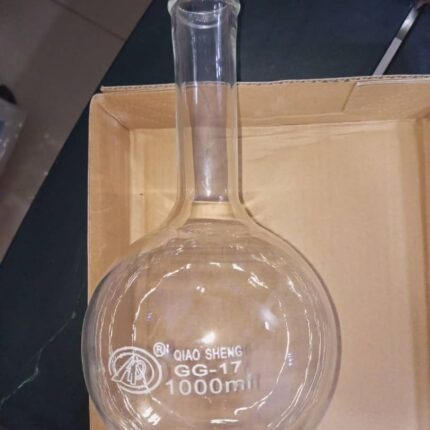
Flat-bottomed flask 1000 ml
The QIAO SHENG GG-17 1000 ml laboratory flask has the following features:
Model: GG-17
Flask Type:
This is a flat-bottomed flask, which provides optimal stability and allows it to stand unsupported on a flat surface, such as a hot plate or laboratory stand.
Materials:
It is made of borosilicate glass, known for its high temperature resistance and good transparency.
Capacity:
The flask has a capacity of 1000 ml, as indicated by the “1000 ml” marking on the glass.
Use:
Flat-bottomed flasks are commonly used in laboratories for processes requiring uniform heating or as reaction vessels.