

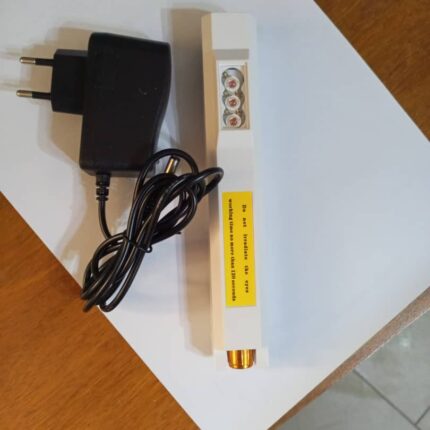
Infrared Vein Finder
It uses infrared light to project an image of blood vessels onto the skin’s surface, allowing for precise and rapid visualization of the venous network.
Safety:
It is designed to be safe, without nuclear radiation or high-power lasers, and limits the risk of cross-infection thanks to its non-contact operation.
Customizable Settings:
It offers one display option, such as one color mode suitable for different skin tones, five brightness levels to adjust the projected image, and different image sizes or detection depths.
Ergonomic and Portable Design:
It is designed to be comfortable to hold and small enough to be easily transported, making it convenient for clinical or home use.
Ease of Use
The device is generally easy to use and learn, with intuitive controls.
Versatility:
It can be used for various medical procedures requiring venous access, such as injections, blood sampling, and infusions, and is suitable for different types of patients (infants, obese patients, the elderly, etc.).
Power Supply:
The device is rechargeable and comes with a power adapter for charging, as shown in the image.
Precautions for Use:
It is important not to irradiate the eyes directly and not to exceed a continuous operating time of 120 seconds.

Dual-Sensor Pulse Oximeter
MODEL: CMS60D
The Contec CMS60D handheld pulse oximeter.
Its main features are:
Measurements and Display: It measures blood oxygen saturation (SpO2) and pulse rate. It displays these values, along with a pulse bar graph and a plethysmographic curve, on a color OLED display.
Design and Portability: It is small, lightweight, and easy to carry.
Ease of Use and Consumption: It is simple to use and has low power consumption, allowing for long battery life (up to 32 hours).
Advanced Features:
Adjustable display brightness.
Review and clock functions.
Alarms for exceeded measured data limits and low voltage (low battery).
Ability to store data (up to 72 hours and 10 patients) and transfer it to a computer via a USB cable and dedicated software.
Sensors: It comes with an integrated SpO2 probe and can be used with different sensors (adult, pediatric, neonatal) as needed.
Accuracy: It ensures accurate measurement even in low pulse rate conditions (up to 0.4%) and is resistant to ambient light.

Centrifuge
MODEL: 80-1
DESCRIPTION
It offers several key features:
Capacity and Speed
It is designed for a capacity of 80 ml and can reach a maximum speed of 4000 revolutions per minute (rpm).
Use:
This model is commonly used in various laboratory applications, including hospitals, chemistry, and biology for analytical experiments.
Features:
It is equipped with a variable speed control and a timer, and can accommodate six 20 ml tubes.
Design:
The 80-1 centrifuge is described as a versatile and reliable piece of equipment for laboratories.

Heating Mantle
The 250 ml laboratory heating mantle.
Key Features:
Capacity: Designed to heat round-bottomed flasks with a capacity of 250 ml.
Temperature Control: It is equipped with electronic temperature control, allowing precise heating control.
Maximum Temperature: Can reach a maximum temperature of 370°C, or even 450°C for some models.
Power: Typically 150 W.
Construction: Chemical-resistant steel or polypropylene outer shell, with thermal insulation made of mineral fiber wool or molded silica.
Safety: Some models include protective fuses and a “cool-touch” outer casing to minimize the risk of burns.
Additional Features: Some heating mantles of this capacity can also incorporate magnetic stirring, allowing the contents of the flask to be heated and stirred simultaneously.
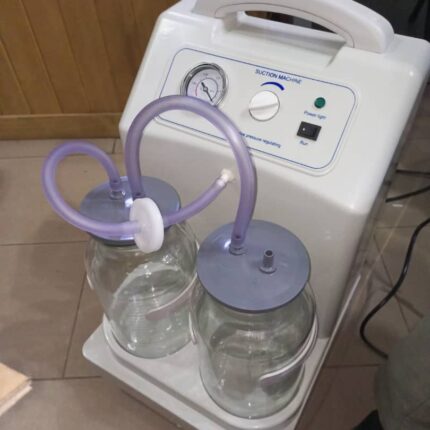
Two-jar Surgical Aspirator
MODEL: YX930D
The image shows a YX930D Surgical Aspirator.
Its main features are as follows:
Design and Mobility:
Fully plastic panel, unique and aesthetic design.
Easily transportable thanks to its compact design and weight (approximately 19.5 kg).
Mounted on casters for easy movement between departments.
Suction Performance:
Uses an oil-free vacuum pump, providing high flow rate and rapid negative pressure, without pollution.
Maximum negative pressure: ≥0.09 MPa (680 mmHg).
Flow Rate: ≥40 L/min.
Features and Safety:
Two 2500 ml glass fluid collection jars, each with an overflow prevention device to prevent liquid from entering the pump.
Air filter to protect the pump from pollution.
Suction control via a hand switch and/or foot pedal, providing hands-free operation.
Low noise level (≤60dB(A)).
Use:
Designed for suctioning liquids (mucus, blood) in surgical or intensive care settings.

Water Bath
MEDELE: DK-420
DESCRIPTION
The DK420 water bath is a laboratory appliance designed for heating and incubating samples at a controlled and stable temperature.
Key Features of the DK-420 Water Bath:
Temperature Control: It is equipped with a digital thermostat that allows precise and automatic temperature control, with a digital display for easy reading. The typical temperature range extends from room temperature +5°C to 99°C or 100°C.
Design and Materials: The DK420 water bath features two stainless steel tanks for corrosion resistance and ease of cleaning, and a high-quality outer casing, sometimes made of powder-coated sheet steel.
Safety and Performance: Heating with a water bath prevents sample burnout, ensuring gentle and uniform heating.
Applications: It is widely used in laboratories for applications such as distillation, concentration, drying, incubation, tempering of emulsions or solutions, and temperature testing.
Technical specifications (example based on similar models):
Capacity: 10 liters for the DK-420 model.
Power: 1000W.
Timer: Includes a timer function, ranging from 0 to 999 minutes.
Voltage: Available in various voltages, such as 110V 60Hz or 220V 50Hz.

Visual Acuidity Chart
The standard logarithmic visual acuity chart, also known as the modified Snellen chart or LogMAR (Logarithm of the Minimum Angle of Resolution) chart.
Primary Use: This chart is used to assess a person’s visual acuity, i.e., the sharpness of their vision.
Structure: It displays “E” letters of various sizes and orientations (up, down, left, or right) across several lines. The letters decrease in size as you move down the chart.
Formulas: The chart includes formulas for calculating visual acuity (V) and design distance (D), as well as the LogMAR (L) value, which is a logarithmic measure of visual acuity.
Test Distance: A design distance of 2.5 meters is specified for the test.
Additional Tests: At the bottom of the table, there are circles with colored numbers, suggesting an integrated color vision test (Ishihara type) to detect potential deficits.
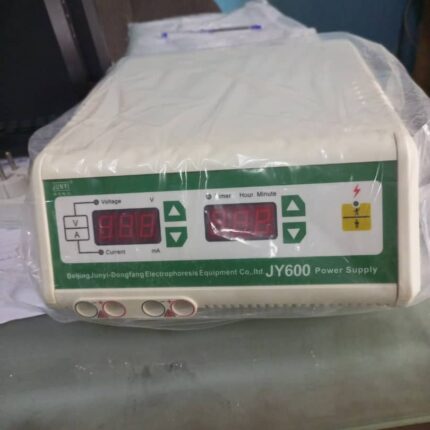
Electrophoresis Device
MODEL: JY600
DESCRIPTION:
The specifications of the JY600 electrophoresis power supply are as follows:
Output Type: Constant Voltage or Constant Current.
Output Range:
Voltage: 5 to 600 V.
Current: 1 to 200 mA.
Maximum Power: 120 W.
Resolution: 1 V, 1 mA.
Timer Range: 1 minute to 9 hours and 59 minutes.
Display: Dual LED digital display showing voltage, current, and power values.
Control: Intelligent microprocessor control unit.
Protection Functions: Automatic detection of no-load, overload, short circuit, rapid resistance change, ground leakage, and system overheating.
Other features:
Automatic memory function.
Automatic switching function.
Touch control panel.
Two sets of output jacks.
Molded shell.
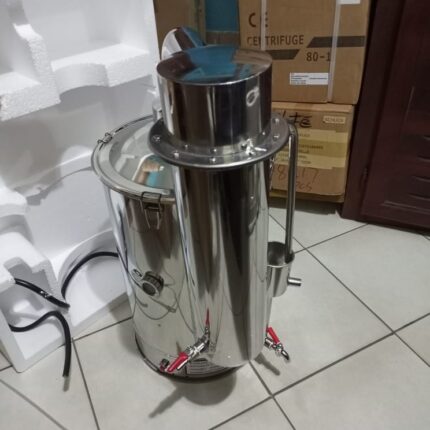
Water Distiller
Available in 10 and 20 liters
The laboratory stainless steel electric water distiller.
Here are its main features:
Material: Made of high-quality stainless steel.
Safety: Automatically cuts off the heating power supply in case of water shortage.
Condensation: Coil-type condensation structure for good cooling effect and high water production.
Water Saving: Cooling water returns to the evaporation barrel to save water resources.
Maintenance: Drain valve to drain concentrated water and improve scaling conditions.
Heating: Copper immersion heating tube with high thermal efficiency and long service life.
Capacity and Power: Available in different capacities (10L, 20L) with corresponding power ratings (e.g., 4.5 kW for 20L/h). Certifications: CE and ISO certified.

Water Distiller
The water distiller shown in the image has several typical features:
Main Function: It is designed to produce distilled water by heating water to 100°C to transform it into vapor, then condensing it back to a liquid state, thus removing impurities.
Capacity: 5 liters and can produce approximately 1 liter of distilled water per hour.
Materials: The interior is made of high-quality stainless steel to ensure the hygiene and purity of the distilled water.
Safety: It is equipped with safety features such as automatic shutoff in case of overheating or insufficient water level, thus protecting both the device and the user.
Design: It is compact and easy to use and clean, with components accessible for maintenance.
Applications: The distilled water produced is suitable for a variety of uses, including medical institutions, laboratories, battery factories, beauty salons, and household use.

Endoscopy Video Processor SV-M2K30
The Endoscopy video processor SV-M2K30 offers advanced imaging capabilities for precise medical diagnostics. It delivers high-resolution visuals, supporting both HD and 4K imaging for enhanced clarity during endoscopic procedures.

HF-300 ventilators are pneumatic and microcomputer controlled
This HF-300 ventilators are pneumatic and microcomputer controlled. They are mainly A / C, SIMV, PSV, Spont, MMV, IPPV, SIGH, PEEP etc, which can set Freq., Inspiration time, Respiration hold time etc parameters to keep management for respiration, the main parts of the machine are imported in high quality level, which greatly improves the reliability and stability of the machine. The machine is reasonable in structure, convenient in operation and reliable in performance, and is suitable for emergency, ICU ward and other respiratory rescue and treatment.
Please read user’s manual before operating.
Main performance and technical index
1.
Ventilation mode and composition:
the ventilator is composed of main unit, humidifier, circuit and oxygen regulator.
Ventilation modes: A/C,SIMV,PSV,SPONT,MMV,IPPV,SIGH, PEEP;
2. Air circuit performance:
a) Maximum safety pressure of air circuit: no more than 12kpa.
b) Inspiratory oxygen concentration: 40-100% ± 15%.
c) The maximum working pressure is not greater than the upper pressure limit.
3. Ventilation performance:
a) Respiratory frequency (f): 4-99 times / min, error ± 15%.
b) Inspiratory time (TI): 0.2-6s, less than 1s ± 0.15s, and other errors ± 15%.
c) Breath holding time (TP): 0-2s, less than 1s ± 0.15s, and other errors ± 15%.
d) Trigger pressure (PT): – 2KPa~0kpa. When the inspiratory trigger pressure is – 2KPa to – 1kPa, the tolerance is ± 20%; when the inspiratory trigger pressure is – 1kPa to 0kpa, the tolerance is ± 200Pa.
e) Tidal volume (VT): 0-2000ml; when 0ml-200ml, display value tolerance ± 40ml; when 200ml-2000ml, display value tolerance ± 20%.
f) Maximum minute ventilation volume: not less than 18L / min.
g) PSV: 2-5kpa, error ± 20%
h) Peep pressure: 0.0kpa ~ 3.0KPa. When 0.0kpa-1.0kpa, the tolerance is ± 0.2kpa; when 1.0kpa-3.0kpa, the tolerance is ± 20%
i) SIMV frequency: 4-99 times / min, error ± 15%.
4. Alarm performance:
a) Pressure upper limit (PH) alarm: 2-6kpa, error ± 20%, audible and visual alarm.
b) Pressure lower limit (PL) alarm: 0.0kpa ~ 4.0kpa. When 0.0kpa-1.0kpa, the tolerance is ± 200Pa; when 1.0kpa-4.0kpa, the tolerance is ± 20%. When the airway pressure is lower than the set value of the lower pressure limit for 5s-15s, there shall be an audible and visual alarm.
c) Upper ventilation limit (MVH) alarm: audible and visual alarm when ventilation is higher than the set value.
d) Low ventilation limit (MVL) alarm: audible and visual alarm when ventilation is lower than the set value.
e) Power off alarm: power off alarm shall be given immediately, and the alarm duration shall not be less than 120s.
f) Insufficient air, insufficient oxygen alarm
g) Mute: no more than 2 minutes.
5. Monitoring performance:
a) Tidal volume (VT): 0-2000ml, 0ml-200ml, display value tolerance ± 40ml; 200ml-2000ml, display value tolerance ± 20%.
b) The measured total frequency (ftot) and autonomous frequency (fspont).
c) Minute ventilation (MV).
d) I: E ratio.
e) Peak pressure (Ppeak).
f) Peep pressure: 0.0kpa ~ 3.0KPa. When 0.0kpa-1.0kpa, the tolerance is ± 0.2kpa; when 1.0kpa-3.0kpa, the tolerance is ± 20%.
6. Overall performance:
a) Power supply: AC 220V ± 22v.50hz ± 1Hz.
b) Main unit input power: 90va.
c) Electrical safety: Meet the relevant requirements of GB9706.1-1995 medical electrical equipment Part I: General requirements for safety for class I type B equipment.
d) Noise of the whole machine: no more than 65dB (a).
e) System compliance: no more than 4ml / 100Pa.
7. Service conditions:
a) Ambient temperature: + 5 ℃ ~ + 40 ℃.
b) Relative humidity: 30% – 75%;
c) Atmospheric pressure: 96-104kpa.
d) Use air source, 0.28-0.6mpa, flow rate > 60L / min.
e) Preheating time: 5 minutes.
8. Dimension: 375 × 320 × 300 mm.
9. Net weight: 16KG.
10. Storage and transportation:
The temperature range of normal storage and transportation of this product is – 15 ℃ ~ + 40 ℃;
Relative humidity is not more than 75%, atmospheric pressure range is 50kPa ~ 106kpa, there should be no acid, alkali and corrosive gas in the room, and there should be no strong mechanical vibration, impact, strong magnetic field and well ventilated place. During transportation, it should be moisture-proof, handle with care, and pay attention to direction signs.