

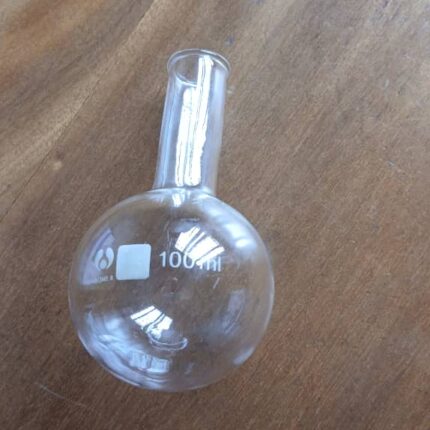
Flat-bottomed flask 100ML
The flat-bottomed flash, 100 ml laboratory flask has the following features:
Flask Type:
This is a flat-bottomed flask, which provides optimal stability and allows it to stand unsupported on a flat surface, such as a hot plate or laboratory stand.
Materials:
It is made of borosilicate glass, known for its high temperature resistance and good transparency.
Capacity:
The flask has a capacity of 100 ml, as indicated by the 100 ml” marking on the glass.
Use:
Flat-bottomed flasks are commonly used in laboratories for processes requiring uniform heating or as reaction vessels.

Flat-bottomed flask 250ML
The flat-bottomed flash, 250 ml laboratory flask has the following features:
Flask Type:
This is a flat-bottomed flask, which provides optimal stability and allows it to stand unsupported on a flat surface, such as a hot plate or laboratory stand.
Materials:
It is made of borosilicate glass, known for its high temperature resistance and good transparency.
Capacity:
The flask has a capacity of 250 ml, as indicated by the 250 ml” marking on the glass.
Use:
Flat-bottomed flasks are commonly used in laboratories for processes requiring uniform heating or as reaction vessels.
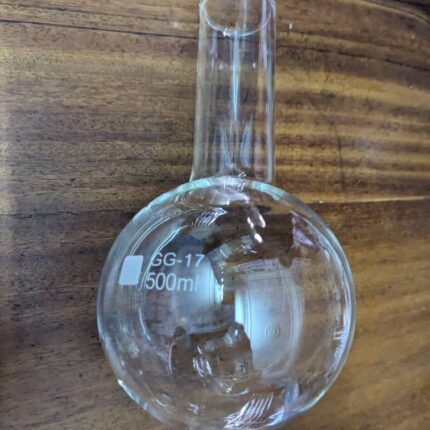
Flat-bottomed flask 500ML
Model: GG-17
The QIAO SHENG GG-17, 500 ml laboratory flask has the following features:
Flask Type:
This is a flat-bottomed flask, which provides optimal stability and allows it to stand unsupported on a flat surface, such as a hot plate or laboratory stand.
Materials:
It is made of borosilicate glass, known for its high temperature resistance and good transparency.
Capacity:
The flask has a capacity of 500 ml, as indicated by the 500 ml” marking on the glass.
Use:
Flat-bottomed flasks are commonly used in laboratories for processes requiring uniform heating or as reaction vessels.

Folding Massage Table
Folding Massage Table – Professional Portable Treatment Solution
Key Features:
✔ Durable & Lightweight Design –
-
Aluminum frame for strength (supports up to 90 kg)
-
Leatherette upholstery (wipe-clean & hypoallergenic)
✔ Enhanced Comfort –
-
Adjustable height for practitioner/client ergonomics
-
Face cradle with removable cover + optional armrests
✔ Portability –
-
Folds compactly with carrying handle & storage bag
-
Net weight: [X] kg (easy transport)
✔ Versatile Use –
-
Ideal for massage therapy, physiotherapy, tattooing, aesthetics

Folding Stretcher
Folding Stretcher – Portable Emergency Transport Solution
Key Features:
✔ Compact & Lightweight Design
-
Folds flat for space-efficient storage in ambulances/ERs
-
Aircraft-grade aluminum frame (high strength-to-weight ratio)
-
600D Oxford cloth (tear-resistant & easy to disinfect)
✔ Patient Safety
-
4-point restraint system (adjustable straps)
-
Side rails prevent rolling (optional models)
✔ Versatile Applications
-
Hospitals: Patient transfers between wards
-
EMS/Search & Rescue: Mountain/confined-space extraction
-
Sports: On-field injury management
Technical Specs:
-
Load capacity: [X] kg (typically 150-200kg)
-
Folded dimensions: ~15×50×100cm (varies by model)
-
Weight: ~8-12kg
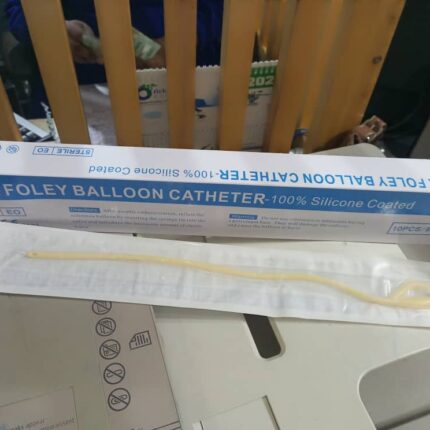
Foley Catheter
The Foley catheter
is a 100% silicone-coated latex Foley balloon catheter, sterile and packaged in boxes of 10.
Key Features:
Material: It is made of latex with a 100% silicone coating, which helps reduce irritation and the risk of encrustation.
Sterility: It is supplied sterile (indicated by “STERILE EO” on the packaging), guaranteeing the absence of live microorganisms before use.
Use: It is an indwelling urinary catheter used for the drainage of urine from the bladder, particularly in cases of incontinence, urinary retention, or during surgical procedures.
Design: It features an inflatable balloon at the distal end that, when inflated with a sterile solution (e.g., sterile water), ensures it is securely held in the bladder.
Ports: Foley catheters generally have two ports: one for urine drainage and another for balloon inflation.
Sizes: Available in various sizes (classified according to the French system, 14F, 18F), with balloon volumes of varying sizes (e.g., 5 ml for standard use).

Fridge Thermometer
The features of the probeless refrigerator thermometer are as follows:
Type: Digital refrigerator and freezer thermometer.
Measuring range: -50°C to +70°C (-58°F to +158°F).
Features:
Temperature display in Celsius (°C) or Fahrenheit (°F).
Max/Min temperature recording function.
Reset button (CLR) to clear Max/Min recordings.
Large LCD display for easy reading.
Indication for battery replacement when the LCD display becomes blurred.
Power supply: Requires one CR2032 battery.
Accuracy: ±1°C (±2°F).
Resolution: 0.1°C (0.2°F).
Placement: Can be hung using an integrated hook or placed on a wall.
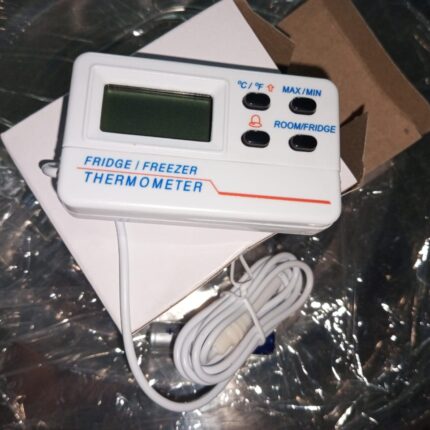
Fridge Thermometer
The features of this digital refrigerator/freezer thermometer are as follows:
Product Type: Digital refrigerator and freezer thermometer.
Features:
Temperature display in °C and °F.
MAX/MIN functions to record maximum and minimum temperatures.
Displays room temperature and refrigerator/freezer temperature.
Temperature alarm to prevent health risks associated with exceeding thresholds.
Measuring Range: Typically -50°C to +70°C.
Design: Equipped with a probe and cable to measure the temperature inside the refrigerator or freezer.

Full Field Digital Mammography
Model: MAM VENUS +
Ratings: 5 KW
Series: VENUS DRV+
Special Features:
Economical solution in digital mammography.
Full field digital mammography with FPD.
Auto release of breast compression after exposure.
AEC with zero point exposure technique.
Integra X : Integrated system console for exposure parameters and image
parameters control.
2 MP medical display monitor.
Additional reporting workstation (optional).

GAMMA-GT LR
The GAMMA GT LR diagnostic kit is a kit for measuring gamma-GT in serum or plasma using the SZASZ method.
Main characteristics:
Product type: In vitro diagnostic (IVD) medical device.
Enzyme measured: Gamma-glutamyl transferase (Gamma-GT or GGT).
Method: SZASZ method.
Sample: Serum or plasma.
Product reference (REF): 10228.
Batch number (LOT): 5835D.
Contents: The kit includes two reagents: R1 (5 x 40 ml) and R2 (1 x 50 ml).
Storage conditions: Between 2°C and 8°C.
Manufacturer: SGM Italia srl, based in Rome, Italy.
Certification: CE marked.
Intended Use: For the diagnosis and monitoring of hepatobiliary diseases by healthcare professionals in the laboratory.
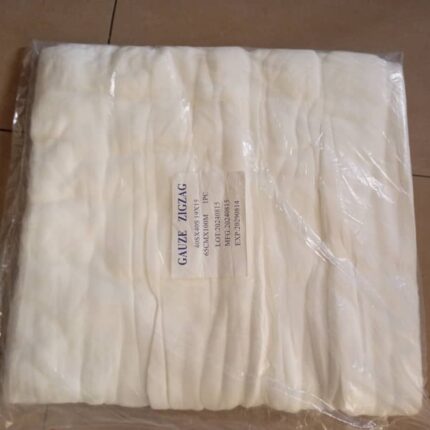
Gauze Compress
The specific characteristics of the gauze compress are as follows:
Gauze type: Zigzag gauze.
Dimensions: 65 cm x 100 m.
Weave: 40S x 40S, 19 x 15 threads (weave density).
Packaging: IPC (Individually Packed).
Batch number: 2024081.
General characteristics of gauze compresses:
Gauze compresses, like the one shown, are medical devices commonly used for wound care and hygiene.
Composition:
They are generally made from absorbent cotton, which makes them soft and absorbent.
Use:
They are intended to absorb bleeding and exudate, clean and disinfect wounds, or make dressings.
Sterility:
They can be sterile (for surgical procedures or infected wounds) or non-sterile (for daily care without the risk of infection).
Folding:
A surgical fold with tucked edges is often used to prevent fraying and minimize the risk of irritation or contamination.
Absorbency:
Their woven structure ensures high liquid absorption capacity.

Gelpi Self-Retaining Retractor
The surgical retractor is a self-retaining retractor of the Gelpi or Williams type.
Characteristics and Uses:
Instrument Type: This is a self-retaining (or self-retaining) surgical retractor, meaning it can remain in place without being constantly held by the surgeon or an assistant.
Primary Function: Its role is to retract tissue, muscles, or organs to create a clear field of vision and sufficient access to the surgical site during a procedure.
Design: It has curved or hook-shaped prongs at the ends, designed to grasp and hold retracted tissue. A locking mechanism (often a ratchet or ratchet) maintains the desired retraction.
Material: Typically made of surgical-grade stainless steel, which is resistant to corrosion and sterilization.
Applications: Commonly used in various surgical specialties, including orthopedics and neurosurgery, for procedures requiring deep or superficial tissue retraction, such as spinal access or femoral surgery.