

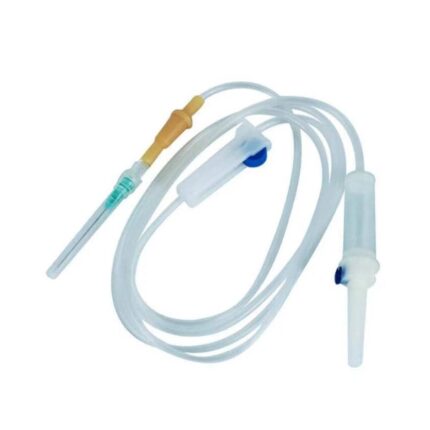
Infusion Pump
Here are the main features of an infusion set:
Essential Components:
Vented Spike: Allows the bottle or solution bag to be pierced and ensures an air inlet for a smooth flow.
Drip Chamber: Allows the flow rate of drops to be visualized and is equipped with a filter to prevent the entry of particles.
Flexible Tubing: Made of medical-grade PVC, it transports the liquid from the bottle to the patient.
Flow Regulator: Allows precise adjustment of the rate of liquid administration.
Injection Site (or Y-Port): An access point for injecting additional medication without interrupting the main infusion.
Luer Lock or Luer Slip Connector: Ensures a secure connection to the needle or catheter inserted into the patient’s vein.
Needle or Catheter: The end inserted into the vein for fluid administration.
Materials: Made from medical-grade materials, soft, non-toxic, and non-bendable PVC.
Sterilization: Sterilized with ethylene oxide to ensure patient safety.
Single Use: Designed for single use only to prevent cross-infection.
Function: Administers fluids, medications, or nutrients directly into the patient’s bloodstream intravenously.

Infusion Splint
The item shown is a Chrisofix infusion splint, designed for immobilizing the wrist and hand during intravenous therapy.
Its key features include:
Secure and Adjustable Immobilization: It features dual hook-and-loop fasteners for secure and customized fixation, preventing hand movement and thus infusion needle displacement.
Ergonomic Design: The splint is designed to hold the wrist, forearm, and hand in an ideal position for IV therapy, reducing the risk of complications such as infiltration or extravasation.
Quality Materials: Made from soft and comfortable materials, it often features an aluminum or PE (polyethylene) core for durability and malleability, allowing for easy adjustment to the shape of the limb.
Ease of Use and Maintenance: The splint is easy to apply and adjust. Some versions have washable covers or are made of sweat-resistant materials that can be cleaned for reuse.
Infusion site visibility: Unlike traditional opaque splints, some infusion splints, such as the TLC Wrist Splint mentioned in the results, feature openings or a transparent design to allow caregivers to monitor the infusion site and quickly detect signs of complications.
Versatility: Available in various sizes to accommodate various age groups (children, adolescents, adults) and often ambidextrous for use on either hand.
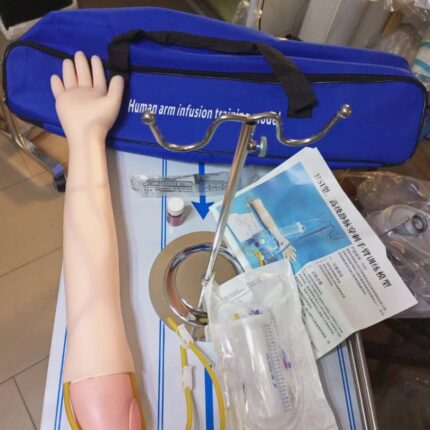
Injection Arm
The IV arm training model, like the one depicted, typically includes these features:
Realistic Design:
Mimics a human arm with adjustable skin and veins, offering a lifelike experience for practicing injections, blood draws, and infusions.
Authentic Puncture Feedback:
Replicates the sensation of needle insertion, including a distinct “pop” and simulated blood return upon correct vein puncture.
Durable and Reusable:
Constructed from high-quality materials, it endures hundreds of punctures without leaking, with self-sealing skin for repeated use.
Included Accessories:
Comes equipped with essential components for comprehensive training, such as an arm stand, fluid containers, and artificial blood.
Versatile Training:
Supports practice of multiple techniques, including IV injections, catheter placement, and blood collection.

Instruments TLIF PEEK Cage
L’ensemble d’instruments TLIF PEEK Cage est un ensemble d’instruments chirurgicaux orthopédiques spécialisés, principalement utilisé pour la chirurgie de fusion intersomatique lombaire transforaminale (TLIF).
Caractéristiques principales :
Matériaux de haute qualité : Les instruments sont fabriqués à partir de matériaux durables, y compris l’acier inoxydable et le PEEK de qualité médicale (Polyétheréthercétone) pour les cages.
Précision et exactitude : Conçus pour permettre aux chirurgiens d’effectuer la procédure TLIF avec une grande précision.
Facilité d’utilisation : L’ensemble est conçu pour être convivial, simplifiant les étapes complexes de la chirurgie de fusion spinale.
Personnalisation : Offre une variété d’options d’instruments pour répondre aux besoins et préférences spécifiques des équipes chirurgicales.
Stérilisation : Les instruments sont conçus pour être facilement stérilisables, assurant l’hygiène et la sécurité lors des procédures chirurgicales.
Application : Principalement utilisé en chirurgie de la colonne vertébrale pour des conditions telles que la maladie dégénérative du disque, la sténose spinale et le spondylolisthésis.
Fonction de la cage TLIF PEEK : La cage PEEK est insérée dans l’espace discal après le retrait du disque blessé, visant à restaurer et maintenir la hauteur discale normale, à fournir une stabilité et à favoriser la fusion vertébrale. Elle est également radiotransparente pour un suivi postopératoire aisé.
Contenu de l’ensemble: Comprend généralement des instruments tels que des alésoirs, des forets, des curettes, des inséreurs d’implants, des écarteurs nerveux et des écarteurs d’espace discal.

Interlocking Tibia Nail
The characteristics of an interlocking tibia nail, such as the one shown, generally include the following:
Material: Made of stainless steel or titanium.
Dimensions:
Diameter: Available in several diameters, such as 8, 9, 10, and 11 mm.
Length: Typically ranges from 260 to 380 mm, with variations of 10 mm.
Type: Typically “Solid” type.
Design:
Each nail has a precisely calibrated diameter, such as 4.5 mm for femoral nails, making them suitable for various patient anatomies and fracture types.

Intramedullary nails
The intramedullary nails shown, whether long or short, are orthopedic implants used to stabilize long bone fractures. Their main characteristics are:
Materials: They are generally made of titanium alloy or surgical stainless steel, biocompatible materials resistant to corrosion and mechanical stress.
Design:
Long nails: Designed for diaphyseal (central portion) fractures of long bones, such as the femur or tibia.
Short nails: Used for proximal fractures, such as those of the proximal humerus or proximal femur (subtrochanteric or intertrochanteric fractures).
Locking: They are equipped with locking screws (e.g., 4.5 mm) that pass through the bone and the nail to ensure stable fixation of the fracture and prevent rotation or shortening.
Functionality:
Cannulated: Many nails are cannulated, allowing for the insertion of a guide wire during surgery for precise positioning.
Indications: Their use varies depending on the patient’s age, the site, and the type of fracture, including diaphyseal and metaphyseal fractures, and nonunions.
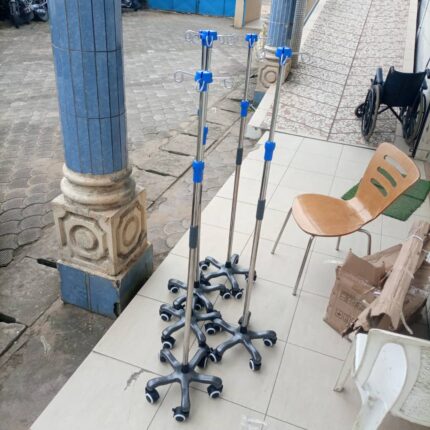
IV pole
- Medical IV poles, also known as IV poles or IV stands, are used in healthcare facilities to hang intravenous (IV) fluid bags or other solutions to be administered to patients.
- They are height-adjustable to accommodate different situations and are equipped with casters for easy mobility.
- The hooks at the top allow for the simultaneous hanging of multiple IV bags or bottles.
- Their stable base ensures the safety of both IVs and patients.

Keyed Shell Impactor
Keyed Shell Impactor: Designed to allow for easy shell fixation and quick adjustments to shell placement.

Kidney Anatomical Model
The Axis Scientific Human Kidney Anatomical Model features the following features:
Magnification:
It is magnified to 3 times life size, providing a detailed view of the kidney’s internal anatomy.
Detailed Anatomical Structures:
It displays the renal cortex, renal medulla (with renal pyramids), major and minor calyces, renal columns, renal pelvis, ureter, renal artery, and renal vein.
Adrenal Gland Included:
The model also includes the adrenal gland, located above the kidney.
Materials: It is generally made of high-quality, environmentally friendly, and durable PVC.
Structure Numbering:
The various anatomical parts are numbered and accompanied by a detailed manual to facilitate identification and learning.
Support Base:
The model is mounted on a stable, white base and can sometimes be removed for further study.
Educational Use:
It is designed as an ideal educational and teaching tool for anatomy and physiology students, as well as for healthcare professionals for patient education.

Kinlee baby scale
Capacity and Precision:
-
Maximum Capacity: 20 kg
-
Graduation: 10 g increments for accurate weight measurement
Design Features:
-
Traditional mechanical operation with an analog dial and a clear red needle for easy weight reading
-
No electronic components—ideal for reliable, maintenance-free use
Platform:
-
Wide, stable weighing platform designed for infant safety and comfort
Maintenance-Free Operation:
-
Battery-free and button-free design ensures long-term reliability and simplicity
Usage Guidelines:
-
Always place on a firm, level surface
-
Set the scale to zero before each use
-
Weigh the baby at the same time daily, without clothing or shoes
-
Ensure the baby remains still and centered on the scale during measurement
Cleaning and Care:
-
Clean using a soft, damp cloth only
-
Avoid harsh chemicals, abrasives, or soaking
-
Store in a dry place away from direct sunlight or heat sources to preserve functionality and longevity

Knee Brace
The “Core Advanced Professional Open Patella Knee Support” (No. 7378) features the following features:
Product Type: Open Patella Knee Support.
Material: Neoprene, providing comfort, flexibility, warmth, and compression.
Design:
Open Patella: Reduces pressure on the kneecap and provides targeted support.
Patella Padding: Provides targeted compression to stabilize the kneecap.
Fit: Contoured, bilateral design, adaptable to the right or left knee.
Adjustable Closures: Allow for a secure, personalized fit.
Functions:
Support and Compression: Helps relieve knee pain, tension, and weakness.
Stability: Stabilizes the knee joint and kneecap.
Therapeutic Heat: Neoprene provides beneficial warmth to reduce pain and promote recovery.
Pressure Reduction: The patellar opening reduces pressure on the kneecap, which can prevent the worsening of certain injuries.
Use: Recommended for support during sports or daily activities, recovery, and to reduce discomfort.

Knee Support Strap
The McDavid Patella Knee Support Strap (Model 414) offers several key features:
Targeted Compression: It features an innovative, non-slip tubular buttress that applies constant, even compression to the patellar tendon, helping to relieve pain associated with conditions such as patellar tendonitis (runner’s/jumper’s knee), arthritis, or Osgood-Schlatter disease.
Custom Fit: The strap features an adjustable hook-and-loop closure (Velcro), allowing for a precise and comfortable fit on each knee.
Material: It is made of 100% latex-free neoprene (excluding the binding/cover fabric), providing resilience, tensile strength, and tear resistance, minimizing the risk of allergic reactions for those with latex sensitivities.
Comfort and Versatility: Its contoured design and 3.2 mm thickness make it comfortable to wear under clothing. It is ideal for various sports activities such as walking, running, hiking, soccer, cycling, basketball, etc.
Level 2 Support: It offers a level 2 support level, providing moderate compression and support.
Easy Care: The strap is hand washable and should be air dried.