

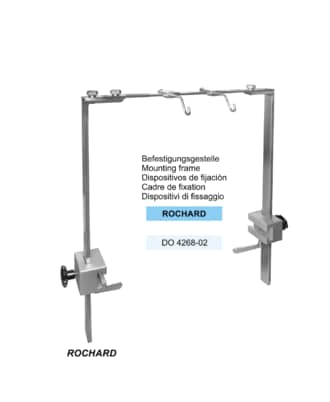
Mounting Frame
The mounting frame (or “Mounting Frame”) from the ROCHARD brand, bearing the reference DO 4268-02.
The main features visible in the image are:
Product Type: Mounting Frame / Mounting Bracket.
Brand: ROCHARD.
Model Reference: DO 4268-02.
Material: Metal device (stainless steel), suggesting strength and durability.
Design: Gantry-like structure with two vertical uprights and an upper horizontal bar.
Attachment: Equipped with clamps at the bases of the vertical uprights, allowing it to be securely attached to a surface (e.g., an operating table or a stand).
Supports: The horizontal bar is equipped with hooks or brackets for hanging or holding other instruments or equipment.
Adjustability: The mounting elements and possibly the brackets are adjustable to accommodate different configurations.
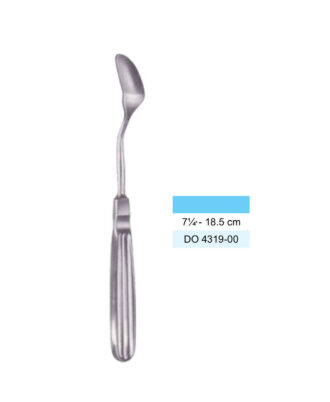
Breisky Vaginal Speculum
The Breisky vaginal speculum, used in gynecology and obstetrics.
Its main features are:
Design:
Curved Jaws: Specially designed to facilitate visualization of the genital tract.
Blunt Tip: Helps slide through narrow openings.
Smooth Outer Curves: Prevents damage to surrounding tissue.
Wide, Ergonomic Handle: With finger indentations for optimal control and increased comfort for the surgeon.
Light Weight: Contributes to surgeon comfort.
Material and Care:
Surgical Grade Stainless Steel: Manufactured with a satin finish to reduce glare.
Sterilizable and Reusable: Can be sterilized and reused for various procedures.
Sizes: Available in various sizes to suit a variety of needs, including 7.5″ – 18.5 cm as shown in the image.
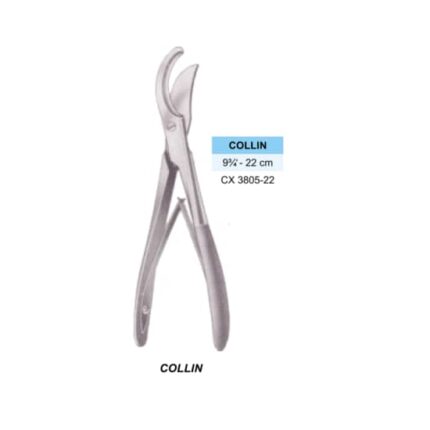
Dental Forceps
The dental forceps, identified as “COLLIN”.
Its main features are:
Model Name: COLLIN.
Dimensions: 9.5 – 22 cm.
Product Reference: CX 3805-22.
Use: It is often used for tooth extraction, particularly for upper molars in children, based on similar products found in search results.
Material: Generally made of surgical-grade stainless steel.
Design: It has serrated jaws for a better grip and ergonomic, non-slip handles for easy handling.

Menley-type retractor
Features of the Menley-type retractor:
Menley-type retractor: This instrument is a surgical retractor used to hold tissue open during surgery. Its design includes handles for manipulation and articulated arms with claws for retraction.
Volkmann-type retractor blades: These are interchangeable blades used with a retractor, specifically labeled as Volkmann-type, with central hooks or perforated valves. The dimensions listed (16 x 19 mm, 16 x 25 mm, 16 x 32 mm) refer to the size of the blades, suggesting their use for different incision depths or sizes. The codes “DO-4209-19”, “DO-4209-25”, and “DO-4209-32” are product reference numbers.

Rochard Valve
The Rochard Valve, a surgical instrument.
Here are its main characteristics:
Instrument Type: It is a suprapubic valve, used as a surgical retractor.
Function: It is used to retract and hold tissue, muscles, organs, or bones to expose the surgical field during surgery, particularly in urology.
Material: Generally made of stainless steel.
Common Dimensions: A common size is 100 mm x 50 mm.
Classification: It is a Class I medical device with CE marking.
Use: It is often used in combination with tissue forceps for precise manipulation and optimal tissue support.

Gelpi Self-Retaining Retractor
The surgical retractor is a self-retaining retractor of the Gelpi or Williams type.
Characteristics and Uses:
Instrument Type: This is a self-retaining (or self-retaining) surgical retractor, meaning it can remain in place without being constantly held by the surgeon or an assistant.
Primary Function: Its role is to retract tissue, muscles, or organs to create a clear field of vision and sufficient access to the surgical site during a procedure.
Design: It has curved or hook-shaped prongs at the ends, designed to grasp and hold retracted tissue. A locking mechanism (often a ratchet or ratchet) maintains the desired retraction.
Material: Typically made of surgical-grade stainless steel, which is resistant to corrosion and sterilization.
Applications: Commonly used in various surgical specialties, including orthopedics and neurosurgery, for procedures requiring deep or superficial tissue retraction, such as spinal access or femoral surgery.

Weitlaner Retractors
Surgical retractor, more specifically a Weitlaner retractor.
Features:
Type: It is a self-locking surgical instrument, meaning it can maintain an open position without requiring constant intervention from the surgeon.
Function: It is used to spread the edges of a surgical incision, tissues, or other parts of the body apart to expose or allow access to the underlying anatomical structure during a procedure.
Design: It has two prongs with teeth (sharp or blunt) that mesh to maintain retraction. The size and type of teeth vary depending on the application (for example, smaller ones are for skin and superficial tissues, larger ones for deeper muscles or bones).
Material: Made of surgical-grade stainless steel, it is designed to be sterile and durable.
Use: To reduce trauma, the position of the retractors should be changed frequently during use.

Umbilical Cord Scissors
Umbilical cord scissors have several distinctive features.
Features:
Type and Function: These are gynecological scissors specifically designed for dissecting and clamping the umbilical cord after birth.
Blade Design:
They have curved blades that act as a non-slip mechanism, ensuring a secure grip on the umbilical cord.
The tips are blunt to reduce the risk of accidental tissue puncture.
Material: They are made of high-quality stainless steel, ensuring durability and corrosion resistance, and are sterilizable.
Available Sizes: They are available in various lengths, such as 5″-13 cm (CX 3000-13) and 6.5″-16 cm (CX 3000-16).
Ergonomics: The design includes ergonomic handles for better control and comfortable handling, including a ratchet-free design and a riveted screw joint for quick handling.
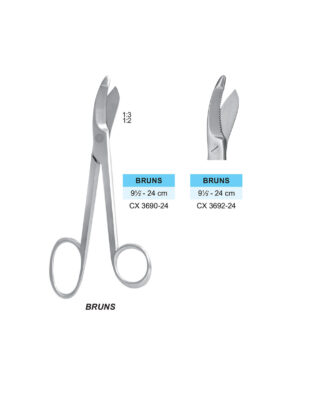
Episiotomy Scissors
The main features of this pair of episiotomy scissors are as follows:
Type: Episiotomy scissors with rounded guide blade.
Length: 19 cm.
Finish: With rounded guide blade.
Advantage: The specially designed blade shape does not obstruct vision during surgery.
Use: Specifically designed for obstetric surgery, particularly for episiotomy during childbirth.

Buie Probe
Buie probe. Its main characteristics are:
Name: Buie Probe
Dimensions: 6.5 inches (approximately 16 cm)
Model Reference: BS 0472-16

Episiotomy Scissors
Braun-Stadler episiotomy scissors are surgical instruments designed for specific procedures, including episiotomy during childbirth.
Their main features include:
Use: Primarily used to make a surgical incision (episiotomy) in the perineum to facilitate childbirth and prevent tearing.
Design:
Angled Blades: The blades are angled relative to the handles, providing better access and visibility during the procedure.
Rounded Lower Blade: The lower branch of the scissors is often angled and rounded at the tip to minimize unintentional injuries.
Specific Cutting Edges: The upper cutting edge may be finely serrated to prevent slipping, while the lower cutting edge is usually very sharp for a clean cut.
Material: Made of high-quality stainless steel, often surgical steel.
Sterility: Available in single-use versions, sterile-packaged to prevent cross-contamination.
Sizes: Available in various lengths to suit clinical needs.

Metzenbaum Scissors
Metzenbaum scissors are delicate surgical instruments, primarily used for dissecting soft and delicate tissues in surgery.
Key Features:
Blades: They have thinner and longer blades compared to Mayo scissors, often with blunt tips, and can be straight or curved. The curved version is frequently used for organ surgery.
Handle/Blade: The handle-to-blade ratio is relatively long.
Material: Made of medical-grade stainless steel, often German AISI 420 or Japanese steel, ensuring durability and corrosion resistance.
Use: Ideal for precise cutting and delicate tissue dissection, including procedures on anatomically vulnerable areas or during ENT, maxillofacial, and cardiac surgery. They are also used to retract tissue without trauma thanks to their blunt tips.
Design: Designed for precision and finesse, allowing for deep incisions inside the body. Their design reduces user fatigue.
Sterilization: Suitable for the prion cycle and sterilizable at high temperatures (e.g., 134°C for 18 minutes).