

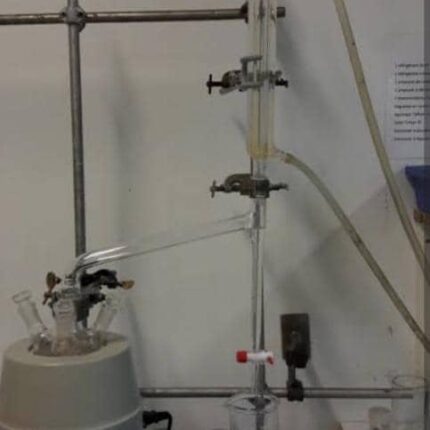
Dean-Stark Apparatus
The apparatus presented is a Dean-Stark setup, used in chemistry for the extraction of water (or other liquids) from a reaction medium, particularly during syntheses requiring the elimination of water to shift the equilibrium and increase yield.
Main Features of the Dean-Stark Apparatus:
Function: It enables azeotropic distillation to separate and collect a liquid (usually water) that is immiscible with the reaction solvent.
Composition: It consists of a graduated, cylindrical, vertical glassware element topped with a reflux condenser and connected to a flask or reactor.
Operating Principle:
During reflux heating, the vapors of the solvent and the liquid to be extracted (e.g., water) rise towards the condenser.
After condensation, the liquids fall back into the graduated tube of the Dean-Stark apparatus. Immiscible liquids separate into two distinct phases based on their density (e.g., denser water settles to the bottom).
The solvent (less dense) overflows from the graduated tube and returns to the reaction flask, while the extracted liquid (water) is collected in the graduated tube and can be removed through a tap.
Typical use: It is frequently used in esterification reactions where the removal of water promotes ester formation.
Variations: There are devices adapted depending on whether the density of the solvent used is lower or higher than that of the liquid to be extracted.
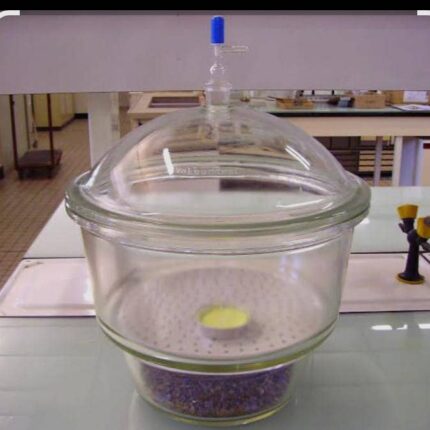
Desiccator
Characteristics of a Desiccator
A desiccator is a piece of laboratory equipment designed to create and maintain a dry environment to protect or dry moisture-sensitive substances.
Its main characteristics are as follows:
Glass or polycarbonate structure: It consists of a circular tank made of thick glass (borosilicate glass 3.3 for better thermal and chemical resistance) or polycarbonate, topped with a hermetic lid.
Hermetic lid: The lid ensures a perfect seal, protecting samples from external moisture.
Perforated tray: Inside, a perforated tray (made of porcelain) is provided to support the sample to be dried or protected, while allowing air circulation and access to the drying agent placed underneath. Desiccant: A moisture-absorbing substance, such as silica gel (with a colored indicator), calcium chloride, or phosphorus pentoxide, is placed at the bottom of the desiccator to absorb residual moisture from the ambient air within the chamber.
How it works: The desiccator maintains a dry environment without actively heating the products, unlike a dehydrator, which uses heat to accelerate water evaporation. It is ideal for drying and preserving moisture-sensitive samples.

Buchner funnel
A glass Buchner funnel.
Here are its main features:
Material: Made of borosilicate glass, offering high chemical and thermal resistance.
Filter disc: Incorporates a sintered glass disc (or “frit”) instead of a filter paper holder, making it useful when conventional filter papers are attacked by reagents (acids or alkalis).
Vacuum connection: Has a side tube with a connection for a vacuum source (often a water pump) to speed filtration.
Ground joint: Equipped with a ground glass cone, allowing a tight connection to other laboratory glassware such as a vacuum flask.
Use: Mainly used for vacuum filtration in the laboratory, particularly for the separation of solids and liquids.

Vacuum Flask
The Erlenmeyer-shaped vacuum flask, also called a Büchner flask, has several distinctive features:
Shape and Structure:
Wide base and conical body, topped with a cylindrical neck.
A side arm with an olive (or glass connector) for connection to a vacuum source, such as a water pump or vacuum pump.
Thick walls to withstand the negative pressure generated during vacuum filtration. Includes a “cleated” base for greater stability and minimized abrasion.
Material:
Made of borosilicate glass (such as DURAN® or PYREX® glass), offering good chemical and thermal resistance.
Functionality:
Designed specifically for vacuum filtration, allowing rapid separation of solid and liquid phases.
Can be used for mixing, cooling, incubation, filtration, and storage in the laboratory.
Autoclavable for sterilization if made of a suitable material.
Compliance:
Complies with international standards such as ISO 6556 or DIN 12476.

Watch Glass
A laboratory watch glass is a versatile piece of laboratory equipment, usually made of glass (soda-lime or borosilicate).
Main Features:
Shape: Circular and slightly concave.
Material: Mainly made of glass (soda-lime or borosilicate), offering chemical resistance. Borosilicate glass is particularly resistant to thermal shock and chemical agents.
Uses:
Covering beakers to protect them from contaminants.
Weighing powders or small quantities of substances.
Serving as a surface for the evaporation of liquids, allowing the observation of precipitates or crystallizations.
Used as a support for mixing substances or observing them under a stereomicroscope.
Dimensions: Available in various diameters, ranging from 40 mm to 250 mm.
Safety: Its ground edges and consistent thickness reduce the risk of breakage.

Desiccant Tube
The laboratory equipment presented is a DURAN® borosilicate glass elbow desiccant tube with a male ground joint.
Its main characteristics are as follows:
Material: DURAN® borosilicate glass (known for its chemical and thermal resistance and low thermal expansion).
Shape: 75° elbow.
Ground Joint: Features a male ground joint (standard size 24/29), allowing for a leak-proof connection with other glassware.
Use: Designed to contain a desiccant, such as calcium chloride (CaCl2), to protect a reaction or system from atmospheric moisture.
Resistance: Offers very good chemical and high temperature resistance, as well as relatively high resistance to temperature fluctuations due to its minimal thermal expansion.

Thiele Tube
The Thiele tube is a piece of laboratory equipment made of borosilicate 3.3 glass, used to determine the melting point of organic compounds.
Its main characteristics are:
Material: High-quality borosilicate 3.3 glass, known for its thermal and chemical resistance.
Typical Dimensions: Total length of approximately 150 mm (6 inches) and main tube diameter of approximately 25 mm (1 inch).
Design: It features a specific shape with a hollow glass side handle that allows convective circulation of the heated oil, ensuring a nearly uniform temperature throughout the oil bath.
Use: It is designed to contain and heat an oil bath in which a capillary tube containing the sample and a thermometer are immersed to observe the melting point.
Thermal Tolerances: Borosilicate 3.3 glass has specific heat tolerances, including a deformation point of -515°C, an annealing point of 565°C, and a softening point of 820°C.

Safety Tube
A safety tube, also known as a Thistle tube, is a glass laboratory instrument primarily used to add liquids to a solution or apparatus system, or to act as a safety valve to relieve excess pressure.
Its main characteristics are:
Structure: It consists of a long, hollow stem and a funnel-shaped reservoir at its upper end.
Material: It is usually made of glass.
Function:
Liquid Addition: It allows liquids to be slowly introduced into a container, such as an Erlenmeyer flask, by inserting the thin end of the stem through a stopper.
Safety: It can be used to prevent overflow in the event of changes in pressure or temperature. An increase in pressure or expansion of the liquid will cause it to rise up the tube and overflow into the reservoir, thus acting as a safety valve.
Variations: The shape of the stem end can vary, resulting in types such as straight, curly, or multi-chamber safety tubes.
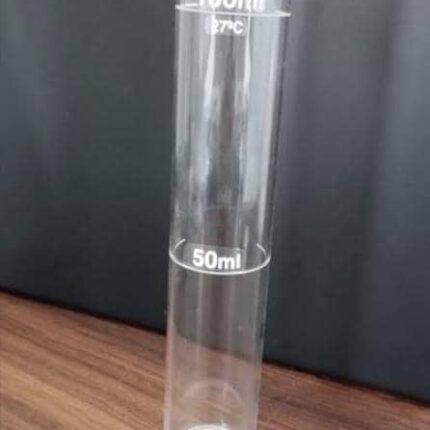
Nessler Tube
The Nessler tube is made of borosilicate glass, used primarily for colorimetric analysis.
Its main characteristics are:
Material: It is made of borosilicate glass, known for its low thermal expansion and resistance to thermal shock.
Capacity and Graduations: The cylinder has a nominal capacity of 100 mL and features a graduation mark at 50 mL, as well as a temperature indication of 27°C.
Design: This is an optically flat-bottomed cylinder with a pouring spout, designed for accurate visual comparisons of color and turbidity between solutions.
Use: Nessler tubes are commonly used in laboratories for colorimetric analysis, such as comparing APHA color or detecting dissolved substances via color changes with specific reagents (e.g., Nessler’s reagent for ammonia).
Accuracy: Class A Nessler tubes, like this one, are manufactured to high precision standards to ensure reliable…

Centrifuge Tube
Centrifuge tubes have several distinct characteristics:
Material: They are made of glass (often borosilicate glass for thermal and chemical resistance).
Bottom Shape: They come in conical bottoms (to promote pellet sedimentation) or round bottoms (for general applications).
Graduations: These tubes are graduated to allow precise volume measurement, while others are not. The graduations are in milliliters (ml).
Caps/Closures: They are equipped with screw caps for a tight seal, or plain necks without caps.
Strength: Centrifuge tubes are designed to withstand high centrifugal forces (expressed as RCF or xg).
Sterility: They can be supplied sterile, particularly for cell culture.
Volume: They are available in a range of sizes, typically from a few milliliters to 50 ml or more.

Coil
A coil is a spiral condenser, also called a serpentine condenser or Graham condenser.
Its main characteristics are as follows:
Form and function: It is a glass tube wound in a helix (solenoid shape) inside an outer shell. It is designed to serve as a refrigerating instrument, primarily in stills or distillation and reflux rigs in chemistry.
Operating principle: A hot gas or vapor passes through the helical tube, while a refrigerant liquid (water) circulates in the outer shell, around the coil. Indirect contact with the cold liquid causes the gas or vapor to condense.
Material: It is made of glass.
Use: It is used to condense vapors during chemical reactions requiring reflux or to separate components by distillation.

Soxhlet Extractor
The image shows a complete Soxhlet extraction apparatus, a piece of laboratory equipment used for extracting compounds from solid materials using solvents.
Its main features are as follows:
Components: It consists of an extractor (main body), a condenser (often Dimroth or Allihn type), and a round-bottom flask.
Material: It is made of borosilicate glass, a glass resistant to heat and chemicals.
Operation: The principle is based on a continuous cycle of boiling and condensation of the solvent. The vaporized solvent rises to the condenser, condenses, and falls back onto the solid sample contained in the extractor. Once the level is reached, the solvent containing the extract flows through a siphon into the flask, where the extract is concentrated.
Application: It is particularly useful for the extraction of fats, oils, pesticides, and other organic compounds from solid samples.
Advantages: It allows for continuous and automatic extraction, saving time and effort compared to manual methods.