


URIT CA-80 Semi-Automatic Chemistry Analyzer
URIT CA-80 Semi-Automatic Chemistry Analyzer
Model: CA-80
Description
Compact yet robust
Large 7-inch color touch screen
High-quality filters with 8 wavelengths
Flow cell and disposable mode
Reaction curve display and printing
Multi-point calibration supported
Internal thermal printer
Keyboard supported
Large memory capacity Storage of 30,000 results
Easy maintenance design
Parameter
Model number CA-80
Material Metal
Power source Electric
Application Small hospital/clinics/laboratory
Light source Halogen lamp, 6 V/10 W
System Open system
Operating principle End point, kinetic, etc.
Flow cell Quartz cell/disposable cuvette optional
Temperature control 25°C, 30°C, and 37°C
Display 7-inch color touchscreen
Interface 1 SD, 3 USB, and 1 RJ-45
Printer Built-in thermal printer.

Radiant Warmer
Maintains the body temperature of newborns, particularly in neonatal intensive care units.
Main features:
Temperature control modes:
It generally offers several modes, such as preheating, manual mode, and baby skin temperature control, regulated by a microcomputer.
Display and alarms:
It has separate screens to display the set temperature, the baby’s actual temperature, and a countdown timer. Audible and visual alarms are built in for overheating, temperature deviations, sensor failures, and other malfunctions, ensuring the safety of the newborn.
Ergonomic settings:
The horizontal angle of the radiation module and the tilt of the bed can be adjusted for easy access to and observation of the baby, as well as for the comfort of the nursing staff.
Ease of maintenance
The transparent acrylic panels around the bed are often removable for easy cleaning and disinfection.
Additional features
Some models include features such as APGAR score countdown, LED lighting with angle and direction adjustment, and interfaces for data connectivity (RS-232).
Operating principle
Heat transfer is mainly achieved through thermal radiation, ensuring continuous and stable heat to maintain the baby’s body temperature.

Electrolyte Analyser
Analysis method: Uses the Ion Selective Electrode (ISE) method.
Parameters measured: Capable of measuring potassium (K), sodium (Na), and chlorine (Cl), with the ability to expand to include calcium (Ca), lithium (Li) and pH.
Speed of analysis: Performs tests quickly, with a speed of approximately 45-60 seconds per sample.
Compatible samples: Ideal for analysing electrolytes in a variety of sample types such as serum, plasma, cerebrospinal fluid and diluted urine.
Electrode: Features a high-precision, long-life electrode.
Operation: Designed for ease of use with an intuitive menu.
Calibration: Features a self-calibration function.
Operating conditions: Recommended working temperature between 5 and 40°C, and relative humidity less than or equal to 80%.
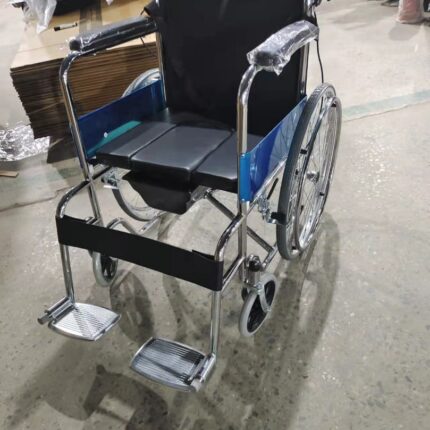
Wheelchair with Potty Seat
Features of a Wheelchair with Potty
A wheelchair with potty, also called a commode or toilet chair, is a piece of medical equipment that combines the functions of a wheelchair and an integrated toilet.
Its main features are:
Frame: Made of chrome-plated steel, providing strength and durability.
Mobility: Equipped with wheels to facilitate user mobility. The casters are equipped with brakes for stability and safety.
Integrated Toilet: A removable potty is located under the seat, providing easy access for the user and facilitating cleaning.
Comfort and Adjustability:
Armrests: Fold down for easy transfers.
Leg/Footrests: Detachable or retractable for comfort and maneuverability.
Seat and backrest: Upholstered for user comfort, in faux leather with a bucket seat.

Talquist Paper
The Tallquist hemoglobin scale, like the R. Terry®, is a quick and easy tool for estimating hemoglobin levels in the blood.
Key Features:
Visual Comparison Method: It compares the color of a drop of blood absorbed onto a filter paper to a predefined color scale to estimate hemoglobin concentration.
Simple and Quick to Use: It does not require sophisticated equipment or electricity, making it useful in resource-limited settings, such as rural areas or primary healthcare centers.
Anemia Screening: It is primarily used for rapid anemia screening by assessing hemoglobin concentration in the blood.
Components: The kit includes a booklet or card with a color scale and absorbent filter papers for collecting blood samples.
Developed in the early 20th century: The Tallquist method was developed around 1900.
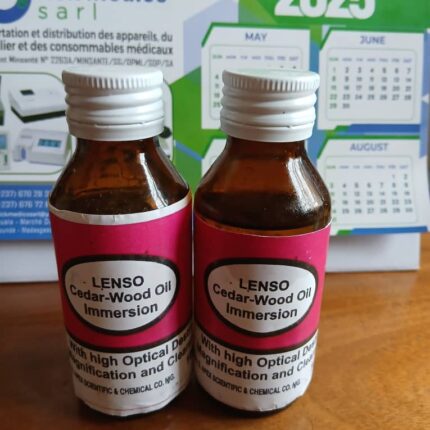
Immersion Oil
LENSO Cedarwood Immersion Oil is an immersion oil used in microscopy to improve the resolution and clarity of high-magnification images.
Key Features:
Use in Microscopy:
It is specifically designed for use with microscope immersion objectives, particularly at high magnifications (e.g., 100x).
Improving Resolution:
Its primary role is to reduce light refraction between the slide and the objective lens, minimizing image blur and increasing the sharpness of details, allowing for better observation of specimens.
Refractive Index:
Cedarwood oil has a refractive index of approximately 1.515, very close to that of the glass used in slides and coverslips, which is crucial for its effectiveness.
Suitable for biological specimens:
It is commonly used for observing biological specimens.
Origin:
It is a natural oil derived from cedarwood.

Reflex Hammer
The reflex hammer has several distinctive features:
Design and Materials:
Made of stainless steel, ensuring strength and durability.
Features a stainless steel head with rubber washers of two different diameters for testing various tendon reflexes.
Integrated Features:
Integrates a stimulation needle screwed into the hammer head for examining skin reflexes and nerve sensation.
A neurological brush is housed in the handle, also used to assess nerve sensation.
Use:
Essential for healthcare professionals, particularly for assessing tendon reflexes and skin and nerve sensation in patients.
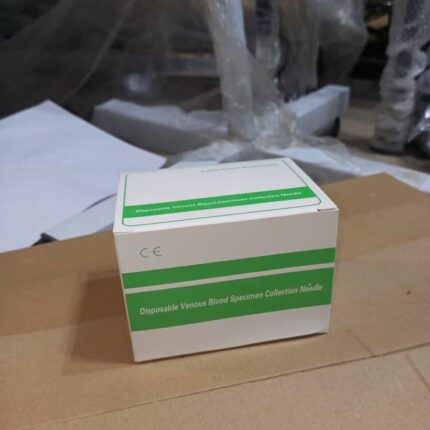
Vaccutaner Needle
Vacutaner needles, like the disposable venous blood collection needle shown in the image, have several important features for the safety and efficiency of blood collection.
General Features:
Single Use:
Designed for single use only to prevent infection and cross-contamination.
Material: The needle itself is made of high-quality stainless steel.
Treated Bevel:
The needle bevel is electrochemically treated to ensure smoother penetration and reduce patient discomfort.
Lubrication:
The cannula is vapor-lubricated to facilitate insertion.
Retractable Sleeve:
A soft, retractable sleeve is provided on the tube side to allow for the collection of multiple tubes.
Gauge Indicators:
Needle size is indicated by a gauge number (e.g., 21G, 23G), with a higher number corresponding to a smaller needle diameter.

Abdominal Gauze Sponge
The characteristics of abdominal gauze sponges are as follows:
Product Type: Abdominal Gauze Sponges
Dimensions: 40SX40S 24X20, or 45X45CM-8PLY, which indicates a size of 45×45 cm and a thickness of 8-ply.
Processing: Pre-washed and X-ray detectable.
Packaging: 2 pieces per pack.
Batch Information:
Batch Number (LOT): 20240815
These sponges are designed to be highly absorbent and are used during surgical procedures to manage fluids and protect wounds. They are also valued for their ease of use and their role in infection prevention due to their sterile nature.
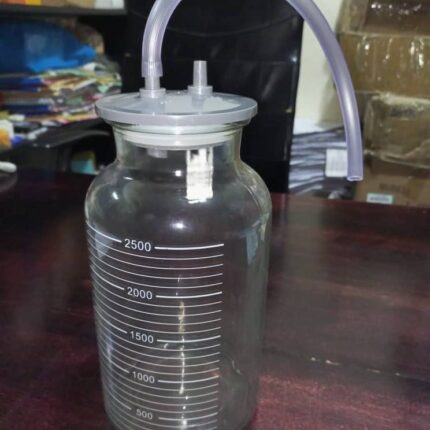
Suction Canister
This glass canister is a medical suction canister, typically used with a surgical suction device. Its main features are:
Material: It is made of glass, making it autoclavable (sterilizable at high temperatures).
Capacity: It has a capacity of 2.5 liters (2500 ml), as indicated by the graduations on the side.
Graduations: Volume markings are present on the side, allowing the suctioned liquid to be measured (500, 1000, 1500, 2000, 2500).
Use: Designed to collect fluids during surgery or other medical procedures requiring suction.
Compatibility: It is compatible with various models of surgical suction devices.
Packaging: Generally sold individually.

Roll Mixer
The Roll Mixer is a piece of laboratory equipment designed for the gentle and homogeneous mixing of samples in test tubes or flasks. Its main features include:
Smooth Rolling and Tilting Action: It uses a rolling and tilting motion that ensures homogeneous mixing of samples while preventing sedimentation, without damaging sensitive materials.
Durable and Compact Design:
Built with sturdy materials, it takes up minimal space on the laboratory bench.
Ease of Use: It is equipped with a simple on/off switch for easy operation.
Prevention of Sedimentation: The continuous movement helps keep particles suspended, preventing sediment from forming at the bottom of containers.
Versatility: It is suitable for mixing various types of biological and chemical samples in tubes or flasks.
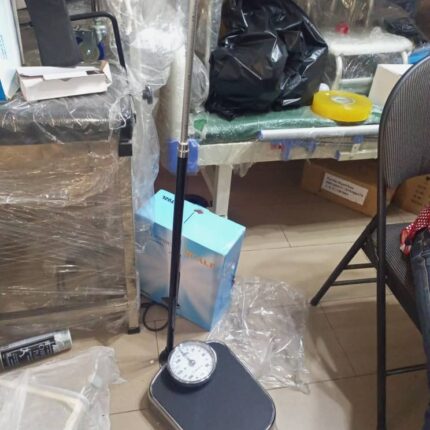
Mechanical Bathroom Scale with Height Rod
MODEL: DT02L
Features of the mechanical bathroom scale with height rod include:
Type: Analog mechanical scale, no batteries required.
Functionality: Measures weight and height using a removable or integrated height rod.
Weight Capacity: Can support a maximum weight of 160 kg.
Height Measurement: The telescopic height rod allows for accurate height measurement, with a typical range of 71 to 190 cm.
Design: Retro or vintage style, with an analog dial and a sturdy base.
Materials: Made of alloy steel, ensuring durability and stability.
Use: Suitable for various environments such as schools, hospitals, or home use.