

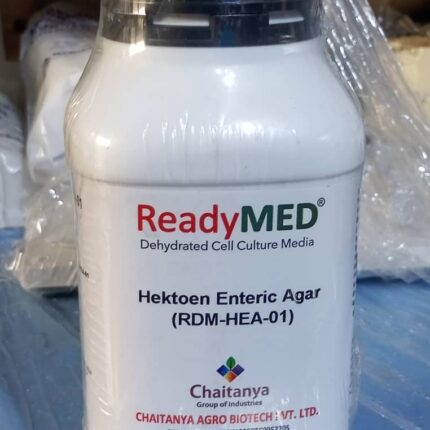
Hektoen Enteric Agar
Hektoen Enteric Agar (HEA) – Technical Specifications
Selective & Differential Medium for Enteric Pathogens
1. Intended Use
-
Primary Application: Isolation/differentiation of Salmonella and Shigella spp.
-
Sample Types: Clinical stool specimens, food, environmental samples
2. Key Functional Components
| Component | Role |
|---|---|
| Bile salts | Inhibits Gram-positive & non-pathogenic Gram-negative bacteria |
| Lactose/sucrose/salicin | Carbohydrate sources for fermentation |
| Sodium thiosulfate + Ferric ammonium citrate | H₂S production detection |
| Bromothymol blue + Acid fuchsin | pH indicators (differentiate fermenters) |
3. Physical Characteristics
-
Color: Green (prepared medium)
-
Clarity: Clear to slightly opalescent
-
pH: 7.5 ± 0.2 at 25°C
-
Format: Dehydrated powder
Performance Characteristics
Colony Morphology
| Organism | Colony Appearance | Biochemical Basis |
|---|---|---|
| E. coli (coliform) | Salmon-pink, may yellow medium | Rapid lactose fermentation |
| Salmonella spp. | Blue-green with black centers | H₂S production (thiosulfate → FeS) |
| Shigella spp. | Pale green, translucent | Non-lactose fermenter |
| Proteus spp. | Colorless with blackening | H₂S production only |
Quality Control Parameters
-
Sterility: No growth after 24h at 35°C
-
Growth Promotion:
-
Salmonella enterica ATCC 14028: Blue-green colonies with H₂S
-
Shigella flexneri ATCC 12022: Pale green colonies
-
-
Selectivity: ≥80% inhibition of E. coli ATCC 25922
Protocol Summary
-
Preparation: Suspend 75g/L, boil to dissolve, autoclave (121°C, 15 min)
-
Plating: Pour into Petri dishes (~20mL/plate)
-
Inoculation: Streak for isolation
-
Incubation: 35-37°C for 18-24h (extend to 48h for low-density samples)
Regulatory & Storage
-
Shelf Life: 3 years (unopened, <30°C)
-
Safety: Handle as potential biohazard post-inoculation
Advantages Over Competing Media
✔ Dual differentiation (fermentation + H₂S)
✔ Superior Shigella recovery vs. SS Agar
✔ Color contrast enhances readability

Müller Hinton Agar
ReadyMED™ Mueller Hinton Agar (RDM-MHA-01)
Standardized Medium for Antimicrobial Susceptibility Testing
Manufactured by Chaitanya Agro Biotech Pvt. Ltd. (Buldhana, Maharashtra, India)
1. Product Overview
-
Form: White biotech-grade dehydrated powder
-
Packaging: 1 kg bottles
-
Storage: 2-8°C (until expiration date)
-
Purity: ≥95%
2. Key Applications
-
Kirby-Bauer disk diffusion testing
-
Broth microdilution assays
-
Standardized AST for non-fastidious pathogens
3. Composition & Performance
| Component | Function | Concentration |
|---|---|---|
| Beef extract | Nutrient source | 2.0 g/L |
| Acid hydrolysate of casein | Amino acids | 17.5 g/L |
| Starch | Absorbs toxins | 1.5 g/L |
| Agar | Solidifying agent | 17.0 g/L |
Critical Properties:
-
Low levels of sulfonamide/trimethoprim inhibitors
-
pH 7.3 ± 0.1 (after solidification)
-
4mm depth compliance for disk diffusion
4. Quality Assurance
-
Batch-to-batch consistency for reproducible zone sizes
-
Validated with reference strains:
-
E. coli ATCC 25922
-
S. aureus ATCC 29213
-
P. aeruginosa ATCC 27853
-
-
Meets CLSI/EUCAST standards
5. Preparation Protocol
-
Suspension: 38g per 1L distilled water
-
Heating: Boil with stirring (100°C, 1 min)
-
Sterilization: Autoclave (121°C, 15 min)
-
Pouring: 25mL per 90mm plate (4mm depth)
-
QC Testing: Verify with control strains
6. Manufacturer Credentials
-
Parent Company: Chaitanya Group
-
Facility: cGMP-compliant production
-
Regulatory Status: IVD-grade (CE marked if applicable)
7. Why Choose ReadyMED MHA?
✔ CLSI-compliant formulation
✔ Optimized for accurate zone edge definition
✔ Traceable raw materials
✔ Long shelf life (typically 3 years)
Product Code: RDM-MHA-01
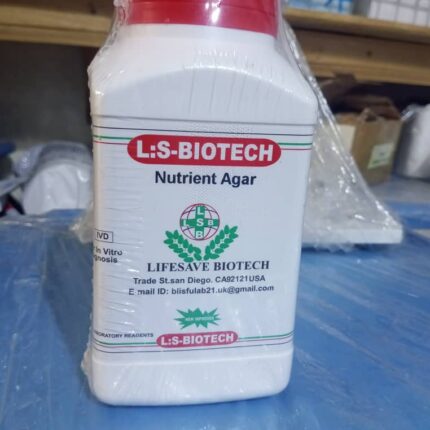
Nutrient Agar
L:S-BIOTECH Nutrient Agar (IVD Grade)
General-Purpose Microbiological Culture Medium
Manufactured/Distributed by LIFESAVE BIOTECH
1. Product Identification
-
Product Name: Nutrient Agar
-
Brand: L:S-BIOTECH
-
Classification:
-
Laboratory reagent (“MORATORY REAGENTS” label)
-
IVD In Vitro Diagnostics (CE marked if applicable)
-
-
Intended Use: Cultivation of non-fastidious microorganisms
2. Key Features
-
General-purpose medium for routine bacteriology
-
IVD-compliant formulation for diagnostic use
-
Standard composition:
-
Peptones (nitrogen source)
-
Beef extract (growth factors)
-
Sodium chloride (osmotic balance)
-
Agar (solidifying agent)
-
-
Typical pH: 7.4 ± 0.2
3. Applications
✔ Quality control testing
✔ Environmental monitoring
✔ Educational demonstrations
✔ Primary isolation of non-fastidious:
-
Bacteria
-
Yeasts
-
Molds
4. Compliance & Safety
-
For In Vitro Use Only (Not for human/animal administration)
-
Manufactured under ISO 13485 (if IVD-certified)
-
Standard shelf life: 3 years when stored sealed at 15-30°C
5. Preparation Protocol
-
Suspend 28g per 1L distilled water
-
Autoclave at 121°C for 15 minutes
-
Pour into sterile Petri dishes
6. Performance Characteristics
-
Growth Promotion: Supports growth of:
-
E. coli ATCC 25922
-
S. aureus ATCC 25923
-
-
Sterility: No contamination after incubation
7. Ordering Information
Manufacturer: LIFESAVE BIOTECH
Packaging: Typically 500g bottles
Storage: Room temperature (dry)
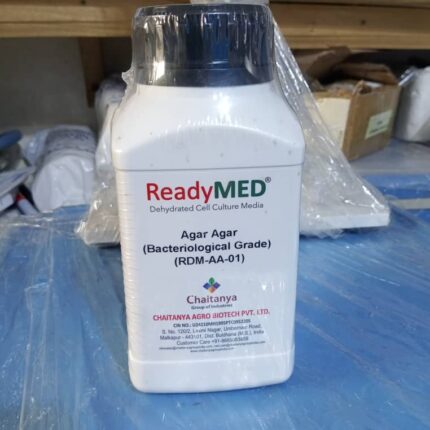
Agar Agar
ReadyMED™ Agar Agar (Bacteriological Grade) – RDM-AA-01
High-Purity Gelling Agent for Microbiological Culture Media
Manufactured by Chaitanya Agro Biotech Pvt. Ltd.
1. Product Overview
-
Form: White to off-white dehydrated powder
-
Grade: Bacteriological (Low DNase/Rnase activity)
-
Gel Strength: ≥1200 g/cm² (1.5% gel at 25°C)
-
Product Code: RDM-AA-01
2. Key Properties
| Parameter | Specification |
|---|---|
| Ash Content | ≤2.5% |
| Gelling Temp | 32-39°C |
| Melting Temp | 85-95°C |
| Microbial Load | ≤100 CFU/g |
| pH (1.5% sol.) | 6.5-7.5 |
3. Functional Applications
-
Base component for:
-
Selective media (e.g., MacConkey, MSA)
-
Differential media (e.g., EMB, XLD)
-
General-purpose media (e.g., Nutrient Agar)
-
-
Typical Use Concentration: 1-2% w/v
4. Technical Advantages
✔ Consistent gelling properties for reproducible media
✔ Low mineral content minimizes interference with selectivity
✔ Optimal clarity for colony morphology observation
5. Storage & Handling
-
Storage: 10-30°C in airtight container (RH <50%)
-
Shelf Life: 5 years from manufacture
-
Safety: Non-toxic; autoclave contaminated material before disposal
6. Preparation Guidelines
-
Suspension: Slowly sprinkle into heated (80-90°C) distilled water while stirring
-
Dissolution: Boil 1 minute to ensure complete hydration
-
Autoclaving: 121°C for 15 minutes (for most applications)
7. Quality Compliance
-
Meets USP/EP/JP standards for microbiological media
-
Batch-specific Certificate of Analysis available

D-Mannitol
D-Mannitol Technical Specifications
*(C₆H₁₄O₆ | CAS No.: 69-65-8 | EC No.: 200-711-8)*
1. Fundamental Properties
| Parameter | Specification |
|---|---|
| Molecular Weight | 182.17 g/mol |
| Appearance | White crystalline powder |
| Melting Point | 167-170°C |
| Solubility | 213 g/L in water (20°C) |
| pH (10% sol.) | 5.0-7.0 |
| Sweetness | 70% of sucrose |
2. Key Applications
A. Pharmaceutical
-
Osmotic diuretic: Reduces intracranial/intraocular pressure
-
Excipient: Tablet filler (direct compression), lyophilization stabilizer
-
Diagnostic agent: Renal function tests
B. Food Industry
-
Low-calorie sweetener (E421)
-
Anti-caking agent in chewing gums/sweets
-
Sugar-free product formulations
C. Microbiology
-
Carbon source in culture media (e.g., Mannitol Salt Agar)
-
Fermentation studies
3. Safety & Handling
| Aspect | Detail |
|---|---|
| Glycemic Index | Low (GI=0) |
| Storage | ≤25°C, dry environment |
| Explosion Risk | Dust-air mixtures may be combustible |
| Regulatory Status | GRAS (FDA), EFSA-approved |
4. Quality Standards
-
Purity: ≥98% (HPLC)
-
Residues: Heavy metals ≤10 ppm
-
Microbial Limits: TAMC <100 CFU/g
5. Comparative Advantages
✔ Renal-safe diuretic (minimal tubular reabsorption)
✔ Tooth-friendly sweetener (non-cariogenic)
✔ High chemical stability in formulations

Burettes
Burettes – Precision Liquid Dispensing Instruments
(For Titrations & Volumetric Analysis)
1. Key Components
| Part | Description |
|---|---|
| Graduated Tube | Long cylindrical glass with precision markings (Class A/B tolerance) |
| Stopcock | PTFE or glass valve for flow control |
| Tip | Tapered delivery end for drop-wise dispensing |
| Mounting Clamp | For secure positioning on stands |
2. Technical Specifications
| Parameter | Details |
|---|---|
| Standard Volumes | 10 mL, 25 mL, 50 mL (Also available: 5 mL, 100 mL) |
| Graduation | 0.1 mL increments (50 mL) |
| Accuracy | ±0.05 mL (Class A) |
| Meniscus Reading | Bottom (clear liquids) / Top (dark solutions) |
| Material | Borosilicate glass (3.3) |
3. Types & Selection Guide
-
Digital Burettes: Motorized, programmable dispensing
-
Microburettes: For <1 mL volumes (0.01 mL gradations)
-
Automatic Zeroing: Self-refilling designs
4. Proper Usage Protocol
-
Rinsing: Pre-wet with titrant solution
-
Filling: Avoid air bubbles (use funnel)
-
Reading: Eye level at meniscus
-
Delivery: Slow, drop-wise near endpoint
5. Calibration & Maintenance
-
Verification: Annual calibration with distilled water
-
Cleaning: Chromic acid for stubborn residues
-
Storage: Vertical position, stopcock grease applied

Volumetric Flask
Volumetric Flasks – Technical Specifications
(Precision Liquid Measurement Vessels)
1. Material & Construction
-
Primary Material: Borosilicate glass 3.3 (e.g., Pyrex®)
-
Thermal shock resistant (ΔT ≤ 200°C)
-
Chemical resistance to acids/bases (except HF)
-
-
Stopper: Ground glass joint (NS 29/32 standard)
-
Markings: Permanent enamel graduation
2. Accuracy & Compliance
| Parameter | Class A Specification |
|---|---|
| Tolerance | ±0.08 mL (100 mL flask) |
| Calibration Temp | 20°C ± 0.5°C |
| Standards | DIN EN ISO 1042, ASTM E288 |
| Marking | Engraved “IN” (TC) & “A” grade |
3. Standard Capacities
| Volume | Neck Diameter | Uses |
|---|---|---|
| 50 mL | 14 mm | HPLC standards |
| 100 mL | 16 mm | Titrant prep |
| 250 mL | 22 mm | Molar solutions |
| 500 mL | 28 mm | Bulk reagents |
4. Key Features
✔ Single graduation mark for precise filling
✔ Hexagonal base for stability
✔ Traceable certification (NIST/DKD)
5. Usage Protocol
-
Cleaning: Chromic acid rinse → triple DI water wash
-
Filling: Meniscus tangent to mark (eye-level)
-
Mixing: 10× inversions (no shaking)
Do NOT heat when sealed – thermal expansion risks rupture
6. Quality Verification
-
Weight Test: Verify volume using distilled water (d=0.9982 g/mL at 20°C)
-
Documentation: Class A requires individual calibration certificate
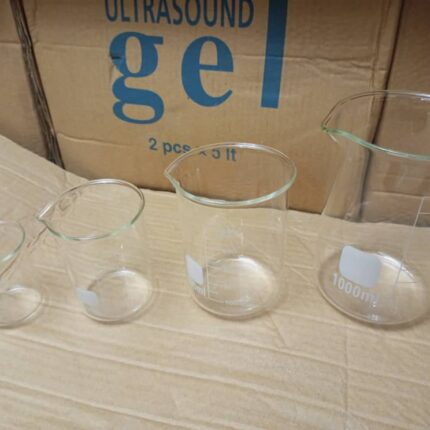
Glass Beaker
Borosilicate Glass Beakers – Technical Specifications
(High-Performance Laboratory Containers)
1. Material Properties
| Characteristic | Boro 3.3 Glass Specification |
|---|---|
| Composition | 81% SiO₂, 13% B₂O₃, 4% Na₂O/K₂O, 2% Al₂O₃ |
| Thermal Shock Resistance | ΔT ≤ 160°C (rapid cooling) |
| Max Operating Temp | 500°C (continuous), 1450°C (short-term) |
| Chemical Resistance | Resists all acids (except HF) and organic solvents |
| Light Transmittance | >95% (400-700 nm visible spectrum) |
2. Product Line Overview
| Capacity | Height | Diameter | Graduation Interval |
|---|---|---|---|
| 100 mL | 90 mm | 50 mm | 10 mL (“APPROX”) |
| 250 mL | 110 mm | 65 mm | 25 mL |
| 500 mL | 130 mm | 80 mm | 50 mL |
| 1000 mL | 160 mm | 100 mm | 100 mL |
Note: All graduations are approximate (±5% tolerance).
3. Key Features
✔ Spout design: Pouring without drips
✔ Wide base: Enhanced stability
✔ Etched markings: Acid-resistant graduations
✔ Autoclavable: Reusable after sterilization
4. Comparative Advantages
| Property | Borosilicate vs. Soda-Lime Glass |
|---|---|
| Thermal Shock | 3× better resistance |
| Chemical Durability | Withstands concentrated acids |
| Cost | 2-3× higher but longer lifespan |
5. Usage Guidelines
-
Heating: Use wire gauze with ceramic center for even heat distribution
-
Cleaning: Avoid abrasive scrubbers to prevent surface scratches
-
Storage: Stack with protective liners to prevent chipping
Safety Note: Discard if cracks/chips appear – compromised glass may fail under thermal stress.
6. Compliance & Standards
-
Meets ASTM E960 (lab glassware)
-
ISO 4797 (thermal shock testing)
-
CE marked for EU markets
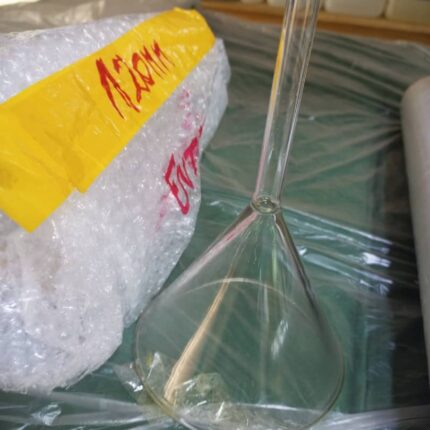
Glass Funnel
Glass laboratory funnel. Its main characteristics are as follows:
Material:
Made of borosilicate glass, known for its resistance to saline solutions, acids, bases, and organic solvents, as well as thermal shock.
Construction:
It consists of a flared conical portion for easy pouring and a tubular stem to direct the flow into a narrow-mouthed container.
Use:
Mainly used for transferring liquids or powders into narrow-mouthed containers without spilling, and can also be used as a filter paper holder during gravity filtration.
Dimensions:
Glass funnels are available in various sizes, namely: 90mm, 120mm, with varying stem diameters and lengths, suitable for various laboratory applications.
Standards:
Manufactured according to specific standards such as ISO 4798 or DIN 12445 to ensure quality and laboratory compatibility.
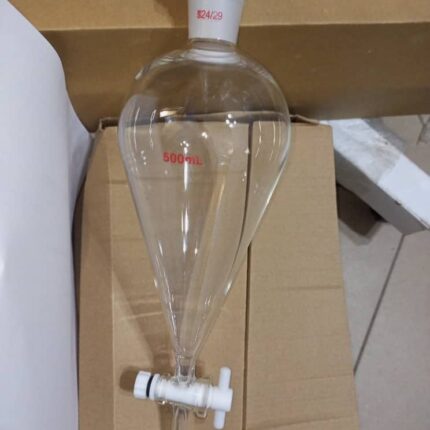
Separating Funnel
The separating funnel has the following characteristics:
Shape:
It is pear-shaped (or conical), optimized for phase separation.
Materials:
Made of borosilicate glass, which gives it chemical resistance and inertness.
Capacity:
The marking on the funnel indicates a capacity of 500 mL.
Stopcock:
It is equipped with a PTFE (polytetrafluoroethylene) stopcock, known for its chemical resistance and leak-tightness. The stopcock allows precise control of liquid flow.
Ground Joint:
The upper neck has a 24/29 type ground joint, indicating compatibility with stoppers or other laboratory equipment of the corresponding size.
Conformity:
This type of funnel complies with international standards such as ISO 4800.
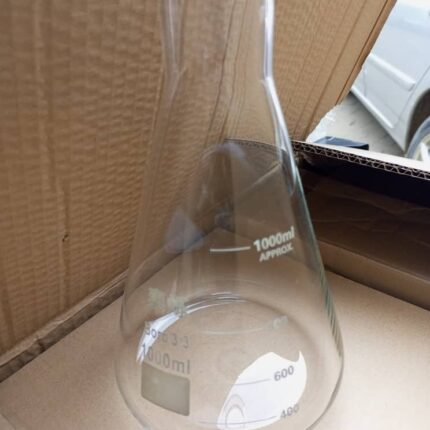
Erlenmeyer flask 1000 ml
A borosilicate glass Erlenmeyer flask has several key characteristics:
Materials:
It is made of borosilicate 3.3 glass (such as Pyrex™ or Duran®), known for its high resistance to thermal shock and chemical corrosion.
Capacity:
The flask pictured has a capacity of 1000 ml, with graduations indicating volumes (e.g., 400 ml, 600 ml).
Shape:
Its conical shape ensures good stability and facilitates mixing and heating liquids. The neck can be narrow or wide.
Graduations:
It has graduations (often white enamel) for approximate volume measurements.
Resistance:
Borosilicate glass provides excellent heat resistance, allowing direct heating and autoclaving for sterilization.
Use:
It is commonly used in laboratories for mixing, heating, cooling, and storing liquids, as well as for titrations and cell cultures.
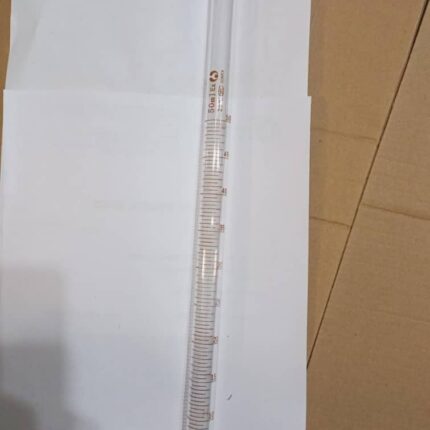
Graduated Pipette
The characteristics of these graduated pipettes are as follows:
Brand and Volume:
This is a Citotest brand graduated pipette, with a maximum volume of 50 ml.
Materials:
It is made of glass, as suggested by its transparency and common laboratory use for this type of instrument.
Graduations:
The pipette features clear and precise graduations, allowing for accurate measurement of liquids.
Conformity:
Graduated pipettes of this type comply with the accuracy standards for laboratory volumetric instruments, such as the ISO 6706 Class B standard for graduated cylinders mentioned for similar Citotest products.
Use:
It is designed for transferring and measuring precise volumes of liquids in the laboratory, particularly for liquid handling.