

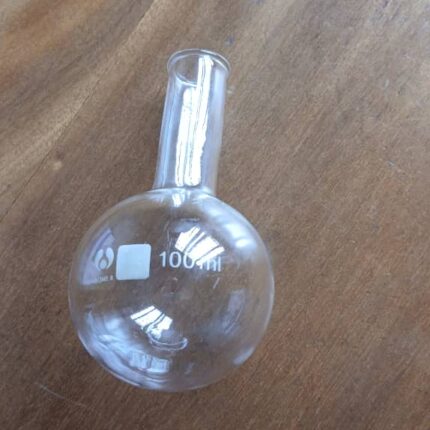
Flat-bottomed flask 100ML
The flat-bottomed flash, 100 ml laboratory flask has the following features:
Flask Type:
This is a flat-bottomed flask, which provides optimal stability and allows it to stand unsupported on a flat surface, such as a hot plate or laboratory stand.
Materials:
It is made of borosilicate glass, known for its high temperature resistance and good transparency.
Capacity:
The flask has a capacity of 100 ml, as indicated by the 100 ml” marking on the glass.
Use:
Flat-bottomed flasks are commonly used in laboratories for processes requiring uniform heating or as reaction vessels.

Flat-bottomed flask 250ML
The flat-bottomed flash, 250 ml laboratory flask has the following features:
Flask Type:
This is a flat-bottomed flask, which provides optimal stability and allows it to stand unsupported on a flat surface, such as a hot plate or laboratory stand.
Materials:
It is made of borosilicate glass, known for its high temperature resistance and good transparency.
Capacity:
The flask has a capacity of 250 ml, as indicated by the 250 ml” marking on the glass.
Use:
Flat-bottomed flasks are commonly used in laboratories for processes requiring uniform heating or as reaction vessels.
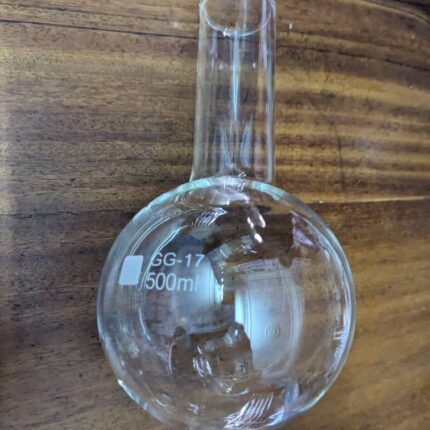
Flat-bottomed flask 500ML
Model: GG-17
The QIAO SHENG GG-17, 500 ml laboratory flask has the following features:
Flask Type:
This is a flat-bottomed flask, which provides optimal stability and allows it to stand unsupported on a flat surface, such as a hot plate or laboratory stand.
Materials:
It is made of borosilicate glass, known for its high temperature resistance and good transparency.
Capacity:
The flask has a capacity of 500 ml, as indicated by the 500 ml” marking on the glass.
Use:
Flat-bottomed flasks are commonly used in laboratories for processes requiring uniform heating or as reaction vessels.

Glass Beaker
Borosilicate Glass Beakers – Laboratory Grade
Brand: APPROX
Key Features:
✔ Premium Material – Made of Boro 3.3 borosilicate glass for exceptional:
-
Thermal resistance (withstands up to 1450°C short-term)
-
Chemical inertness (resists acids/solvents)
-
Mechanical durability
✔ Precision Graduations –
-
Clear “APPROX” markings for approximate measurements
-
Available in 250ml, 500ml, 1000ml (and other standard sizes)
✔ Optical Clarity – >95% light transmittance for easy observation
Laboratory Advantages:
-
Autoclavable – Reusable after sterilization
-
Thermal Shock Resistant – Suitable for rapid temperature changes
-
Versatile – Ideal for mixing, heating, and titrations
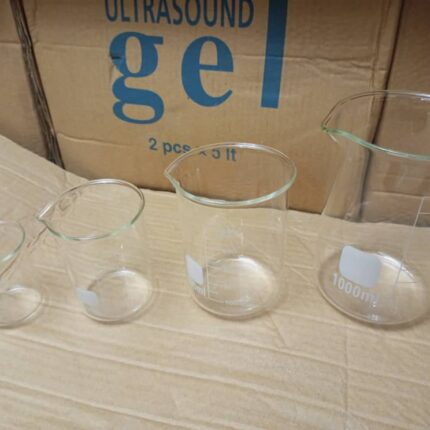
Glass Beaker
Borosilicate Glass Beakers – Technical Specifications
(High-Performance Laboratory Containers)
1. Material Properties
| Characteristic | Boro 3.3 Glass Specification |
|---|---|
| Composition | 81% SiO₂, 13% B₂O₃, 4% Na₂O/K₂O, 2% Al₂O₃ |
| Thermal Shock Resistance | ΔT ≤ 160°C (rapid cooling) |
| Max Operating Temp | 500°C (continuous), 1450°C (short-term) |
| Chemical Resistance | Resists all acids (except HF) and organic solvents |
| Light Transmittance | >95% (400-700 nm visible spectrum) |
2. Product Line Overview
| Capacity | Height | Diameter | Graduation Interval |
|---|---|---|---|
| 100 mL | 90 mm | 50 mm | 10 mL (“APPROX”) |
| 250 mL | 110 mm | 65 mm | 25 mL |
| 500 mL | 130 mm | 80 mm | 50 mL |
| 1000 mL | 160 mm | 100 mm | 100 mL |
Note: All graduations are approximate (±5% tolerance).
3. Key Features
✔ Spout design: Pouring without drips
✔ Wide base: Enhanced stability
✔ Etched markings: Acid-resistant graduations
✔ Autoclavable: Reusable after sterilization
4. Comparative Advantages
| Property | Borosilicate vs. Soda-Lime Glass |
|---|---|
| Thermal Shock | 3× better resistance |
| Chemical Durability | Withstands concentrated acids |
| Cost | 2-3× higher but longer lifespan |
5. Usage Guidelines
-
Heating: Use wire gauze with ceramic center for even heat distribution
-
Cleaning: Avoid abrasive scrubbers to prevent surface scratches
-
Storage: Stack with protective liners to prevent chipping
Safety Note: Discard if cracks/chips appear – compromised glass may fail under thermal stress.
6. Compliance & Standards
-
Meets ASTM E960 (lab glassware)
-
ISO 4797 (thermal shock testing)
-
CE marked for EU markets
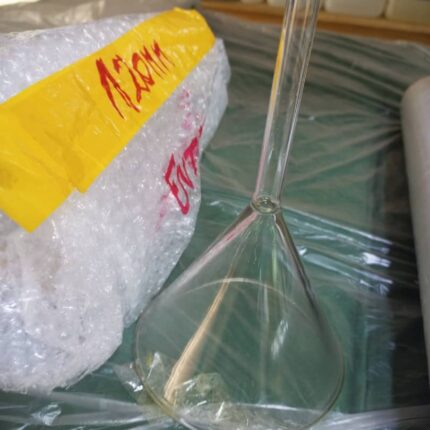
Glass Funnel
Glass laboratory funnel. Its main characteristics are as follows:
Material:
Made of borosilicate glass, known for its resistance to saline solutions, acids, bases, and organic solvents, as well as thermal shock.
Construction:
It consists of a flared conical portion for easy pouring and a tubular stem to direct the flow into a narrow-mouthed container.
Use:
Mainly used for transferring liquids or powders into narrow-mouthed containers without spilling, and can also be used as a filter paper holder during gravity filtration.
Dimensions:
Glass funnels are available in various sizes, namely: 90mm, 120mm, with varying stem diameters and lengths, suitable for various laboratory applications.
Standards:
Manufactured according to specific standards such as ISO 4798 or DIN 12445 to ensure quality and laboratory compatibility.
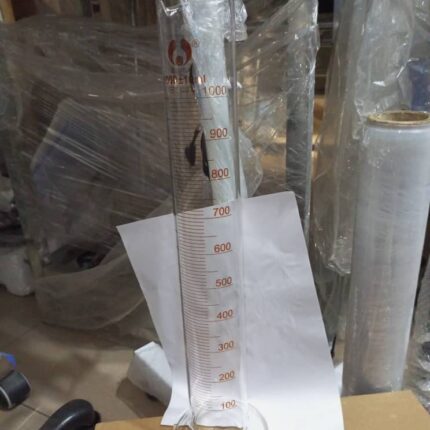
Graduated Cylinder 1000 ml
A graduated cylinder is a laboratory instrument used to accurately measure liquid volumes. Its main characteristics are as follows:
Materials:
This is a graduated cylinder made of borosilicate glass, known for its resistance to chemicals and thermal shock.
Shape and Structure:
It has an elongated cylindrical shape and is equipped with a stable base (here, a round base, although hexagonal bases also exist) and a pouring spout to facilitate the transfer of liquids.
Graduations:
The cylinder is clearly graduated, allowing the volume of liquid contained to be read. In the image, the graduations are visible from 100 ml to 1000 ml, indicating a maximum capacity of 1 liter.
Accuracy:
Graduated cylinders are designed for precise volume measurement, often calibrated “to contain” (TC or In) and classified according to accuracy standards (such as Class ).

Graduated Cylinder 100ML
A graduated cylinder is a laboratory instrument used to accurately measure liquid volumes. Its main characteristics are as follows:
Materials:
This is a graduated cylinder made of borosilicate glass, known for its resistance to chemicals and thermal shock.
Shape and Structure:
It has an elongated cylindrical shape and is equipped with a stable base (here, a round base, although hexagonal bases also exist) and a pouring spout to facilitate the transfer of liquids.
Graduations:
The cylinder is clearly graduated, allowing the volume of liquid contained to be read. In the image, the graduations are visible from 10 ml to 100 ml.
Accuracy:
Graduated cylinders are designed for precise volume measurement, often calibrated “to contain” (TC or In) and classified according to accuracy standards (such as Class ).

Graduated Cylinder 250ML
A graduated cylinder is a laboratory instrument used to accurately measure liquid volumes. Its main characteristics are as follows:
Materials:
This is a graduated cylinder made of borosilicate glass, known for its resistance to chemicals and thermal shock.
Shape and Structure:
It has an elongated cylindrical shape and is equipped with a stable base (here, a round base, although hexagonal bases also exist) and a pouring spout to facilitate the transfer of liquids.
Graduations:
The cylinder is clearly graduated, allowing the volume of liquid contained to be read. In the image, the graduations are visible from 20 ml to 250 ml.
Accuracy:
Graduated cylinders are designed for precise volume measurement, often calibrated “to contain” (TC or In) and classified according to accuracy standards (such as Class ).
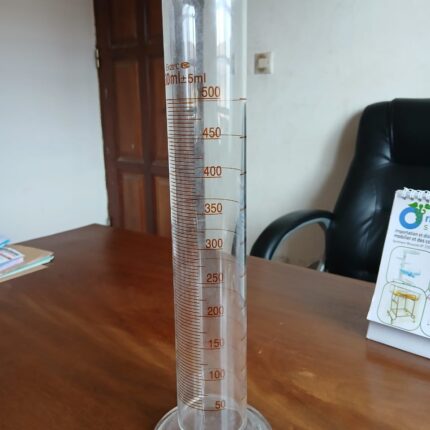
Graduated Cylinder 500ML
A graduated cylinder is a laboratory instrument used to accurately measure liquid volumes. Its main characteristics are as follows:
Materials:
This is a graduated cylinder made of borosilicate glass, known for its resistance to chemicals and thermal shock.
Shape and Structure:
It has an elongated cylindrical shape and is equipped with a stable base (here, a round base, although hexagonal bases also exist) and a pouring spout to facilitate the transfer of liquids.
Graduations:
The cylinder is clearly graduated, allowing the volume of liquid contained to be read. In the image, the graduations are visible from 100 ml to 500 ml, indicating a maximum capacity.
Accuracy:
Graduated cylinders are designed for precise volume measurement, often calibrated “to contain” (TC or In) and classified according to accuracy standards (such as Class ).
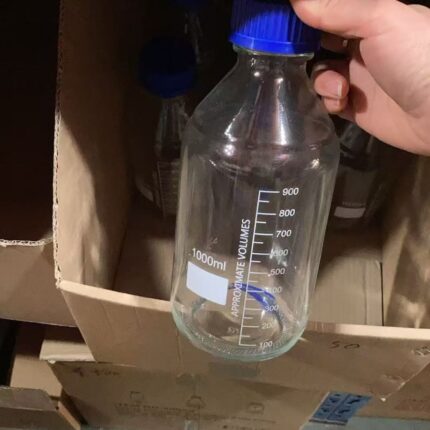
Graduated Flask
Laboratory graduated flask, made of borosilicate glass, with the following characteristics:
Capacity and Graduation:
It has a maximum capacity of 1000 ml and is graduated for approximate measurements, with markings indicating 50 ml, 100 ml, 150 ml, 200 ml, 500 ml, and 1000 ml.
Material:
It is made of borosilicate glass 3.3, a type of heat- and chemical-resistant glass commonly used in laboratories.
Flask Type:
This is a reagent bottle or narrow-necked flask, such as those used for storing chemicals or for operations requiring precise measurements.
Cap:
It has a blue screw cap, ensuring an airtight seal.
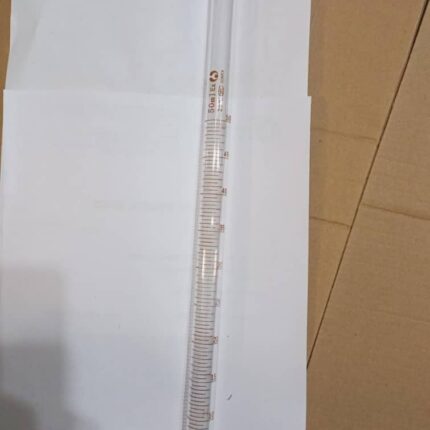
Graduated Pipette
The characteristics of these graduated pipettes are as follows:
Brand and Volume:
This is a Citotest brand graduated pipette, with a maximum volume of 50 ml.
Materials:
It is made of glass, as suggested by its transparency and common laboratory use for this type of instrument.
Graduations:
The pipette features clear and precise graduations, allowing for accurate measurement of liquids.
Conformity:
Graduated pipettes of this type comply with the accuracy standards for laboratory volumetric instruments, such as the ISO 6706 Class B standard for graduated cylinders mentioned for similar Citotest products.
Use:
It is designed for transferring and measuring precise volumes of liquids in the laboratory, particularly for liquid handling.