

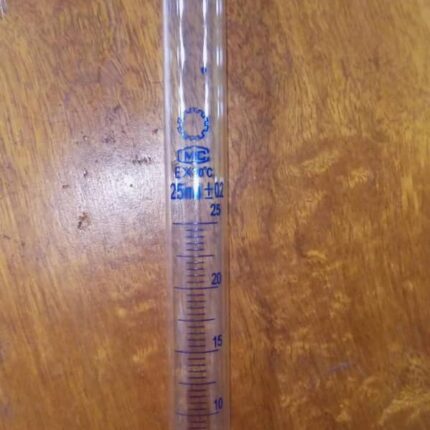
Test Tubes 25 ml
The characteristics of a test tube like the one pictured include the following:
Materials:
Clear glass (such as soda-lime glass or borosilicate).
Shape:
A narrow cylindrical body with a base that can be round (U-shaped), conical (V-shaped), or flat, and a top opening. The image shows a flat bottom.
Dimensions and Capacity:
Test tubes come in various sizes and volumes. The one pictured is graduated up to 25 ml, with an accuracy indication of “±0.2”. The visible graduations are 5, 10, 15, 20, and 25 ml.
Use:
Used in laboratories to hold, mix, and heat chemicals, or for specific analyses such as food quality control or blood tests. The object in the image, being graduated, is more specifically a flask, used to precisely measure liquid volumes.
Resistance:
Resistance to temperature changes and chemicals varies depending on the type of glass.
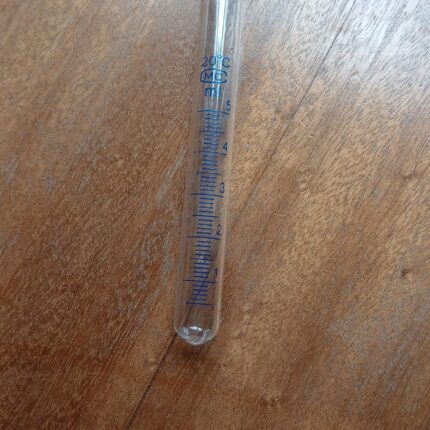
Test Tubes 5ml
The characteristics of a test tube like the one pictured include the following:
Materials:
Clear glass (such as soda-lime glass or borosilicate).
Shape:
A narrow cylindrical body with a base that can be round (U-shaped), conical (V-shaped), or flat, and a top opening. The image shows a flat bottom.
Dimensions and Capacity:
Test tubes come in various sizes and volumes. The one pictured is graduated up to 5ml, with an accuracy indication of “±0.2”. The visible graduations are 1, 2, 3, 4, and 5ml.
Use:
Used in laboratories to hold, mix, and heat chemicals, or for specific analyses such as food quality control or blood tests. The object in the image, being graduated, is more specifically a flask, used to precisely measure liquid volumes.
Resistance:
Resistance to temperature changes and chemicals varies depending on the type of glass.

Thiele Tube
The Thiele tube is a piece of laboratory equipment made of borosilicate 3.3 glass, used to determine the melting point of organic compounds.
Its main characteristics are:
Material: High-quality borosilicate 3.3 glass, known for its thermal and chemical resistance.
Typical Dimensions: Total length of approximately 150 mm (6 inches) and main tube diameter of approximately 25 mm (1 inch).
Design: It features a specific shape with a hollow glass side handle that allows convective circulation of the heated oil, ensuring a nearly uniform temperature throughout the oil bath.
Use: It is designed to contain and heat an oil bath in which a capillary tube containing the sample and a thermometer are immersed to observe the melting point.
Thermal Tolerances: Borosilicate 3.3 glass has specific heat tolerances, including a deformation point of -515°C, an annealing point of 565°C, and a softening point of 820°C.

Vacuum Flask
The Erlenmeyer-shaped vacuum flask, also called a Büchner flask, has several distinctive features:
Shape and Structure:
Wide base and conical body, topped with a cylindrical neck.
A side arm with an olive (or glass connector) for connection to a vacuum source, such as a water pump or vacuum pump.
Thick walls to withstand the negative pressure generated during vacuum filtration. Includes a “cleated” base for greater stability and minimized abrasion.
Material:
Made of borosilicate glass (such as DURAN® or PYREX® glass), offering good chemical and thermal resistance.
Functionality:
Designed specifically for vacuum filtration, allowing rapid separation of solid and liquid phases.
Can be used for mixing, cooling, incubation, filtration, and storage in the laboratory.
Autoclavable for sterilization if made of a suitable material.
Compliance:
Complies with international standards such as ISO 6556 or DIN 12476.
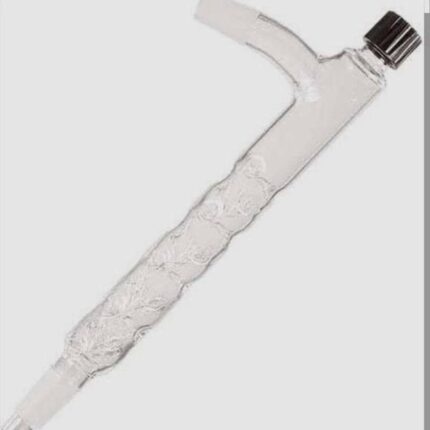
Vigreux Column
Characteristics of a Vigreux Column
The Vigreux column is a piece of laboratory glassware commonly used for fractional distillation. Its main features are as follows:
Internal Structure: It is characterized by the presence of glass spikes or indentations inside the tube, which increase the contact surface between the liquid and vapor phases. These indentations can be horizontal or inclined to optimize vapor-liquid contact and redistribute the liquid.
Distillation Function: These spikes promote successive cycles of vapor condensation and vaporization, thus allowing for more efficient separation of the components of a mixture based on their volatility (fractional distillation).
Material: It is generally made of borosilicate glass, a material known for its good chemical and thermal resistance.
Connections: It may have ground joints (standard conical joints) to facilitate connection to other glassware, such as a distillation flask and condenser.
Integrated distillation head: It incorporates a distillation head with connections for a thermometer, allowing the temperature of the vapors to be measured during distillation.
Number of theoretical plates: The column’s efficiency is characterized by its number of theoretical plates, which is related to the number of vaporization-condensation cycles. The higher this number, the better the separation of the mixture.
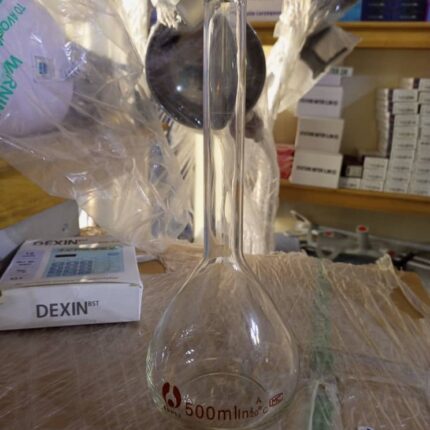
Volumetric Flask
Bomex Class A Volumetric Flask – 500ml
Precision Laboratory Instrument
✔ Certified Accuracy –
-
Class A compliance (meets DIN EN ISO 1042 & DIN 12664)
-
Exact volume measurement (“In”/TC) at 20°C reference
✔ Premium Borosilicate Glass –
-
Pyrex®-grade thermal/chemical resistance
-
Engraved graduation mark on tapered neck
✔ Secure Containment –
-
Includes ground glass stopper for leak-proof sealing
-
500ml capacity (clear permanent marking)

Volumetric Flask
Volumetric Flasks – Technical Specifications
(Precision Liquid Measurement Vessels)
1. Material & Construction
-
Primary Material: Borosilicate glass 3.3 (e.g., Pyrex®)
-
Thermal shock resistant (ΔT ≤ 200°C)
-
Chemical resistance to acids/bases (except HF)
-
-
Stopper: Ground glass joint (NS 29/32 standard)
-
Markings: Permanent enamel graduation
2. Accuracy & Compliance
| Parameter | Class A Specification |
|---|---|
| Tolerance | ±0.08 mL (100 mL flask) |
| Calibration Temp | 20°C ± 0.5°C |
| Standards | DIN EN ISO 1042, ASTM E288 |
| Marking | Engraved “IN” (TC) & “A” grade |
3. Standard Capacities
| Volume | Neck Diameter | Uses |
|---|---|---|
| 50 mL | 14 mm | HPLC standards |
| 100 mL | 16 mm | Titrant prep |
| 250 mL | 22 mm | Molar solutions |
| 500 mL | 28 mm | Bulk reagents |
4. Key Features
✔ Single graduation mark for precise filling
✔ Hexagonal base for stability
✔ Traceable certification (NIST/DKD)
5. Usage Protocol
-
Cleaning: Chromic acid rinse → triple DI water wash
-
Filling: Meniscus tangent to mark (eye-level)
-
Mixing: 10× inversions (no shaking)
Do NOT heat when sealed – thermal expansion risks rupture
6. Quality Verification
-
Weight Test: Verify volume using distilled water (d=0.9982 g/mL at 20°C)
-
Documentation: Class A requires individual calibration certificate

Watch Glass
A laboratory watch glass is a versatile piece of laboratory equipment, usually made of glass (soda-lime or borosilicate).
Main Features:
Shape: Circular and slightly concave.
Material: Mainly made of glass (soda-lime or borosilicate), offering chemical resistance. Borosilicate glass is particularly resistant to thermal shock and chemical agents.
Uses:
Covering beakers to protect them from contaminants.
Weighing powders or small quantities of substances.
Serving as a surface for the evaporation of liquids, allowing the observation of precipitates or crystallizations.
Used as a support for mixing substances or observing them under a stereomicroscope.
Dimensions: Available in various diameters, ranging from 40 mm to 250 mm.
Safety: Its ground edges and consistent thickness reduce the risk of breakage.

Weighing Bottle
A weighing bottle, also called a weighing flask.
Its main characteristics are:
Type of laboratory glassware: This is a piece of laboratory equipment commonly used for accurately weighing solids or small quantities of liquids.
Material: Generally made of borosilicate glass (Boro 3.3) for its heat resistance and chemical stability.
Stopper: It is equipped with a ground-in stopper (or milled sealing plug) to ensure a tight seal, preventing the absorption of moisture or carbon dioxide by the reagent and minimizing evaporation.
Dimensions: The numbers “30×50” in the image indicate the dimensions of the bottle, namely 30 mm in diameter and 50 mm in height.