

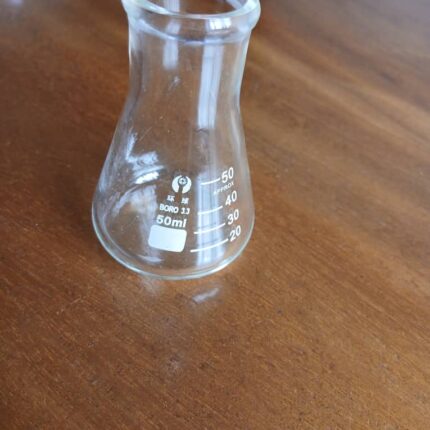
Erlenmeyer Flask 50ML
A borosilicate glass Erlenmeyer flask has several key characteristics:
Materials:
It is made of borosilicate 3.3 glass (such as Pyrex™ or Duran®), known for its high resistance to thermal shock and chemical corrosion.
Capacity:
The flask pictured has a capacity of 50 ml, with graduations indicating volumes (20,30,40,50ml).
Shape:
Its conical shape ensures good stability and facilitates mixing and heating liquids. The neck can be narrow or wide.
Graduations:
It has graduations (often white enamel) for approximate volume measurements.
Resistance:
Borosilicate glass provides excellent heat resistance, allowing direct heating and autoclaving for sterilization.
Use:
It is commonly used in laboratories for mixing, heating, cooling, and storing liquids, as well as for titrations and cell cultures.
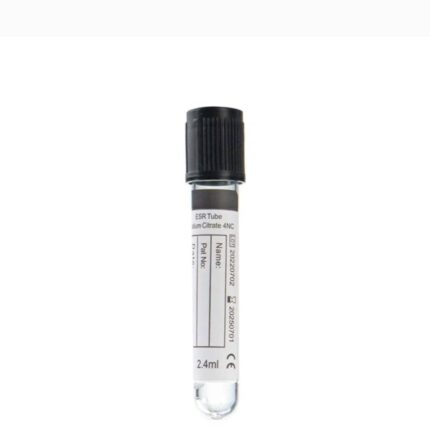
ESR (Erythrocyte Sedimentation Rate) Tubes
The blood collection tube shown is an ESR (Erythrocyte Sedimentation Rate) tube, also known as a 4NC sodium citrate tube. Its main features are:
Use: It is specifically designed for the collection and anticoagulation of blood for erythrocyte sedimentation rate (ESR) testing.
Anticoagulant: It contains a 3.8% sodium citrate solution.
Anticoagulant/Blood Ratio: The mixing ratio is one part citrate solution to four parts blood (1:4).
Volume: Available in 2.4 ml, 1.6 ml, 3.2 ml, and 4 ml.
Material: Made of PET (polyethylene terephthalate) or glass.
Cap: The cap is black, which is a standard feature for ESR tubes containing sodium citrate.
Markings: The tube includes fields for the patient’s name (Name), patient number (Pat No.), and batch and date information.
Certification: It bears the CE mark, indicating its compliance with European health, safety, and environmental protection standards.

Exactech Equinoxe Modular Shoulder Prosthesis
Exactech’s Equinoxe® modular shoulder prostheses, pictured, offer several key features:
Modularity: The system is designed to offer high flexibility. A platform humeral stem allows for conversion from a primary or hemifracture shoulder to a reverse shoulder without removing the humeral stem.
Glenoid Solutions: The system offers a wide range of glenoid solutions, including pear-shaped, pegged, keeled, and augmented options, designed to preserve bone and provide initial and biological fixation.
Reverse Biomechanics: The Equinoxe system design aims to lateralize the humerus to create a more anatomically correct deltoid shell, promoting stability and improving active rotation by tensioning the remaining cuff.
Humeral Head: The anatomical stem allows for surgical conversions (e.g., from a total shoulder to a reverse shoulder) without requiring stem removal. Glenoid curvatures allow for the combination of different head and glenoid sizes while maintaining optimal radial offset.
Stemless Technology (for select models): Some models, such as the Equinoxe stemless shoulder, utilize direct metal 3D printing for their manufacturing, providing primary stability.
Surgical Navigation (GPS): The Equinoxe system can be used with GPS navigation to guide the surgeon during implantation, enabling precise positioning of implants and screws.

Exactech Equinoxe Shoulder Prosthesis
The Exactech Equinoxe shoulder prosthesis offers several key features:
Modularity and Flexibility: It is a modular system that allows surgeons to transition from a primary shoulder or hemifracture to a reverse shoulder without removing the humeral stem, thanks to the platform stem.
Anatomical Adjustments: It offers dual eccentricity (humeral head and replicator plate) that allows independent adjustment of medial and posterior offsets, ensuring anatomical orientation of the humeral head.
Various Glenoid Solutions: The system offers a wide range of glenoids (pear-shaped, peg-shaped, keel-shaped, and augmented) to accommodate various bone defects and preserve bone.
Osseointegration Design: For stemless prostheses, it incorporates a 3D-printed structure with optimized porosity, designed to promote osseointegration and biological fixation.
Biomechanical Improvement: The design, particularly for reverse prostheses, aims to lateralize the humerus7 for a more anatomical deltoid envelope and better tension of the remaining rotator cuff, thus improving active rotation.
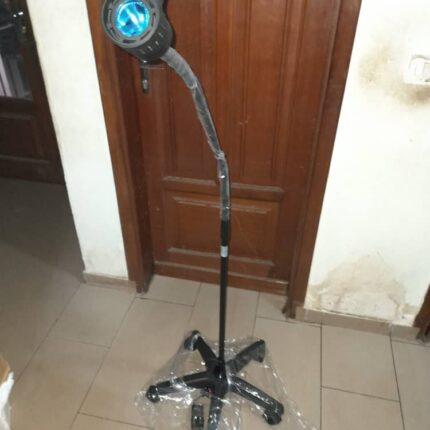
Examination Lamp
Examination lamps are essential medical devices used to provide focused, intense illumination during clinical examinations and minor procedures. Their features include the following:
General Characteristics:
Light Source:
LED: Long lifespan (approximately 50,000 hours), low energy consumption, heat-free, intense white light.
Halogen: Warm light similar to natural daylight, economical to purchase, but shorter lifespan (approximately 2,000 hours) and heat generation.
Luminous Intensity (Lux): Measured at a given distance.
Color Temperature (Kelvin): Indicates the color of the light.
Color Rendering Index (CRI): Measures the color fidelity of colors under illumination (Ra > 95 for good color reproduction).
Design and Mobility:
Lamp Head: Compact, adjustable.
Flexible arm (gooseneck): Allows precise positioning of the light.
Base: On casters for easy mobility, with brakes for stability.
Alternative mounts: Desk clamp, wall mount, rail mount.
Additional features: Switch with dimmer, contactless (infrared) switch for hygiene.
Application areas: General medicine, minor surgery, gynecology, ophthalmology, ear, nose, and throat (ENT).
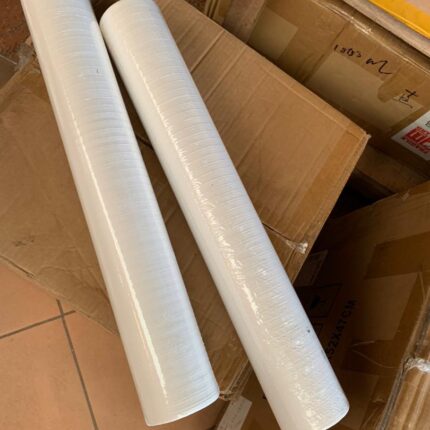
Examination Sheet
Characteristics of Examination Sheets
Examination sheets are essential medical consumables with several important features to ensure patient hygiene and comfort during examinations.
Composition and Structure:
Made of pure cellulose wadding, double-layered for improved absorption.
Embossed and laminated to provide an absorbent side (wadding) and a waterproof side (laminated).
Functionality and Hygiene:
Absorption: Designed to effectively absorb liquids and spills, reducing the risk of contamination and discomfort.
Protection: Serve as a barrier between the patient and medical equipment, preventing direct contact and limiting the risk of cross-contamination.
Single-use: Single-use only to ensure optimal hygiene and prevent the proliferation of microbes.
Dimensions and Format:
Available in 50×50 size
Pre-cut into individual sizes on a roll for ease of use.
Comfort: It provides a soft, breathable surface for patient comfort during the examination.

External Fixator Instruments
The external fixator instruments featured here are:
High-quality materials: Made of premium stainless steel, aluminum, and titanium for durability and corrosion resistance.
Specific design for orthopedic surgery: The set is designed for external fixation, fusion, stability, and alignment of bones, particularly in the treatment of complex fractures and limb lengthening.
Modular components: Includes carbon fiber rods, clamps (pin clamps, rod-to-rod clamps), cortical screws, and cancellous bone screws, allowing adaptation to various clinical applications.
Radiocluency: Carbon fiber rods are radiolucent, allowing radiographic monitoring without significant obstruction, facilitating the monitoring of bone healing.
Load-bearing capacity: Carbon fiber rods offer high strength, supporting significant loads during bone healing.
Biocompatibility: Materials, particularly carbon fiber, are generally well tolerated by the body, minimizing the risk of adverse reactions.
Rigorous Quality Testing: Instruments undergo quality tests such as boiling, form, and performance testing to ensure their reliability.
Sterilizable: Supplied in sterilized aluminum cases, suitable for use in the operating room.
Versatile Application: Used for rapid initial fixation, periarticular fractures, severe comminuted fractures, orthopedic reduction, certain pelvic ring injuries, and pediatric fractures, as well as for non-unions and post-traumatic infections.

Extracortical Clamp
The device shown in the image is an extracortical clamp, also known as an extracortical clamp device (ECD).
Its main features are as follows:
Design: It is specifically designed for the fixation of bone fragments, particularly when a massive foreign body (such as a nail or the stem of a joint prosthesis) is already present within the bone.
Function: It allows these bone fragments to be fixed to the support of an external fixation device.
Use: It can be used as an alternative in the treatment of periprosthetic fractures.
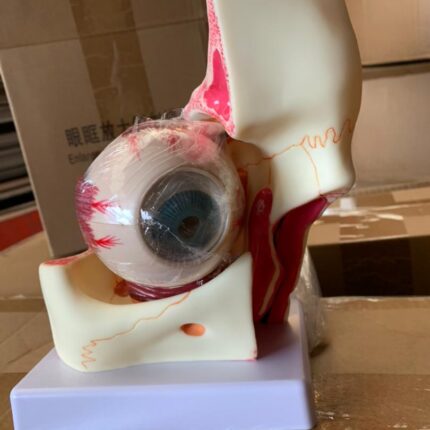
Eye and Orbit Anatomy
A magnified anatomical model of the human eye and orbit, designed for educational purposes in medical and academic settings.
Main Features:
- Magnification: Typically 3x the size of a real human eye and orbit, enhancing visibility of internal and external structures
- Composition and Detachability: Comprises multiple detachable parts (e.g., 10 parts), including the orbit, sclera, cornea, iris, ciliary body, choroid, and retina, allowing detailed study of the eye’s hierarchical structure
- Material: Made from high-quality, durable, and environmentally friendly PVC
- Fidelity and Detail: Features clear textures, high fidelity, and precise details to support accurate understanding of eye anatomy
- Educational Use: Ideal for teaching and studying eye anatomy, suitable for students and medical professionals
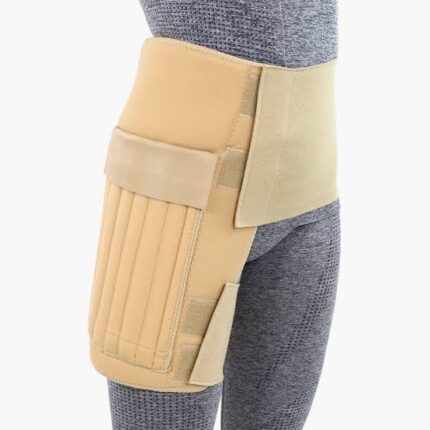
Fabric Hip Brace
The main features of the Fabric Hip Spica (Fabric Hip Spica or Fabric Post-Operative Hip Spica Support) are:
Material: Made from laminated fabric or Velfoam, it is lightweight, breathable, and provides gentle support and cushioning.
Design: It features a hip band and a thigh sleeve with elastic for a comfortable fit.
Support and Stability: It incorporates eight removable, malleable stays (often aluminum) that can be shaped for a customized fit and help control excessive abduction and adduction, providing additional stability.
Fitment: Velcro or hook-and-loop fasteners allow for easy adjustment and dressing checks.
Latex-Free: Its latex-free design makes it suitable for all users.
Use: It is designed to be worn after hip surgery to protect the joint or for people who have recently stopped using a larger brace.
Dimensions: The hip band is approximately 20 cm long, the thigh sleeve is approximately 13.5 cm deep, and the total length of the brace is approximately 42.5 cm.

Fathom Pedicle-Based Retractor
The Fathom™ Pedicle-Based Retractor is a surgical retractor designed for minimally invasive spinal procedures, including transforaminal lumbar interbody fusion (TLIF).
Its key features include:
Cranial/Caudal Telescoping Blades: These blades are telescoping and allow for patient-specific adjustment.
Controlled Medial Blade Manipulation: The system allows precise control to adjust the length of the medial blade and achieve a customized lateral-to-medial tilt, providing powerful medial retraction and optimized visualization of the surgical site.
Three-Point Fixation: This design ensures retractor rigidity and consistent intraoperative visibility.
Continuous Standard Blades: Blades of varying lengths, from 35 to 140 mm, are available.
Integration with other systems: It integrates with the Mariner® MIS pedicle screw system and Orthofix’s 7D FLASH™ technology platform, as well as the complete SeaSpine portfolio.

Female Urinal
The features of the portable female urinal are as follows:
Design: It has an anatomical shape specially adapted for use by women, allowing it to be used while sitting, standing, or lying down. It features a built-in handle for easy carrying and handling.
Material: Made of lightweight and durable polypropylene plastic, making it easy to clean and reusable.
Capacity and Measurement: It is graduated, allowing for the measurement of urine volume, and its capacity is generally 500 ml.
Use: Designed for people with mobility difficulties, such as bedridden patients or those with limited mobility, as well as for outdoor activities and travel.
Hygiene: Its design is designed to prevent leaks and spills, and the non-porous material helps maintain hygiene.