


General Surgery Set
The AROMA General Surgery Set is a set of surgical instruments packaged in a box, usually made of stainless steel, designed for general surgical procedures.
General Features:
Material: The box and instruments are made of medical-grade stainless steel, ensuring durability, corrosion resistance, and ease of sterilization.
Contents: Although the exact contents may vary, a general surgery set like the AROMA set typically contains a selection of essential instruments for various surgical procedures. This includes forceps (dissecting, hemostats, etc.), scissors (straight, curved, tissue, etc.), needle holders, scalpel handles, retractors, and other tools specific to general surgery.
Sterilization: The box and its instruments are designed to be autoclavable, allowing for effective and safe sterilization before use.
Organization and Transport: The metal box provides an organized and secure way to store, transport, and display surgical instruments, facilitating quick access and management during procedures.
Quality (according to the brand): The “Aroma for Quality” label on the box suggests an emphasis on the quality of the instruments and their packaging, aimed at ensuring precise and reliable performance.

Gentian Violet
Crystal Violet (Gentian Violet): Key Characteristics
Crystal Violet, also known as Gentian Violet, is a triarylmethane dye with significant applications in microbiology and medicine. Its key properties are outlined below.
-
Primary Application: Its principal use is in microscopic staining, most notably in the Gram stain procedure. It differentiates bacteria by causing Gram-positive organisms to retain the dye and appear purple, while Gram-negative bacteria do not retain it and can be counterstained a different color.
-
Mode of Action: As a cationic (positively charged) dye, it readily binds to negatively charged cellular components, such as proteins and nucleic acids (DNA/RNA).
-
Antimicrobial Properties: It exhibits potent antibacterial and antifungal activity, which has led to its historical use as a topical antiseptic for treating minor skin infections and wounds.
-
Chemical Composition: It is an organic chemical compound classified as an aminotriarylmethane, also known under the broader name of methyl violet.
-
Physical Properties:
-
Appearance: In its pure form, it is a dark green, crystalline or powdery solid that dissolves in water to form an intense purple solution.
-
Solubility: It is highly soluble in water and chloroform, and partially soluble in alcohol and glycerol.
-
-
Safety Profile: Crystal violet requires careful handling. It is very toxic to aquatic life and is classified as a potential carcinogen (cancer-causing agent) in humans.

Glass Beaker
Borosilicate Glass Beakers – Laboratory Grade
Brand: APPROX
Key Features:
✔ Premium Material – Made of Boro 3.3 borosilicate glass for exceptional:
-
Thermal resistance (withstands up to 1450°C short-term)
-
Chemical inertness (resists acids/solvents)
-
Mechanical durability
✔ Precision Graduations –
-
Clear “APPROX” markings for approximate measurements
-
Available in 250ml, 500ml, 1000ml (and other standard sizes)
✔ Optical Clarity – >95% light transmittance for easy observation
Laboratory Advantages:
-
Autoclavable – Reusable after sterilization
-
Thermal Shock Resistant – Suitable for rapid temperature changes
-
Versatile – Ideal for mixing, heating, and titrations
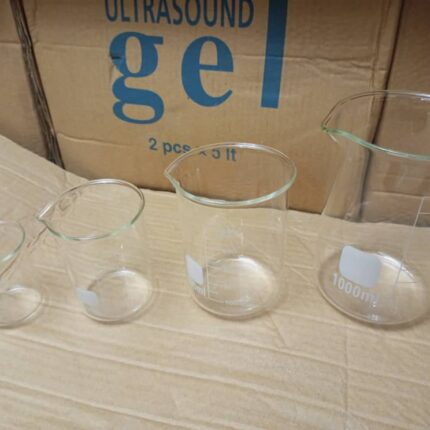
Glass Beaker
Borosilicate Glass Beakers – Technical Specifications
(High-Performance Laboratory Containers)
1. Material Properties
| Characteristic | Boro 3.3 Glass Specification |
|---|---|
| Composition | 81% SiO₂, 13% B₂O₃, 4% Na₂O/K₂O, 2% Al₂O₃ |
| Thermal Shock Resistance | ΔT ≤ 160°C (rapid cooling) |
| Max Operating Temp | 500°C (continuous), 1450°C (short-term) |
| Chemical Resistance | Resists all acids (except HF) and organic solvents |
| Light Transmittance | >95% (400-700 nm visible spectrum) |
2. Product Line Overview
| Capacity | Height | Diameter | Graduation Interval |
|---|---|---|---|
| 100 mL | 90 mm | 50 mm | 10 mL (“APPROX”) |
| 250 mL | 110 mm | 65 mm | 25 mL |
| 500 mL | 130 mm | 80 mm | 50 mL |
| 1000 mL | 160 mm | 100 mm | 100 mL |
Note: All graduations are approximate (±5% tolerance).
3. Key Features
✔ Spout design: Pouring without drips
✔ Wide base: Enhanced stability
✔ Etched markings: Acid-resistant graduations
✔ Autoclavable: Reusable after sterilization
4. Comparative Advantages
| Property | Borosilicate vs. Soda-Lime Glass |
|---|---|
| Thermal Shock | 3× better resistance |
| Chemical Durability | Withstands concentrated acids |
| Cost | 2-3× higher but longer lifespan |
5. Usage Guidelines
-
Heating: Use wire gauze with ceramic center for even heat distribution
-
Cleaning: Avoid abrasive scrubbers to prevent surface scratches
-
Storage: Stack with protective liners to prevent chipping
Safety Note: Discard if cracks/chips appear – compromised glass may fail under thermal stress.
6. Compliance & Standards
-
Meets ASTM E960 (lab glassware)
-
ISO 4797 (thermal shock testing)
-
CE marked for EU markets
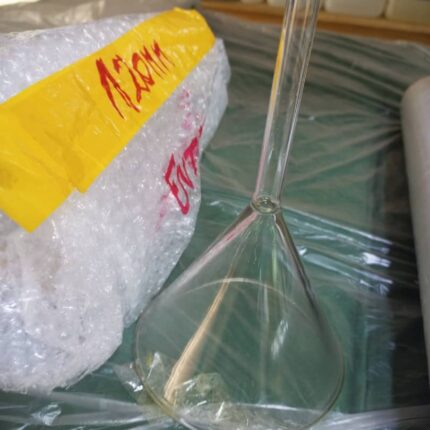
Glass Funnel
Glass laboratory funnel. Its main characteristics are as follows:
Material:
Made of borosilicate glass, known for its resistance to saline solutions, acids, bases, and organic solvents, as well as thermal shock.
Construction:
It consists of a flared conical portion for easy pouring and a tubular stem to direct the flow into a narrow-mouthed container.
Use:
Mainly used for transferring liquids or powders into narrow-mouthed containers without spilling, and can also be used as a filter paper holder during gravity filtration.
Dimensions:
Glass funnels are available in various sizes, namely: 90mm, 120mm, with varying stem diameters and lengths, suitable for various laboratory applications.
Standards:
Manufactured according to specific standards such as ISO 4798 or DIN 12445 to ensure quality and laboratory compatibility.

Glucose LR MONO
The following are the characteristics of the product “GLUCOSE LR MONO”:
Product Name: GLUCOSE LR MONO
Method: GOD-POD (Glucose Oxidase-Peroxidase) colorimetric enzymatic method
Use: IVD (In Vitro Diagnostics)
Certifications: CE Marked
Storage Conditions: Between 2°C and 8°C
Reference Number (REF): 10013
Batch Number (LOT): 5891
Contents: 4 x 100 ml (4 vials of 100 ml each)
Components: R1 4 x 100 ml (one reagent, also in 4 x 100 ml)
Manufacturer: SGM Italia srl - Via Olivadi 20 – 00126 Rome – Italy

GOT-AST LR
The characteristics of the GOT-AST LR diagnostic kit are as follows:
Product Name: GOT-AST LR (Glutamate Oxaloacetate Transaminase – Aspartate Aminotransferase, Long Range).
Method: Timed kinetic method according to the recommendations of the IFCC (International Federation of Clinical Chemistry and Laboratory Medicine).
Use: In vitro diagnostic (IVD) medical device for the quantitative determination of AST/GOT activity in human serum or plasma, primarily for the screening and diagnosis of liver disorders.
Storage and Stability:
Recommended storage temperature: 2-8°C.
Stability of unopened reagents: Until the expiration date if stored between 2 and 8°C.
Stability after opening: The contents, placed in the analyzer at approximately 10°C, are stable for 28 days.
Kit composition:
Total contents: 5 x 50 ml.
Reagent R1: 5 x 40 ml (probably Buffer/Enzyme).
Reagent R2: 1 x 50 ml (α-oxoglutarate/Coenzyme).
Manufacturer: SGM.
Identification numbers:
Reference (REF): 10139.
Batch number (LOT): 5952.
Certification: CE marking, indicating compliance with European Union health, safety, and environmental protection requirements.
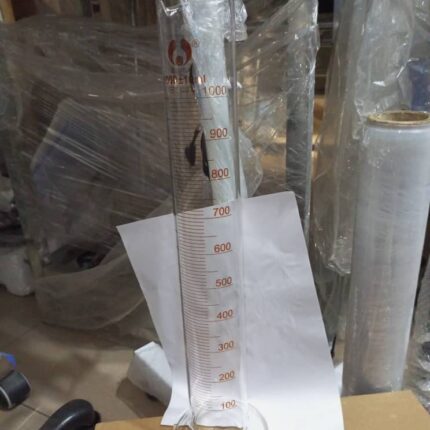
Graduated Cylinder 1000 ml
A graduated cylinder is a laboratory instrument used to accurately measure liquid volumes. Its main characteristics are as follows:
Materials:
This is a graduated cylinder made of borosilicate glass, known for its resistance to chemicals and thermal shock.
Shape and Structure:
It has an elongated cylindrical shape and is equipped with a stable base (here, a round base, although hexagonal bases also exist) and a pouring spout to facilitate the transfer of liquids.
Graduations:
The cylinder is clearly graduated, allowing the volume of liquid contained to be read. In the image, the graduations are visible from 100 ml to 1000 ml, indicating a maximum capacity of 1 liter.
Accuracy:
Graduated cylinders are designed for precise volume measurement, often calibrated “to contain” (TC or In) and classified according to accuracy standards (such as Class ).

Graduated Cylinder 100ML
A graduated cylinder is a laboratory instrument used to accurately measure liquid volumes. Its main characteristics are as follows:
Materials:
This is a graduated cylinder made of borosilicate glass, known for its resistance to chemicals and thermal shock.
Shape and Structure:
It has an elongated cylindrical shape and is equipped with a stable base (here, a round base, although hexagonal bases also exist) and a pouring spout to facilitate the transfer of liquids.
Graduations:
The cylinder is clearly graduated, allowing the volume of liquid contained to be read. In the image, the graduations are visible from 10 ml to 100 ml.
Accuracy:
Graduated cylinders are designed for precise volume measurement, often calibrated “to contain” (TC or In) and classified according to accuracy standards (such as Class ).

Graduated Cylinder 250ML
A graduated cylinder is a laboratory instrument used to accurately measure liquid volumes. Its main characteristics are as follows:
Materials:
This is a graduated cylinder made of borosilicate glass, known for its resistance to chemicals and thermal shock.
Shape and Structure:
It has an elongated cylindrical shape and is equipped with a stable base (here, a round base, although hexagonal bases also exist) and a pouring spout to facilitate the transfer of liquids.
Graduations:
The cylinder is clearly graduated, allowing the volume of liquid contained to be read. In the image, the graduations are visible from 20 ml to 250 ml.
Accuracy:
Graduated cylinders are designed for precise volume measurement, often calibrated “to contain” (TC or In) and classified according to accuracy standards (such as Class ).
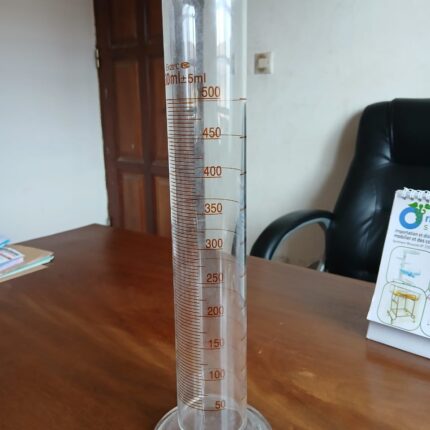
Graduated Cylinder 500ML
A graduated cylinder is a laboratory instrument used to accurately measure liquid volumes. Its main characteristics are as follows:
Materials:
This is a graduated cylinder made of borosilicate glass, known for its resistance to chemicals and thermal shock.
Shape and Structure:
It has an elongated cylindrical shape and is equipped with a stable base (here, a round base, although hexagonal bases also exist) and a pouring spout to facilitate the transfer of liquids.
Graduations:
The cylinder is clearly graduated, allowing the volume of liquid contained to be read. In the image, the graduations are visible from 100 ml to 500 ml, indicating a maximum capacity.
Accuracy:
Graduated cylinders are designed for precise volume measurement, often calibrated “to contain” (TC or In) and classified according to accuracy standards (such as Class ).
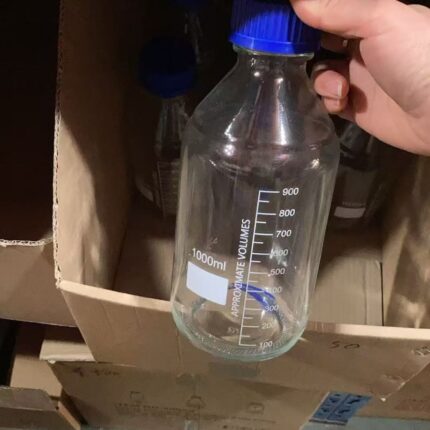
Graduated Flask
Laboratory graduated flask, made of borosilicate glass, with the following characteristics:
Capacity and Graduation:
It has a maximum capacity of 1000 ml and is graduated for approximate measurements, with markings indicating 50 ml, 100 ml, 150 ml, 200 ml, 500 ml, and 1000 ml.
Material:
It is made of borosilicate glass 3.3, a type of heat- and chemical-resistant glass commonly used in laboratories.
Flask Type:
This is a reagent bottle or narrow-necked flask, such as those used for storing chemicals or for operations requiring precise measurements.
Cap:
It has a blue screw cap, ensuring an airtight seal.